MATRIXSYNTH

Wednesday, January 23, 2013

Make Noise Wiard Wogglebug Eurorack Module


via this auction

Google Play Promo, G-Stomper Drum Machine for Android

Published on Jan 23, 2013 galplaneth·16 videos

"Google Play Promo Video, G-Stomper Drum Machine for Android
(Device: Samsung Galaxy Tab 10.1)

G-Stomper is a highly optimized Drum Machine/Groovebox for doing electronic live performances on your Android device.

https://play.google.com/store/apps/details?id=com.planeth.gstomperdemo

https://play.google.com/store/apps/details?id=com.planeth.gstomper

Official Website:
http://www.planet-h.com/gstomper/"

Numark Orbit DJ Controller Video


Video overview added to this post.

W I N D C H I M E S ELECTRONICS

"W I N D C H I M E S ELECTRONICS is Amanda Eicher and Yasi Perera making things that seem to depend on mass means, with the help of many collaborators, among them Thomas Buckler (web and graphics), Chris Cohen (accounting), Randall Fontes (state) and Walter Funk (waveforms)."

Yasi worked with Don Buchla & Associates.  W I N D C H I M E S current project is what they call "a light harmonizing time house".  The following is captured for the archives here.  Click through above for the animated gif and of course the rest of the site.

"It generates a single signal, suitable for both lighting and audio, in resolution of detected/imagined stimuli taken in by its touch and light sensors. It attempts to follow the circadian light-time around it and contribute to the harmony of its local time.

The visualization at left shows the kitten-sized cast-plastic structure, built to hold shoji paper screens. The patterned windows diffuse light from a complex of LEDs and electronic filters designed to behave like moving post-'black body' flame.

The pattern of illumination is, filtered differently, available at an 1/4" audio output, ready to drive an instrument amplifier. The audio is optionally emitted combined with sub-audio control signals, which can be demodulated to use later in the signal path by future modulation-aware signal processors packaged in 'stompbox' format.

The top, snooze bar, is a silver zigzag - capacitive touch sensor and CdS light sensor synthesizing touch and light information into a microprocessor-mediated response.

The Light Harmonizer is sensitive to touch-kinds: lightness of touch, timing of approach, and motions across and around. Unfinal attempts at categorical perception. First touches dim the light briefly, then it comes back in viscosity. Regular patterns of touches, it tries to predict and continue. ALSO 'day' to 'day': say, touches you give at lunch - every lunch - even if not regular per our usual clocks, are taken, speculatively, as regularities. Deviations from your regular lunchtimes, shown back in flushes, noticing what is astral weeks, what is dim weeks, when is the decade of french revolutionary 10 day weeks. In searching, we keep the memory sparse; without many bits, we find salience in action.

Its illumination varies also at frequencies we may hear, so at the audio output, fingers thump: bass drums, chimes, 100 metronomes' granular synthesis: embers, wind-through-trees, -through-chimes. We establish a circular heieracrchy of sound types: percussion, arrayed algorithmically, then stochastically, until, being noise, they form the elements of other drum sound syntheses. This carries on early work in computer music by Paul Berg, Herbert Brün, Arun Chandra, Rich Gold, S. R. Holtzman, G. M. Koenig, and Iannis Xenakis, among others, exploring sound manipulation at the machine instruction level as compositional. A physical platform for the exploration of seminumerical algorithms (Knuth's term) in relation to experience- both the experiences of music, and lived time. We take 'seminumerical' to pertain to aspects of postulation beyond Knuth's computer-scientific notion of 'hardware', into pertinence of form. Peter Naur displays this connection in examining problems, tools, and people as mutually constitutive.

We hope to take time as a place to display and collect user interface, generating informational 'persistence' in time itelf as a basis upon which to 'communicate'. 'Persistence in time' implies an expanded notion of rhythm, as qualia, consistent with classical concepts."

The Analog Lab NYC-Leo Delibes | Flower Duet from Lakmé on Moog Sonic V


Published on Jan 23, 2013

"Moog muSonics Sonic V that was recently repaired by The Analog Lab in NYC.

From Matrixsynth:
It has 2 osc's (saw, tri, square/pulse) 2 lfo's (saw,ramp,tri square) a ring modulator, a noise generator (white or pink), an external input, 2 outputs and 2 built in speakers. The speakers can be bypassed by using the second output. It is monophonic (plays one note at a time) and/or duophonic (plays two notes at a time). It even has a 'scale' knob on the front panel so it can play microtones.

The Sonic V has a 24db diode filter which is very expressive. It has that Moog sound when you want it, but you can also have it sound quite different. It can sound more gritty or aggressive then other synths containing the traditional Moog 24db transistor ladder filter thanks to the diode filter design and also to the addition of the ring modulator.

www.theanaloglab.com

(special thanks to http://m.matrixsynth.com/2009/10/moog-musonics-sonic-v-analog.html)"

Roland Juno-60 "Monoton"


'(C) 2013 vintage synthesizer demo track by RetroSound
all sounds: Roland Juno-60 Analog Synthesizer
drums: Roland TR-707
recording: multi-track without Midi"

via Marko on The MATRIXSYNTH Lounge

Polivoks VCF VCG D01

Published on Jan 23, 2013 Ted James Butler·56 videos

"Testing out the replacement chips for my Polivoks VCG. Using Polivks VCG saw and triangle oscillators before and after the filter, modified by the Hertz Donut and Double Andore."
Rare EMS Synthi E SN 147.E Analog Synth For Auction

Note: links to listings are affiliate links for which the site may be compensated.

via this auction

"ultra rare EMS Synthi E (not Reheberg). This is an educational version of Synthi, using patch cables instead of pin points. It has been manufactured in 1975 and only about 200 units (and this one is s/n 147.E), so this is almost extinct as synthesizer. This unit is in a good shape, for an almost 40 years old instrument. Volume faders are a bit noisy when you move them and the touch pad needs to be pushed hard to properly play, but can be easily serviced..."
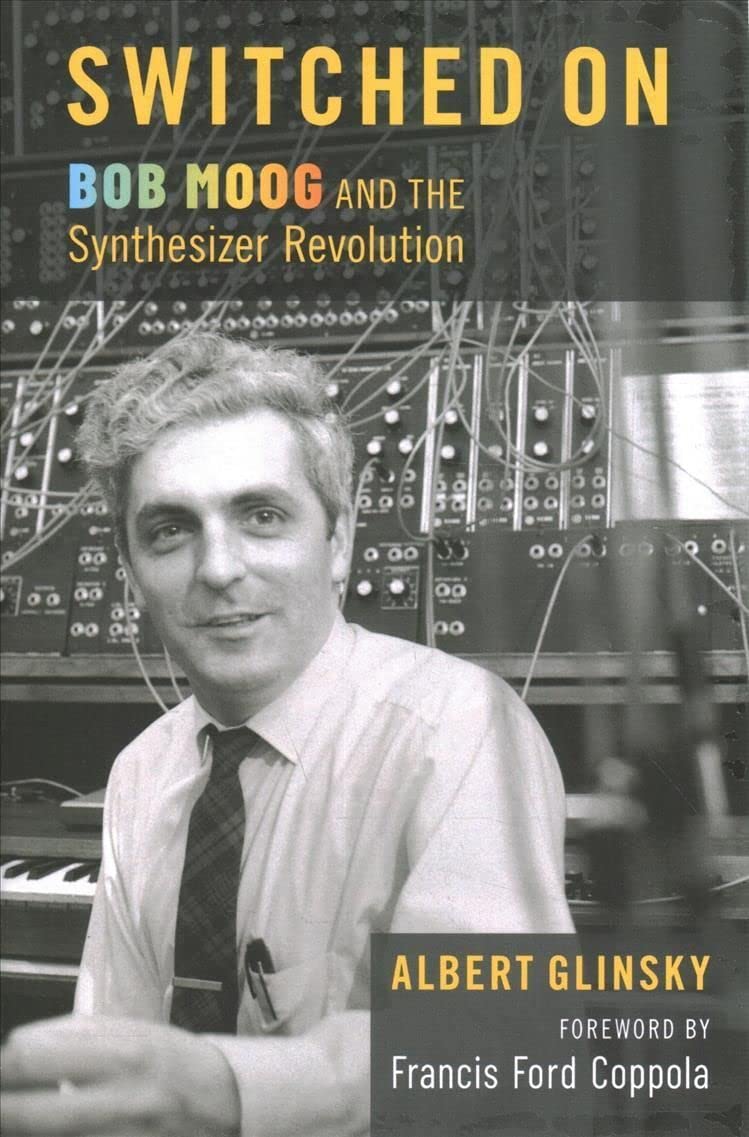

NAMM 2013: The place to be: Bob Moog Foundation booth at NAMM

Published on Jan 23, 2013 moogfoundation·64 videos

"Check out the amazing visitors we had at our NAMM booth in 2012. Our booth was a hub of excitement as throngs of people stopped by to check on our progress. Going to NAMM this year? Come see us in booth 5307!"

NAMM 2013: Numark Introduces Orbit - 1st Wireless Handheld DJ Controller

"NUMARK INTRODUCES THE WORLD’S FIRST WIRELESS HANDHELD DJ CONTROLLER

Orbit offers DJs unprecedented wireless control with 16 backlit pads, large aluminum control wheel, built-in 2-axis accelerometer, belt clip, and 8 hours of personality on a single charge.

Cumberland, R.I. (January 24, 2013) – Numark, the world’s leading manufacturer of DJ technology, introduces Orbit, a first-of-its-kind wireless handheld DJ performance controller. Numark will unveil Orbit at and around Booth 6700 at the 2013 NAMM show, January 24-27 in Anaheim, California.

Numark’s Orbit is the next step in the evolution of the performing DJ. Made to be held in the hands, strapped to your body using its built-in clip, or placed on the table, Orbit packs an unheard-of amount of control into an ergonomic game-controller-on-steroids design, which has every inch, inside and out, tailor-made for live performance. Orbit can be used wired via the included USB cable, which also charges it, or wireless using 2.4 GHz ultra-low-latency connectivity. Orbit features 4 selectable banks of 16 backlit pads, 8 on each side, for adding and blending effects, launching hot cues and samples, and more. Located in the center of Orbit are 4 bank selection buttons, 4 virtual knobs, and a large aluminum-faced touch- sensitive control wheel, which controls the selected virtual knob for instantly tweaking effects and filters.

“If you want to be a serious DJ these days, you need the guts and the gear to get out on the stage and perform,” said Chris Roman, Numark Product Manager. 'Orbit embraces that reality to its core, empowering DJs with performance capabilities that will need to be seen and experienced to be believed. It’s intuitive, operating like an extension of the DJ—not to mention it’s the most fun you’ll ever have on stage.'

Orbit’s live-performance design extends even to the inside of the device, where it has an embedded 2-axis accelerometer, which can be assigned to 2 different parameters per bank and activated instantly via 2 shoulder buttons. All of Orbit’s controls are fully mappable, so DJs will be able to customize their settings for effects control, transport control, volume control, or any other MIDI parameter. Numark will demonstrate Orbit for the first time at Booth 6700 at the 2013 NAMM show."

Update:

Numark Orbit DJ Controller Video Talkthrough

Published on Jan 23, 2013 DigitalDJTips·204 videos

"Small, well made, and hi-tech, the Numark Orbit is a US$99 wireless Midi DJ controller that on first look appears a great product. It can we worn on your arm, and has an accelerometer built in for extra performance fun."
PREVIOUS PAGE NEXT PAGE HOME


© Matrixsynth - All posts are presented here for informative, historical and educative purposes as applicable within fair use.
MATRIXSYNTH is supported by affiliate links that use cookies to track clickthroughs and sales. See the privacy policy for details.
MATRIXSYNTH - EVERYTHING SYNTH