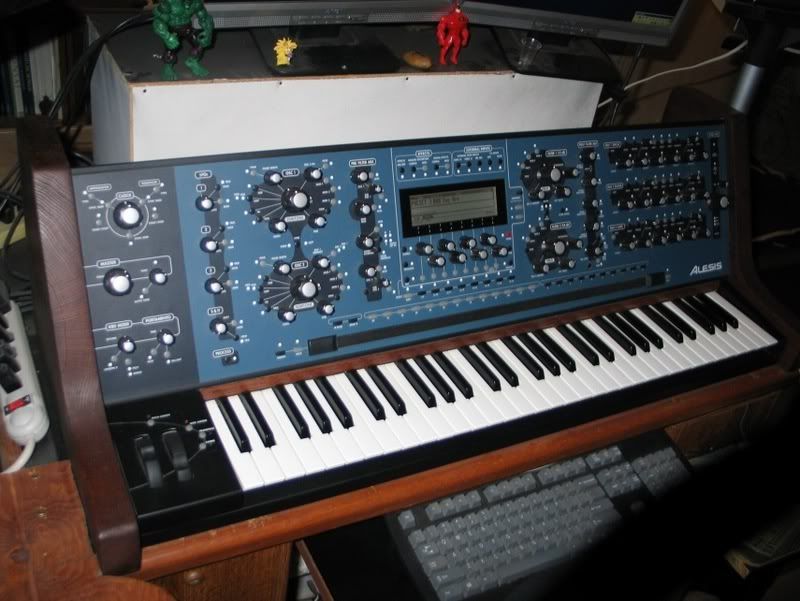
This was a custom mod. I originally put a post up in August of 05 here. Anyone know the website where more info on this mod is hosted? I accidentally lost the link when mucking around with Blogger's settings a while back.
Update: I found the original site but it is down. Some info and additional shots pulled from the Internet Archive Way Back Machine. You can find some thumbnails there, but most give you a 404 if you click on them for the larger shot. I pulled the large pics below before they are gone forever.
"Alesis made Synthesis History when they released their Alesis Andromeda A6, an analog polysynth bred with new technology and classic analog sound! Sixteen awesome voices with two types of filters, a vast modulation system, and enough bells and whistles to make the Andromeda A6 THE most highly featured analog polysynth in existence. If it only had a sloped panel...
SPECS:
* Take one Andromeda, lightly used (but out of warranty - very important!)
* Add one black on blue BETA Panel - because the pre-production beta panels were lacking the Pre- and Post-Filter Mix VIEW buttons, either the buttoncaps must be pulled off of the switches on the PCBs OR two holes need to be carefully drilled through the panel to accomodate. I drilled the holes after measuring about fifteen times each.
* Tilt that panel at approx. the same slope as the Korg MS-20. Requires the extending of a couple of ribbon cables inside, and some pop-rivetted braces. Not too hard.
* Custom wood endcheeks of nice Oak, plus a wood accent over the keyboard. I chose to go with thick, high quality wood to make Aurora more of a beast.
* Replace all green LEDs with red high-intensity ones. This also required changing some resistor values to increase the brightness.
* Replace the LCD with a Hantronix Blue-on-White display. Also, some resistor changes are needed.
* Have a very agreeable Alesis burn a custom Boot EPROM with the custom-designed bootup screen below.
* Build a custom top panel, complete with several additional controls (two joysticks, several switches and knobs) as well as a full 16-channel mixer with level and pan per channel, one for each of the 16 individual outs on the Andromeda.
* Add lots of careful, hard work and time, and PRESTO - you have the Aurora A6!
The Name: I went with Aurora for a couple of reasons.
1. Alliteration - AurorA - AndromedA - get it?
2. There is some legend/lore as to how the Alesis Andromeda got its name. Could be related to the Greek mythos. Could be related to the Andromeda galaxy. Could be darts thrown at dictionary pages :-) In any case, Aurora fits with the mythology bent because in Roman mythology, Aurora was the goddess of the dawn (Andromeda was rescued and married by Perseus in Greek mythos). Aurora also fits the 'celestial' thing as well, as the Aurora Borealis. Either way, it kept with what might have perhaps been Alesis' reasons for naming the Andromeda.
3. I just liked it.
4. The A6 is kept because this fits with Alesis' naming convention (QS8 = 81-key QuadraSynth, A6 = 61-key Analog). There is some rumor that A6 was a play on ASICs, the custom chips within Andromeda, but I'm assured this is just rumor :-) "
"Alesis Andromeda A6 16 voice analog polyphonic synthesizer. This A6 has the coveted and rare black overlay. It is extremely rare, only 61 black overlays were ever made and no more will be made. Out of the 61 overlays that were made, a portion of those were destroyed by bad attempts at installing the overlay properly. This is a rare opportunity to own a Black Andromeda A6 and could be the only chance to get your hands on one. Keep in mind that the black overlay can be removed in the future, which also protects the A6's top panel. All voices tune, and everything is functional. It has a few light scratches on the bottom, other than this, it is in extremely good cosmetic condition."
Super nice custom black Alesis Andromeda A6 by Thomas Heck. It's actually a new panel overlay. Only 20 have been produced. If you'd like one you can reach Thomas at heckthomas34 at gmail.com. The following is what Thomas had to say about them:
"As you can imagine, I like the Andromeda. This is an analog synth with unbelievably huge possibilities, but I have never liked the choice of materials and colors for the instrument's shell/case.
I made twenty overlays (they will be the only ones made), to give the possibility of having a black Andromeda. The side panels are just prototypes.
The new overlay can be applied over the old one, but it does require unscrewing the two plastic caps at each end of the ribbon controller, as this is needed to open the synth. However, it is not difficult to do."
This one in via Thomas Heck who brought us the custom black front panel overlays posted here. This A6 was modified to have a hinged front panel as well. Some of you might remember the Alesis Aurora mod.
Pictured to the left is Professor William Hoskins (via). What you see there is not the mystery Moog, but his Moog modular system. This post is about another Moog synth, one most likely based on the Sonic VI. If you have any information on what this synth might be after reading this, please feel free to leave a comment or contact me directly. My contact info is on the bottom right of the site. I have already contacted Michelle Moog-Koussa and Brian Kehew author of Kaleidoscope Eyes A Day in the Life of Sgt. Pepper, as well as Trevor Pinch, author of Analog Days [Amazon hardcover & paperback, preview on Google books], and featured in this exclusive post. I also contacted James Husted of Synthwerks, George Mattson of Mattson Mini Modular, Steven Jones of Synthwood, and Carbon111, all of whom know their synth history. None were familiar with what the synth might be.
The story: I was recently contacted by a Paul Rego with the following:
"I've been searching the Internet for over a year now and have not been able find a specific synth. Since you seem to know and work with every type of synth known, I thought I'd ask you...
Around 1973 - 1974, I took private synthesizer lessons at Jacksonville University (Florida). The instructor was Professor William Hoskins and the synth was a custom Studio Moog assembled by Professor Hoskins.
One day, Professor Hoskins showed me his personal, portable synthesizer. He brought out what looked like a brown suitcase. When he opened it, I saw a Moog Sonic VI.
This is nothing new. I've seen lots of images of this synth on the Internet. The one aspect of this particular synth, that I cannot find anywhere, is that it had a touch-sensitive keyboard. The keyboard was made of plastic and had a gray / brown color. Outlining the keys (showing the location of the 'white' and 'black' keys) was an almost medium blue color (about an eighth-inch thick). (He and I tinkered with this synth for about a half-hour to an hour.)
Professor Hoskins passed away several years ago, so I can't ask him about it. I did contact his family but they don't remember anything about this synth.
I do remember Professor Hoskins telling me that he and Bob Moog had 'gone to school together'. I think he was referring to electronics school but I never asked him more about it. I thought I had read somewhere that Professor Hoskins and Bob Moog had briefly worked together on a Sonic VI prototype but I don't know if that's true. (Even if what I saw was a prototype, someone has to own it now and should be proud enough of it to post some photos somewhere.)
I thought the background story might help in your own research on this.
Basically, I'd just like to know if this synth ever existed or am I just not remembering it correctly.
Thank you for your time and attention."
My first obvious guess considering the blue was the Buchla Music Easel or separate Buchla touchplate keyboard modded into the case of a Sonic VI. I sent Paul a couple of links to various images.
Paul replied: "the synth I saw didn't look like the Buchla Easel. Good call though.
The 'blue', which outlined the keys on the Sonic VI I saw was a bit lighter in color than the blue in your photos and maybe had a bit of green in it (closer to turquoise). There was no red or other color on the keyboard (that I can remember) and the entire keyboard seemed to be one piece of plastic with only the blue / green outlines separating the 'keys'.
I also read a story recently about the time when Musonics bought Moog and had a synth ('Sonic V'?) of their own, at that time, but I haven't research this too much yet. One thought I had was the synth I saw was something from Musonics but was never officially released (until it had the 'Moog' name placed on it). I'm pretty sure the synth I saw had the 'Moog' logo and the word 'Sonic VI'. (Not 100% sure but it seems clear in my memory.)"
I also sent Paul images of the EMS Synthi AKS. Paul replied it was the closest, but definitely not it.
I contacted Michelle Moog-Koussa and Brian Kehew to see if they knew of anything. Michelle replied: "...I can tell you that we have several of William Hoskins reel-to-reel tapes in the archives, so there was obviously a significant professional relationship between he and Bob.
I don't ever remember reading anything about the Sonic VI, but maybe Brian does. One thing I can tell you for sure is that Dad began working with John Eaton in 1970 on the Multi-Touch Sensitive keyboard [left via]. The main component of the MTS was the touch-sensitive keyboard, of course. It's not out of the realm of possibility that Dad would have used his work with John to push boundaries on another project."
Brian replied: "Bob didn't design or build the original Sonic V (from Musonics before they bought Moog) that was Gene Zumchak: The Sonic V did have a brown wood style. It's even unlikely Bob did much on the Sonic Six as it was the same thing with a new outer case.
The Sonic VI was the version Moog made in 1972 and later, in a plastic suitcase version. Many of these were made vs the very few Sonic V's. So one might think they saw a Sonic VI when it was the V (same front panel and features). But the brown suitcase and colored keys and touch sensitive thing are ALL unusual. I know a little about Prof Hoskins from the paperwork of the past, but no mention of this synth. Definitely unusual to have keys like that anywhere, anytime!" Followed by: "And there IS touch (velocity) sensitivity on Wendy Carlos' synth by 1971 for Clockwork Orange, but it's used under the normal keyboard. THIS velocity was very possible, but would not make the keys look different. Again - maybe a Sonic V was retrofitted with a cooler keyboard later in the 80s, but why not do so on a BETTER synth!?" :)
On a separate thread, Trevor Pinch got back to me with the following: "Bill Hoskins was important in that he was one of the first people David VanKouvering approached about minimoog reiail sales etc. I have a good album of his somewhere! I think he may have been Bob's favorite composer for a while.
I have no idea about the touch key board but I'm in touch with Gene Zumchak the guy who designed the Sonic Six, so I'll ask him. (I guess you know the joke that the Sonic Six was known by Moog engineers as the Chronic Sick!)
Actually its story might be kinda interesting - Zummy (as he is known) told me that it was made with 741 op amps and in many ways was more advanced than the minimoog.
Maybe it has had an unfair press. I never heard one or saw one for real."
James Husted sent me the image of Professor Hoskins at the top of this post. I sent it to Paul to see if maybe it brought back any memories that might help.
He replied: "The custom Moog modular in that photo is the same one I took lessons on. However, this is an early photo and when I saw that Moog modular, Professor Hoskins had already added a top layer to that cabinet — which included a Moog sequencer. (I have a photo of it, that I took around 1990, but the top part of the photo, showing the upper section, is cut off.)
The reason you didn't see Professor Hoskins' 'Sonic VI' is... I'm guessing that he didn't bring it to the university very often. When I saw it, I was at his home. He had invited me over one Saturday afternoon to see HIS custom Moog modular. It was in his garage, which he had made-over into a nice studio. It also had a two-manual organ, at least two reel-to-reel tape decks and LOTS of recording tape. Later, during that same session, he said 'There's something else I want to show you. Come inside.' We went into the living room and I sat on the couch. He said 'I'll be right back.' After about a minute, he came back carrying a brown 'suitcase'. He set it on the coffee table in front of me and sat down on the couch. He opened it up and... Whoa! I had never seen one of these and it was the first time I had seen a Ring Modulator!
---
I remember seeing Professor Hoskins play his Sonic VI during a live performance of his album 'Galactic Fantasy / Eastern Reflections'. The Jacksonville University orchestra played most of his composition but at one point his Sonic VI was brought out and he played it while at center stage. I could see it clearly from my seat but, of course, I could only see the back of it, which simply looked like the back of a brown suitcase.
---
Sorry it took so long to get back to you. Since I think this is important, I thought I'd try to recreate the 'Sonic VI' I think I saw. I 'Photoshopped' a production Sonic VI and attached it to this message. It's the best image of what I think I saw.
Modifying the image forced my memory to go into more detail. Here's what I'm fairly certain of:
• The outer color of the "suitcase" was almost dark brown.
• The outer shape was more square than the production Sonic VI.
• The thickness of the top and bottom sections was thicker than the production Sonic VI model.
• The keyboard was made of slightly textured plastic, otherwise completely flat, was brown / gray in color and had a vibrant blue outline between the keys. (I'm not 100% sure if the "black" keys were outlined or solid blue.)
• The background color of the back panel and the area surrounding the keyboard was almost dark brown. It looked like it was made out of either pressed cardboard or thin wood. It really reminded me more of the thin 'wood' used in old, tube televisions and radios (during the 1960s).
What I'm not 'fairly sure' of:
• I can't remember if it had a Mod Wheel.
• I think there was more space between the modules.
• I think it had two speakers (placed on the left and right side of the back panel). Each might have been the size of the center speaker-grill in my photo.
• I can't remember if there were any connectors, switches or knobs on the keyboard section."
Update: via Aaron aka theglyph in the comments: "Holy shit! That's the guy from JU. There was an electronics repair/pawn shop here in Jacksonville called Active Electronics that had a bunch of synths back in 90's. The owner had a sign in the store explicitly stating that the synths were not for sale and that customers were not allowed to walk up and look at them or touch them. I walked in day and walked close enough to notice that the MiniMoogs had very low serial #'s. It wasn't until I read Analog Days that I found out that the earliest Mini were sold here in Jacksonville. There so much more to this story that I don't know where to begin but I can say that I did an obscure Moog at the store that I've never seen photographed since and I simply thought I was loosing my mind recollecting it. WOW!
Cheers,
theglyph"
Update: Above, Brian originally mentioned Bill Hemsath as the person that designed the Sonic V. He meant to say Gene Zumchak. This has been updated.
Updates: via Dorothy in the comments:
"HI, as a Hoskins kid, I watched Dad perform on the synthesizer and I know we had the Sonic but I thought it was a "V". Dad had several custom modules built for him by Bob Moog. They were friends but didn't go to school together -- Dad went to Trumansburg NY to work with Bob on the synthesizer that they got for Jacksonville University (in 1969, I think). I will have to go digging in the Will Hoskins letters that I have. Those of you who knew Dad know that he was very meticulous about writing up the components that he bought and what they were for.
Late in Dad's life, when he was basically letting go of most composing effort except for revising existing scores, Bob helped Dad find a collector (in Germany, as I recall), who bought all of Dad's big home synthesizer. I think some of the smaller units were in the hands of Steve Smith, who was Dad's right-hand man at the JU studio for some years. Whatever happened to them, I don't think Dad would have cared as long as someone was using them to create music. He wouldn't have collected synthesizers as museum pieces, he actively used everything he got from Moog until he was ready to let it go."
Followed by: "BTW, that last time I spoke to Bob Moog was after Dad died, when Bob came to Rochester NY http://www.esm.rochester.edu/news/?id=132 which is near where I live now. Bob spoke very fondly of working with Dad, because Dad cared as much about the science of music synthesis as any composer Bob knew. Dad did some work with him on modulators and other components for JU and the Hoskins home studio."
Followed by: "Hoskins synth photo --not a Sonic -- in news article 1970 [link]"
Update 6/6/2010:
Some more interesting bits of Moog history:
Trevor Pinch checked with Gene Zumchak who had the following to say:
"I am not aware of a touch sensitive keyboard on the Sonic V or 6. It did have a two-note keyboard and the highest key pressed and lowest pressed could be routed to Osc 1 and Osc 2.
They removed the keyswitch bus and superimposed a highpitch (100KHz?) tone on the voltage string. This might have been the source of a whine that some users complained about that wasn't present in the Sonic V."
via Josh Brandt: 'Okay, I did hear back from David Mash [VP of IT at Berklee and friend of Bob Moog], who says that the story he was telling me several years ago was about a keyboard Bob was building for John Eaton. I asked about the story he'd told me and if the pictures you posted could be of the instrument he'd been talking about, and he said:
"The story I was no doubt telling was definitely about the keyboard Bob built for John Eaton [middle pic above]. Bob was going to show us the completed instrument (which my friends Jeff Tripp and Paul Derocco helped complete), but we never got to see it due to the way the conversation turned over dinner. I did see the instrument several times during the design/build stages and again later after it was complete.
The keyboard was simply a controller and not a synth, so definitely not the portable synth the blog is referring to. I know Brian, and was involved briefly with him and a bit more with Michelle Moog on the NAMM Museum exhibit, and they used a couple of my photos for the exhibit. They're great people and working hard to preserve Bob's legacy.'"
Update via WmJHeart in the comments:
"Thanks Matrix, for hosting this page. I own a copy of Will's Galactic Fantasy & Eastern Reflections (my personal favorite) recording on vinyl. But I also discovered and listened to the entire album on YouTube recently! Here:"
Galactic Fantasy - Eastern Reflections (1979)[Full Album]
Published on Jul 12, 2017 TheHomecoming
"Rare electronic/synth/moog private pressing LP
TITLE 'Galactic Fantasy - Eastern Reflections'
William Hoskins, "Galactic Fantasy, Eastern Reflections" [CP-158]
TRACK 01 AUDIO TITLE "Overture : Stars Are Suns" PERFORMER "William Hoskins" INDEX 01 00:00
TRACK 02 AUDIO TITLE "Intermezzo : Interplanetary Communique" PERFORMER "William Hoskins" INDEX 01 06:39
TRACK 03 AUDIO TITLE "Star Nocturne" PERFORMER "William Hoskins" INDEX 01 08:11
TRACK 04 AUDIO TITLE "Scherzo : Comets" PERFORMER "William Hoskins" INDEX 01 16:35
TRACK 05 AUDIO TITLE "Beyond Beyond" PERFORMER "William Hoskins" INDEX 01 18:54
TRACK 06 AUDIO TITLE "Prolog : Theme and Variation" PERFORMER "William Hoskins" INDEX 01 23:40
TRACK 07 AUDIO TITLE "Lower Heterophonie" PERFORMER "William Hoskins" INDEX 01 27:55
TRACK 08 AUDIO TITLE "Song : Open Skies" PERFORMER "William Hoskins" INDEX 01 31:22
TRACK 09 AUDIO TITLE "Drum Chime" PERFORMER "William Hoskins" INDEX 01 35:28
TRACK 10 AUDIO TITLE "Upper Heterophonie" PERFORMER "William Hoskins" INDEX 01 39:41
TRACK 11 AUDIO TITLE "Epilog : Processional" PERFORMER "William Hoskins" INDEX 01 41:30
A1
Overture: Stars Are Suns
A2
Intermezzo: Interplanetary Communique
A3
Star Nocturne
A4
Scherzo: Comets
A5
Beyond Beyond: An Entropy Study
A6
Eastern Reflections
Eastern Reflections
B1
Prolog: Theme and Variation
B2
Lower Heterophonie
B3
Song: Open Skies
B4
Drum Chime
B5
Upper Heterophonie
B6
Epilog: Processional
Criminally under-rated set of Early American Moog Modular Synthesizer Music - the sole release by composer William Hoskins, the 'Director of Electronic Music and Composer-in-Residence at Jacksonville University in Florida.' Issued in 1979 by the Harriman, NY-based Spectrum - a 'Division of UNI-PRO Recordings, Inc.' the LP consists of a pair of discrete pieces, with each taking up a side of its own."
Update via Kimberly S Beasley in the comments:
"Hello, everyone. I am the current chair of the Department of Music at Jacksonville University and I have the original Sonic VI manuals and one of Hoskin's Moogs....happy to share photos tomorrow."
Kimberly sent in the images with the following:
"This has been in the possession of our Professor Emeritus Dr. William Schirmer as it was given to him by Hoskins. Hoskins' granddaughter Dorothy is also aware of the instrument. We also have a large collection of manuscripts of Hoskins.
There is also a mini-Moog we just refurbished in our recording studio."
You can see WM. Hoskins written on the top right of the manual. Note "Home Copy" on the blue cover. It's kind of neat to think of him perusing through the manual in the comfort of his home.
 This was a custom mod. I originally put a post up in August of 05 here. Anyone know the website where more info on this mod is hosted? I accidentally lost the link when mucking around with Blogger's settings a while back.