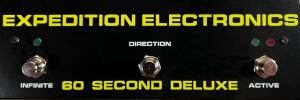
"All sound is coming from the Minilogue and the Eventide Space pedal. The Space pedal is capable of huge reverbs, choruses, delays, and tremolos. It sounds absolutely beautiful. It has lots of parameters, and it can be a bit difficult to get around because the knob functions will often change depending on the FX algorithm you're using."
"Burnt Dot Quartet performs improvised music for trumpets and modular synthesizers in quadraphonic space. Featuring Sarah Reid on trumpet, Ryan Gaston on Eurorack and Serge synthesizsers, and special guests Kris Tiner on trumpet and telematic performance by Todd Barton on Buchla and other synthesizers.
The concert is taking place on February 17th at 8pm PST at:
The Wild Beast Pavilion
California Institute of the Arts
24700 McBean Parkway
Valencia, CA 91355
Burnt Dot is an improvisational duo formed by Sarah Belle Reid (trumpet) and Ryan Gaston (modular synthesizer) in 2014. From violent gestures to undulating textures and sparse flickers, Burnt Dot uses open forms to explore and extend the unique vocabulary of each of their instruments, and aim to discover just how much of the area beyond their typical sonic territory is still unmapped. Burnt Dot specializes in free improvisation, prompt-based performance, and interpretation of graphic scores."
"Kris Tiner (b. 1977) is a California-based trumpet player, composer, and improviser. Featured on NPR Music as one of a handful of new trumpet voices impacting modern music, his playing has been described as 'extraordinarily inventive' in Signal to Noise Magazine, and the LA Weekly claims 'Trumpeter Kris Tiner can turn barbed wire to beauty.'"
"Todd Barton is a composer, sound designer, multimedia performer, analog synthesist specializing in Buchla Electronic Musical Instruments. Todd is a praised improvisor, composer, and consulting artist for Buchla Electronic Musical Instruments."
Hi everyone, I'm thinking about retiring the video and audio labels on the site. When the current format of MATRIXSYNTH launched back in 2005, videos and audio posts weren't as common so the labels made sense. Now, the majority of posts that go up are video posts which of course have audio. If you are asking yourself why I even created the labels in the first place, SoundCloud didn't launch until 2007, two years after this version of MATRIXSYNTH launched, and YouTube launched in February of 2005; people were just beginning to upload their synth videos, so if you can believe it, they weren't as common back then. The majority of posts were synth pics which of course never got a label. I've been using the video and audio labels since then without really thinking about it. Now they just seem kind of odd. It's akin to having a post or synth label on a site that consists of nothing but posts on synths. If anyone actually does rely on them, let me know, otherwise consider this the last post to have the labels.
And the resulting piece including a mini review from Terrible Beat:
Under the Tree with Novation Circuit
Published on Dec 8, 2015
"Here I am sitting under the Xmas tree with my Novation Circuit. I hope this video helps those of you interested in investing in one. You can see me create something quickly from scratch near the end of the video (https://youtu.be/rukEjtzHgHw?t=541). Track list is below:
Floatation Tank Thoughts https://youtu.be/rukEjtzHgHw?t=25
Bad Bloke https://youtu.be/rukEjtzHgHw?t=292
Shinjuku Nights https://youtu.be/rukEjtzHgHw?t=372
What I like about the unit:
- Firstly, the visuals on the system really help. It's not just a pretty face. The visual sequencer, integrated keyboard, pattern control, gate/velocity etc everything is so intuitively laid out in front of you. So, no deep menu diving.
- Exploration. This can also, understandably, be a negative aspect. But, if the user embraces the lack of labelling of what the encoders (knobs) do for each patch and just explore, more often than not, happy accidents occur!
- Automation. Recording the knob tweaks is awesome. Also, the visual feedback from the little LED is really helpful. As well as the live automation recording, there is the ability to step input knob tweaks, a la parameter lock-like (see Elektron units) functionality.
Things that could be improved:
- Quick audition of patches. As there are no little screens, choosing from the 64 patches can be difficult to remember and therefore lotto-like. A quick middle C preview would be great. Albeit, whilst Play button is disabled.
- No biggy for me, but a nice to have. Panning. The stereo width can be adjusted for parts using some of the delay presets, but that's not ideal.
That's all I can think of for now. Hope you enjoy the video. Look out for more. Please leave a comment and like ;)"
Our new chipmusic concept album is a collection of ambient music crafted to help facilitate relaxation. Over 1 hour of mind defragmenting tones for you to enjoy! Each sound is hand crafted from the Commodore 64 personal computer's SID sound chip. Portions of the album were co-written by a computer as many of the notes were set to be selected by the CPU at random! All tones have been digitally processed for maximum smoothness and optimum ambiance. Relax and Enjoy!
credits
released February 12, 2016
"(c)2016 vintage synthesizer demo track by RetroSound
all sounds: SCI Prophet VS Vector Synthesizer (1986)
recording: multi-track without MIDI
fx: a bit delay and reverb"
"This amazing classic axe comes with a mint condition Roland MPU-101, which is the best (fastest) MIDI to Gate/CV converters on the market and is very rare. The Moog's Trigger Input has been professionally modified to invert the polarity of the industry-standard Roland trigger/gate and is easily un-doable with simple tools, but why? (Moog products of this time had an inverted trigger polarity from all other synth manufacturers, and are intended to be driven by a Moog Sequencer output only). This rare interface allows MIDI functionality and; thus, defacto computer control for one of the fattest sounding classics available...tweeze the filters in real-time and rerecord in playback mode while the track plays back. Play faster, hipper, more correct bass lines after editing, etc.; the list goes on. This little trick made me sound like a player with great chops and groove."