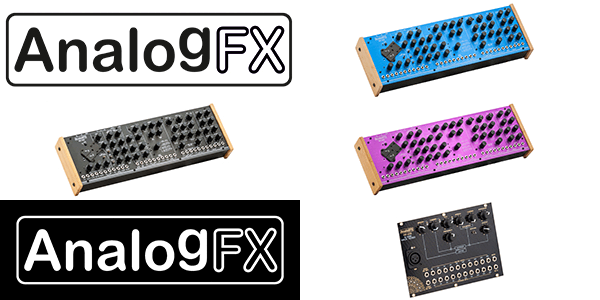
This one is in via Soviet Space Child. It appears the old Creamware Minimax, Pro12 and Prodyssey emulations have a new home.
"Introducing the Dino Park – The World’s first Top-End Modelling Synthesizer as affordable DIY Kit
Play with the Dinosaurs
For makers. For musicians. For everyone seeking the big sound! When you enter Dino Park, you will meet three staggering creatures from the past! Once before, these legends shook the earth. CreamWare’s absolutely faithful emulations set the standard for analog modelling in late 90s and their quality is unsurpassed today. Now they are back – in a new exciting form!
Every Dino Park comes with the legendary Minimax, Pro12 and Prodyssey pre-installed!"
"DIY Workshops coming soon from Music Thing Modular and Future Sound Systems. Join our events mailing list for advance ticket sales and info in the next few weeks." Details here
"All functions are working. The unit has some signs of age but overall in great condition!! All keys, sliders, knobs and buttons working well. Tested before listing. Please see pictures"
Note: links to listings are affiliate links for which the site may be compensated.
Update: This is actually a Rev 2. Note the volume knob is on the top right where the Cassette section is on the Rev3. See this pic of a Rev 3 for comparison. Apologies for not catching this. As always, if you buy online be sure to go through the site selling for buyer protection. That said here is the previous link if you want to see for yourself.
"*Professionally SERVICED in FULL Working order*
Works in 220V.
MIDI IN/OUT/THRU (Wine country) + Flight case ( new )"
As for the DK70, an interesting side note according to the description is that it was released in Brazil as the Giannini GS 7010 polyphonic synthesizer. You can find demos of it in the archives here.
"It is very similar to a Korg Poly-800, in that it operates like an analog synth, but its oscillators, LFO and envelope generators are all digital. Like the Poly-800, the DK-70 has eight oscillators/voices, but all the voices are mixed together through a single "monophonic" analog lowpass filter which was shared for all voices. Like a monophonic synthesizer, the filter was switchable between single or multiple modes. In single mode, the first key pressed triggers the filter envelope, and unless all keys are released, the filter does not re-trigger. In multi mode, each key pressed in turn triggers the filter envelope, even if other keys are still pressed down.
The oscillators are called "DCOs", and the envelope generated called a DEG (for Digital Envelope Generator). Digital components were much cheaper at the time and this allowed the DK70 to approximate the sound of an analog synth, but have 8 note polyphony without being cost prohibitive to the average user.
An unusual feature of the DK70 is that, while it appears to have the form factor of a standard synth, it has guitar strap pegs and can be used as a keytar. (The Poly-800 also had this feature.) An accessory called the "Stage Set" can be attached to the left side to provide a grip (similar to that of the SH-101), where the player may manipulate a ribbon-style pitch bender, as well as have access to buttons that change patches, change octaves and engage the LFO modulation.
It stores 50 patches, 10 of which are user assignable. A cartridge port accepted a cartridge which could store an additional 50 patches. All programming is done via pushbuttons, somewhat limiting its "tweakability" for live performances.
It also has an onboard two-track sequencer, which can be programmed by setting the tempo and recording a performance (unlike a step sequencer, where notes were entered in sequential order and played back at fixed durations). The performance would then loop when played back.
The synth engine was also available as a keyboardless, rack-mount or table top version called the Expander-80, similar to the Korg EX-800. Released in Brazil as Giannini GS 7010 polyphonic synthesizer"
"Demo of the incredible Roland SH-5 analog synthesizer, featuring various sounds & patches. This Roland SH-5 synth demo features oscillator, LFO, filter, mixer and modulation tweaking to showcase various sounds and patches on the Roland SH-5.
The Roland SH-5 is an iconic and rare vintage monophonic synthesizer that was manufactured from 1976-1981. It features 2 VCOs (32' to 2' with triangle, saw, square and pulse waveforms), 2 LFOs (LFO1 = saw, reverse saw; LFO2 = triangle, sine, square) and 1 S&H with sample time & delay time.
The Roland SH 5 has 2 VCF filters: 1 multimode LP/BP/HP and 1 Bandpass, both with cutoff and resonance. 2 Envelopes (1 AR and 1ADSR) can be routed to filter, osc and amp, and there is env sensitivity and keyboard tracking on the filter. On the back of the SH-5 are various inputs/outputs for CV and other control.
Additional features include portamento, pitch bend, ring modulation, soft & hard sync, white & pink noise, external audio input, VCA panning, VCA-triggering via S&H, LFO2 or external trigger. A comprehensive Mixer section allows for routing of 5 audio signals through VCF, VCF+BPF, BPF, or direct to VCA.
The Roland SH-5 is a classic vintage synthesizer that can output massive bass, piercing resonance, create amazing textures/noise/FX, and of course leads and other standard tones. The additional bandpass filter is also a key feature that sets the Roland SH-5 apart from many other synths in terms of tone.
Roland SH-5 are becoming increasingly rare on the second hand market, often commanding high prices as many consider it to be the pinnacle of vintage Roland monosynths. If you have the opportunity to try a Roland SH-5, do not hesitate as it is a fantastic instrument."
"Have you ever wondered how digital synthesizers work? In today's video, Andy shows how to build one with just a handful of parts. He'll use a standard MIDI interface and line-level output for maximum compatibility, and an FPGA for maximum fun! Connect with Andy on the element14 community: http://bit.ly/2TS8tp5"
See the FPGA label directly below for more FPGA based synthesizers. This post, as many, is just meant to let you know this is out there - for those of you interested in Synth DIY.

 "Introducing the Dino Park – The World’s first Top-End Modelling Synthesizer as affordable DIY Kit