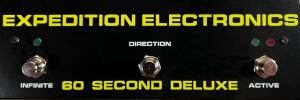
via Mike Beard / GearMedia, who is interested in partnering with someone to manufacture and distribute these.
"A modular 19" rack design similar to the rack mounted moogerfoogers. Each model would be able to be purchased separately and mounted above its Moogerfooger counterpart for simpler more modular style patching or alternatively, keep the MF on the floor and use a custom snake to connect to the rack. Maybe even a eurorack style with 1/8" on the front."
YouTube via SCHAAFJOERG | September 16, 2010 Joerg Schaaf is the man behind Radikal Technologies. "Ryo's journey is the first track with a video, where I played an e-guitar and a bass beside the Spectralis. I had no time to create a new movie for this one - so I put some old scenes together. But I really wanted to upload the music to youtube as well.
I produced the music with digital performer and one Spectralis synthesizer. All guitar and bass sound processing has just been made with the standard plugins of Digital Performer. Forgive me the timing issues - I am not playing guitar and bass for a long time. I am just at a beginners level."
YouTube via klubmoozak | February 21, 2011 | Also see this post for some pics and words via Noiseconformist. "NETZZEIT & IN DER KUBATUR DES KABINETTS & KLUB MOOZAK präsentieren: "Silver Apples of the Moon" mit MORTON SUBOTNICK
22:00 Uhr Morton Subotnick: Demonstration des originalen Buchla Synthesizer
22:45 Uhr Silver Apples of the Moon (1967) und A Sky of Cloudless Sulphur (1978)
Eintritt (Abendkasse): 10,- Vorverkauf Jugendinfo (1010 Wien , Babenbergerstr.1): 8,-
Vor 50 Jahren lernte Morton Subotnick, einer der Pioniere elektonischer Musik, Don Buchla kennen und gab kurze Zeit später einen Synthesizer in Auftrag, den Buchla 100 series Modular Electronic Music System. Diesen Synthesizer von 1963 nutzte Morton Subotnick, um Silver Apples of the Moon zu komponieren, das erste Werk für Elektronik, das von einem Plattenlabel (nonesuch) in Auftrag gegeben wurde.
Gemeinsam mit Robert Moogs' Moog Synthesizer revolutionierte der Buchla die Musik und den Sound seiner Zeit. Nach ihrer Performance Ende Jänner bei der Transmediale Berlin 2011 präsentieren Morton Subotnick und Lillevan auch beim Auftritt im Fluc in Wien die Werke "Silver Apples of the Moon" und "A Sky of Cloudless Sulphur" mit Live-Elektronik (Morton Subotnick) und Live-Video (Lillevan).
"Roland System 100 (101&102) Make Noise Brain (2xPP) and René to Doepfer A 152 as a 40 step sequencer to Toppobrillo Quantimator two outs to 101&102 System 101&102 cross modulation (ext cv in)& Ringmodulation Ringmodul 1 from 102 Ringmodul 2 Maestro Ringmodulator both RM's Carrier in from Moog Freq Box Audio System 101 & 102 to Boss PN 2 to Boss PN2to Boss SL-20 Drums Roland EF 303 Syn Rhythm function midi out to Boss DR770 DR 770 to EF303 audio in EF 303 to System 101 &102 to Boss SL-20 Master clock Logic Kenton Pro 2000 II to 4ms RCD 7 tracks Donna da cat"
via this auction "Rare vector synth with a unique gritty aliasing sound together a similar grainy reverb. At the very foot of this page I have uploaded a Soundcloud demo of what it sounds - the TG 33 was recorded directly into an Akai z8 Sampler with no added effects.
With the advent of 'plugins' too many artists in the electronic field sound the same and so the search for unique, by-gone instruments continues. Here we have a TG 33 which was developed by the people left at Sequential Circuits who had joined Korg who were later takenover (briefly) by Yamaha. Dave Smith was behind the SY22/TG33 a sort of poor mans Sequential VS. The Sequential boys went on to develop the Wavestation for Korg however, that was a silky sounding synth that was very much of its era. The TG 33 on the other hand as this grainy, bitcrushed sound that is very of the moment - think Daft Punk Tron or Chiptune music.
It was released in 1990 (I was 10!)
What is good for? Metallic, droney strings and scraping sounds. Excellent for ambient sounds which would take ages to program on any other synth but with Vector you are mixing 2 synth engines ...its not just mixing
Features: TG33 has two synthesis engines: AWM (12-bit PCM) and CWM (2-Operator FM). This hybrid architecture is called DASS. There are two layering modes: 1PCM+1FM (32 polyphonic) and 2PCM+2FM (16 polyphonic). The Vector controls the mix balance and the detuning.
AWM section TG33 has 128 12-bit PCM waveforms in 1MB ROM. There is no filter, as is the case with lower-end PCM synths at that time. The LFO modulation is relatively fast. It can be used to imitate a kind of cross-modulation like Roland JV's FXM.
FM section TG33 uses 2-Operator FM with 8 basic waveforms. It can be only partially editable from the front panel. Users must choose one from 256 preset FM settings, and edit Amp Env, Brightness, LFO etc. As the AWM section has no filter, timbre motion should be created with this FM section.
Using SysEx, all the hidden parameters can be edited (see below). Vector
There are two Vectors; Level Vector and Detune Vector to control mix balance and the detuning. They can be controlled in realtime with the Joystick/MIDI CC or 50-step sequence for each. The vector sequence stops in the release segment.
16 FX types including reverb, short delay and digital distortion are available. There is no modulating effect like chorus."
 via Mike Beard / GearMedia, who is interested in partnering with someone to manufacture and distribute these.