"Demonstration of Frame Based Synthesis technique. Three different recordings have been crossfaded into each other, however each recording contains raw SuperCollider synthesis with no additional editing or processing. The crossfades appear at 2:43 and 12:30. For more info, visit cylob.blogspot.com or www.cylob.com"
"I started programming in the first version of SuperCollider in 1998, making a simple drum machine / synth, and later a granular automatic remix tool. After a few years break, I returned to the program in 2001 (version 2 on Mac OS 9) and made a new "drum machine" with many more different sounds. Extending this further, I added 8 step sequencer modules and a much more involved synthesis system to go with it. I used this new program, named Cylob Music System 3000, to make a series of EP's which were released in 2004. After this I started to investigate the new version of SuperCollider running on Mac OS X, which, although it had a much steeper learning curve, was much more flexible in terms of sound patching and generation. Attempting to learn from my previous mistakes, I set about making a new version of my program (CMS Environment) the scope of which has grown to encompass many different ways to compose and create sound.
The CMS consists of 784 classes, the code itself coming to 4.1 MB. It remains a work in progress, having taken 5 years so far."
Title link takes you to more info. Also check out DJ Cylob's blog, Cyloblog.
"Exploring direct CV control of the Fumana's 16 bands.
00:00 Intro
00:03 Explanation
00:13 Adjusting bands
01:56 Storing and recalling band level configurations
03:08 Jam 1
07:10 Jam 2
09:40 Five Alive
Details of the album 'I Will Cross Any Bridge' can be found at https://kud.li/csr015."
Frap Tools Fumana Part 1: Center & Width (Eurorack modular synth filter, spectral transfer, vocoder)
video upload by Cylob Sonic Research
"Exploring the Center and Width controls of the Frap Tools Fumana eurorack filter module.
00:00 Intro
00:03 Center and Width knob controls
01:23 Modulating Center with sine LFO
02:47 Modulating Width with sine LFO
04:19 Modulating with saw LFO
05:37 Modulating with Zig Zag wave LFO
06:45 Modulating Center with multi stage envelope
07:05 Modulating Width with multi stage envelope
08:31 Adding drums
10:39 Drums and multi stage envelopes try two
13:45 Ambi interlude
14:08 Ambi track jam with stereo panned bands
"Giving the acidlab.de M303, Din Sync OSC303 and VCF303 modules a workout.
Sequenced with a custom patch running in SuperCollider controlled with two Novation Launchpads."
Acid Modules Sound Test (acidlab.de M303, Din Sync VCO303 & VCF303, Eurorack modular synth, filter)
"Recording the output of the envelope followers analysing speech, then playing this back at a much slower rate modulating a three tone drone, then drenching that in reverb.
00:00 Intro
00:03 Source material
00:25 Recording the band analysis output
00:40 Playback
01:36 Adding reverb
07:32 Freezing playback
09:29 Reversing playback direction
20:45 Changing reverb algorithm
"The Macbeth Micromac-D is a boutique analogue synth from 2013. It has a three oscillator design, and I think it sounds lovely. There’s just one problem. It can only play one measly note at a time! But what if it were possible to play this synth with unlimited polyphony, in real time? Let's find out! ---------- 00:00 Introduction, Micromac sound demos 02:02 Technique explanation 03:51 First listen 06:27 Patch parameters 10:13 Multistage envelopes 14:03 Jam 1 18:49 Jam 2 19:52 Jam 3 23:26 Discrete MIDI notes ---------- Some additional information:
The explanation of the first patch was simplified. There are a couple of issues to contend with when generating polyphonic parts from a monosynth. There isn’t just one buffer in use, rather multiple in action. Every note on rotates the buffer to be recorded into. This allows the notes of the previous chord to die away while the next chord starts to play, if the playback speed for those previous notes still leaves some signal to be played.
Another issue has to do with recording. A new note on should kill recording into the previous buffer. Otherwise, the notes of the previous chord still in action will start playing a recording of the new note on. I made this selectable in the first patch, because the effect may be desirable from an aesthetic viewpoint.
One more consideration when using an analogue synth controlled with CV and gate as the sound source. If notes are already being held down when the source synth is retriggered, the gate will remain high. As a result, the envelope will not restart. Therefore it’s best to use an envelope generator which is able to be retriggered, like the Intellijel Dual ADSR. That way, every new incoming note will retrigger the envelope.
One last thing: neither version of the patch compensates for audio latency, which means that lower notes are a little late to start."
YouTube via djcylob. Audio comes in at :43 "Demo of OSCemote and SuperCollider running simultaneously on the same iPod Touch, using the app "Backgrounder" available on Cydia for jailbroken devices. The SuperCollider code used can be found at http://code.google.com/p/oscemote/wik...
"The Michigan Synth Works MSW-810 is a replica of a Roland analog monosynth from 1983, a cousin of the much more famous MC-202. But it has its own distinct sound, somewhat beefy and powerful, reminiscent of even earlier Roland synths from the seventies. What will happen when the MSW-810 meets modern replicas of vintage Boss chorus pedals? Let's find out!
Putting in a cameo appearance is the Michigan Synth Works SY0.5, a eurorack adaptation of the vintage Pearl Syncussion. Everything controlled by two Launchpads together with some custom SuperCollider patches.
00:00 Intro
00:03 Setup
00:46 Noodling
03:56 Chorus
06:41 Dimension
09:58 Multitracking
11:07 Stacking the recordings
11:32 Track one
16:30 Dramatic stabs
16:53 Track two
YouTube via djcylob "Video courtesy of Chris Moss Acid: http://myspace.com/chrismossacid The projection reflects the display and operation of the Monome 128, and gives info about the performance, such as BPM, track titles, time remaining and so on. The shapes gradually morph between randomly selected presets. DJ program and visuals made with SuperCollider: http://supercollider.sourceforge.net/
P.S. The audio dropouts are due to the camera used and were not present in the original performance!"
"This track contains the results of experimenting with home made resynthesis. A short sung phrase has been analysed in 24 bands for pitch, amplitude and "spectral flatness" (a scale which would have at one end a sine wave, and at the other white noise.) This information is used to play oscillators of various kinds. The control data may be transposed, slowed down or speeded up, slewed, skewed, quantised, thresholded or otherwise altered. The track begins with the original recording, followed by several resynthesised results, played live with SuperCollider and containing no additional processing." You can find more at Cylob Also see these prior posts (scroll after click).
"2 copies of Supercollider / CMS Environment were run at the same time, one feeding the Mackie mixer and one feeding the Gemini. Seperate channels were mixed on the Mackie while different loops were selected using the joypad. Inbetween these tracks, secondary loops were played through the Gemini mixer and crossfaded/ punched in as required. All stopping and starting of tracks was achieved manually! Most of the sounds are synthesised, although many of the drum sounds are samples, and there are a few "bass waves" sampled from analogue synths."
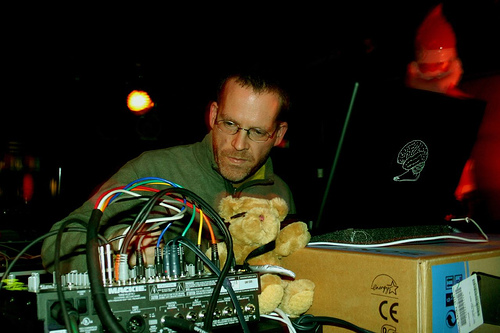
And a teddy bear for good measure.
: )
Title link takes you to more info including more images, videos and samples.