Showing posts sorted by date for query 700 Function Processor. Sort by relevance Show all posts
Showing posts sorted by date for query 700 Function Processor. Sort by relevance Show all posts
Tuesday, February 03, 2026
700 Function Processor Patch #4 | simple techno
video upload by Gm Xe
"This patch creates a simple techno groove using three PatternSeq channels.
Each PatternSeq sends trigger signals to the drum machine, pitch CV, and pulse signals to the 208. Wave shape is modulated with random control for added movement and variation.
Three PatternSeq modules handle:
Trigger outputs to the drum machine
Pitch CV sequencing
Pulse signals to the 208
Random modulation applied to wave shape
Hope you enjoy this patch.
#700FunctionProcessor #Buchla208 #BuchlaSynthesizer #ModularSynth
#PatternSequencer #CVSequencer #WestCoastSynth #ModularPerformance
#ElectronicMusic #ExperimentalMusic #SoundDesign#techno#4U Modular"

Monday, February 02, 2026
700 Function Processor Patch #3 | One Module, More Patch Space
Saturday, January 24, 2026
700 Function Processor Update: New Pattern_Seq App Walkthrough
video upload by Gm Xe
"*700 Function Processor is now officially released.*
This video showcases the latest *Pattern_Seq* app included in the production version.
This is a quick walkthrough of the main features and functions of Pattern_Seq.
For other functions, please check the related demo videos:" [posted here]
700 Function Processor Patch #1 | One Module, More Patch Space
video upload by Gm Xe
See dealers on the right for pricing and availability on gear.
LABELS/MORE: Buchla, Gm Xe, New Updates, News
LABELS/MORE: Buchla, Gm Xe, New Updates, News
Monday, December 15, 2025
NEW Project Development Update: 700 Complex Function Generator Demo – Quick Overview
video upload by Gm Xe
Also see: 700_funtion_M4L with 700 voice system
"700 – Complex Function Processor (Demo Version)
This video shows a demo of the 700 Complex Function Processor, currently in active development.
Features include:
4 independent channels, each running its own app
4 independent pulse managers (one per channel)
2 independent random and expressive modulation channels
4 configurable pulse outputs
2 editable noise outputs
Most operations are performed directly via analog knobs and buttons, without deep menus.
⚠️ This video demonstrates a test / prototype version.
The core DSP algorithms and hardware functionality have been successfully tested.
A more complete and refined version of the product will be updated in the near future.
Thanks for watching.
For the latest updates, please visit the official website:
https://gmxe.org
#Buchla
#700FM VOICE
#Module synth
#Buchla FORMAT
#synthesizer
#Function Generator
#modularsynth"
See dealers on the right for pricing and availability on gear.
LABELS/MORE: Buchla, Gm Xe, New Modules, News
LABELS/MORE: Buchla, Gm Xe, New Modules, News
Wednesday, October 22, 2025
The Florian Schneider Collection to Be Auctioned at JULIEN*S November 19
Note: links to listings are affiliate links for which the site may be compensated.

via JULIEN*S

 "THE FLORIAN SCHNEIDER COLLECTION
Auction to be held at Musician's Hall of Fame & Museum, Nashville, on November 19
An incredible collection of more than 450 artifacts from the life and career of Florian Schneider, co-founder of the pioneer electronic band Kraftwerk."
Pics and videos featuring some of the gear below, and his Lederhosen for good measure (thanks greg!).
Update: the post has been fully updated with all the synth related gear. This may just well be the longest post to be featured on the site. I wanted to capture all the pics for all of the details including notes, scuffs, and of course serial numbers. It's an interesting look into what he used, the condition he keped his gear, in some cases, how he actually used his gear. Note the phonetics on the keys of the Casio CZ-101 and DX-100. Note the Midi Switch Box with a built-in speaker? What's that about? Note the camouflage key strap on the Korg RK-100 Remote Keyboard. Did he pick it out himself or did the keytar just come with it? Note the repeat midi controllers and the MIDI saxaphones. Wind was his primary instrument. You'll find a ton of the acoustic gear he used in the other listings. This is a fascinating insight into both what and how he used his gear.
Side note: there is no affiliate compensation for this post. The note at the top automatically shows for all posts with the Auction label.
Rack Mount Sennheiser VSM-201 Vocoder
Starting Bid $5,000
Estimate $20,000 - $40,000 USD
A late 1970s Sennheiser VSM 201 Vocoder with no serial number from the personal studio and collection of Florian Schneider of Kraftwerk (see images). While it’s said that only a few dozen of these Vocoders were produced, a few examples made it into the hands of forward-thinking musical artists including Herbie Hancock, Daft Punk, and of course, Kraftwerk, who used a VSM-201 like this on their albums Man Machine (1978) and Computerworld (1981). The VSM-201 has an intelligible sound that has not yet been bested by modern gear. Includes power cable. This VSM-201 has been removed from its wooden enclosure (which bears the serial number plate) and modified with a metal rack mount casing, presumably for live use. Requires 240v, IEC power cable not included.
Dimensions: 19 x 9 x 9 inches
Category: Kraftwerk, Equipment
Provenance: PROVENANCE From the Estate of Florian Schneider

via JULIEN*S

 "THE FLORIAN SCHNEIDER COLLECTION
Auction to be held at Musician's Hall of Fame & Museum, Nashville, on November 19
An incredible collection of more than 450 artifacts from the life and career of Florian Schneider, co-founder of the pioneer electronic band Kraftwerk."
Pics and videos featuring some of the gear below, and his Lederhosen for good measure (thanks greg!).
Update: the post has been fully updated with all the synth related gear. This may just well be the longest post to be featured on the site. I wanted to capture all the pics for all of the details including notes, scuffs, and of course serial numbers. It's an interesting look into what he used, the condition he keped his gear, in some cases, how he actually used his gear. Note the phonetics on the keys of the Casio CZ-101 and DX-100. Note the Midi Switch Box with a built-in speaker? What's that about? Note the camouflage key strap on the Korg RK-100 Remote Keyboard. Did he pick it out himself or did the keytar just come with it? Note the repeat midi controllers and the MIDI saxaphones. Wind was his primary instrument. You'll find a ton of the acoustic gear he used in the other listings. This is a fascinating insight into both what and how he used his gear.
Side note: there is no affiliate compensation for this post. The note at the top automatically shows for all posts with the Auction label.
Rack Mount Sennheiser VSM-201 Vocoder
Starting Bid $5,000
Estimate $20,000 - $40,000 USD
A late 1970s Sennheiser VSM 201 Vocoder with no serial number from the personal studio and collection of Florian Schneider of Kraftwerk (see images). While it’s said that only a few dozen of these Vocoders were produced, a few examples made it into the hands of forward-thinking musical artists including Herbie Hancock, Daft Punk, and of course, Kraftwerk, who used a VSM-201 like this on their albums Man Machine (1978) and Computerworld (1981). The VSM-201 has an intelligible sound that has not yet been bested by modern gear. Includes power cable. This VSM-201 has been removed from its wooden enclosure (which bears the serial number plate) and modified with a metal rack mount casing, presumably for live use. Requires 240v, IEC power cable not included.
Dimensions: 19 x 9 x 9 inches
Category: Kraftwerk, Equipment
Provenance: PROVENANCE From the Estate of Florian Schneider
See dealers on the right for pricing and availability on gear.
LABELS/MORE: ARP, Auctions, Casio, Doepfer, Dynacord, EMS, exclusive, exclusive2025, Future Retro, Korg, MOOG, News, oscilloscopes, RHEEM, Roland, Sennheiser, SOVIET, synth humor, Updates, Yamaha
LABELS/MORE: ARP, Auctions, Casio, Doepfer, Dynacord, EMS, exclusive, exclusive2025, Future Retro, Korg, MOOG, News, oscilloscopes, RHEEM, Roland, Sennheiser, SOVIET, synth humor, Updates, Yamaha
Saturday, October 12, 2024
Machina Bristronica 2024
video uploads by sonicstate
Playlist:
1. Bristronica 24: MyVolts The Silent Alchemist Nears Shipping
We caught up with Caroline who gave us the latest update to the *Silent Alchemist*, a versatile power hub designed for musicians. Featuring five isolated USB-C outputs and a high-wattage sixth output capable of delivering 100 watts, the device can power a Mac with the remaining outputs providing 20 watts each. Its independent circuits ensure noise-free operation, catering to a variety of devices including the Dreadbox module and Sysmo slope generator.2. Bristronica 24: Circuit Happy ML2M Clock Sync module updates
The Silent Alchemist uses innovative step-up power tips to convert USB-C input to the correct voltage for various devices. There's also new feature: an uninterruptible power supply allowing seamless transition between wall and power bank sources. Also introduced were updated cables, such as silver candy cords and floating ring TRS to TS cables, expanding connection flexibility. The Silent Alchemist is expected to be available in December with a competitive pricing strategy.
More Info:
https://myvolts.com/
At Bristronica 2024, we caught up with the creator of the *ML2M*, who introduced us to the latest version. The ML2M is a compact Eurorack module with Wi-Fi capabilities, allowing seamless synchronization with Ableton Live, Bitwig Studio, and iOS music apps using Ableton Link without the need for cables. It either connects to an existing network or creates its own, ensuring robust sync even in environments with unreliable Wi-Fi. The module, which retains its 2HP size, now features MIDI integration through TRS jacks. Users can access a web interface to configure each output for different clock divisions and reset triggers, making setup straightforward and flexible.3. Bristronica 24: Archaea Exchange Patching Module
Alongside the ML2M, there's also the Missing Link Junior. This desktop version offers the same functionality but in a box format, complete with MIDI and CV clock outputs. Both products are now accessible, with a starting price of $250.
At Machina Bristronica 2024, we caught up with Arran from @archaea_modular_synthesis who presented the *Exchange Module*. This programmable patcher, a year in the making, evolved from its early prototype stage to a fully functional module. Arran explained how the Exchange can route synth voices via a beam controller and three exchange modules installed within the skiff, allowing for versatile patching. Operating like a matrix patchbay, it enables users to select inputs and outputs with the push of a button, create presets, and chain multiple modules for synchronized patching.
Communication between the modules occurs over the Eurorack power bus as well as over MIDI via the USB-C connection. The Exchange maintains analog integrity, ensuring there’s no conversion latency. The forthcoming release expected in late November 2024, includes a USB-driven editor for enhanced control capabilities.
See dealers on the right for pricing and availability on gear.
LABELS/MORE: Archaea, Circle Guitar, Circuit Happy, Componental, Dreadbox, Halftime, Landscape, Machina Bristronica, MATRIXSYNTH Members, Midicake, myVolts, News, Patching Panda, Toadstool Tech, u-he
LABELS/MORE: Archaea, Circle Guitar, Circuit Happy, Componental, Dreadbox, Halftime, Landscape, Machina Bristronica, MATRIXSYNTH Members, Midicake, myVolts, News, Patching Panda, Toadstool Tech, u-he
Thursday, June 13, 2013
DK Synergy II+ Synthesizer with Kaypro II PC SN 01272
Note: links to listings are affiliate links for which the site may be compensated.

via this auction
"The listing is for a Digital Keyboards Synergy II+ synthesizer with Kaypro II PC in great condition! One of the first premium digital synthesizers manufactured in the US , The synth is based on Dr. Hal Alles from Bell Labs synthesizer architecture.This model is the programmable version and has the solid wood casing which only came out with the very early serial numbers. The wood was replaced by tolex to reduce cost in following years. Approx 700 total Synergy units were made of which about 300 were said to be the upgraded programmable version.It is estimated that only 100 or so units are still operational today of which about 20% are the higher end wooden case version. When the Synergy II + hit the market in the early 80s, they were going for upwards of $10K for the wooden programmable version with Kaypro PC. The DX7 came out with their FM synthesis in 83 for $2500 and changed the entire synth industry. After that DK was dumping their units for under $7K with Kaypro and eventually went under in 1985. I payed $5,450 (including shipping) for this unit 8 months ago so for a 30 year old rare synth , it is still holding it's value.
U+fh!WBRuQNbynK!~~60_57.JPG) The Synergy II+ 's Kaypro II PC is in great shape as well with two functional drives and the 1980s style green light screen resolution is still very prominent. You can find Kaypro PCs for sale on eBay should you ever need a back up. The sale includes everything you see in the photos- Synergy synth, Kaypro PC and keyboard, null modem cable to RS232 port ,original operational manual for the synth( not a copy), instructions for understanding the Kaypro and the complete Synergy library.The library includes close to 500 patches. It includes the L1-L13 FDs, VCART1-VCART6 FDs and Wendy Carlos Library( WENDY 1-WENDY3 FDs). All library, diagnostic, software systems and boot disks have been backed up with multiple copies, anywhere between 4-6 sets of each. The sale also includes a 2 hour video made by the original owner who purchased this synth as a floor model in 1983. The video on DVD is well thought out as well as his written start up instructions to get a new owner going. You definitely want to review the video and documents to understand the nuances using the synth and PC software . Included are the original documents listing the names and categories of the library disks and patches/voices in alphabetical order and by instrument or sound type. Other documents include synth schematics, pin schematics if you want to make your own null modem cables and addendum released by DK.
The Synergy II+ 's Kaypro II PC is in great shape as well with two functional drives and the 1980s style green light screen resolution is still very prominent. You can find Kaypro PCs for sale on eBay should you ever need a back up. The sale includes everything you see in the photos- Synergy synth, Kaypro PC and keyboard, null modem cable to RS232 port ,original operational manual for the synth( not a copy), instructions for understanding the Kaypro and the complete Synergy library.The library includes close to 500 patches. It includes the L1-L13 FDs, VCART1-VCART6 FDs and Wendy Carlos Library( WENDY 1-WENDY3 FDs). All library, diagnostic, software systems and boot disks have been backed up with multiple copies, anywhere between 4-6 sets of each. The sale also includes a 2 hour video made by the original owner who purchased this synth as a floor model in 1983. The video on DVD is well thought out as well as his written start up instructions to get a new owner going. You definitely want to review the video and documents to understand the nuances using the synth and PC software . Included are the original documents listing the names and categories of the library disks and patches/voices in alphabetical order and by instrument or sound type. Other documents include synth schematics, pin schematics if you want to make your own null modem cables and addendum released by DK.
 This synthesizer is definitely not for the touring musician or quick knob turning gratification player. This synth is typically purchased as a collectors piece or a programmers synth who enjoys sound sculpting for personal pleasure or studio recording. This synth has unique architecture and very sophisticated envelope control . What makes the Synergy II+ unique even to this day is that you voice each oscillator twice for both frequency and amplitude and you have 16 different envelope points for each envelope. So you get to control how each voice changes in response to velocity. For example, you might choose to have a phase modulated envelope that rises very sharply at low velocities and dies off fast, but at high velocity(loud notes) it rises less sharply and dies off much more slowly. Or you could do the opposite with the carrier envelope scheme which means the loudness envelope of the timbre operates normally with a sharper attack the harder you press the key but a shorter decay at louder amplitudes. Since you can define two 16 point frequency envelopes for each oscillator and you are dealing with phase modulation, you can have sound going from strictly harmonic overtones to inharmonic partials and back again over time or set it up to go inharmonic to harmonic and back again. And this effect is with just two oscillators. Typical Synergy II+ patches use 3-6 oscillators so you can also detune them to get chorus effects. Another reason to set up multiple chains of oscillators for a patch is to have different sets of overtones moving in and out of harmony against one another which gives you very complex timbral effects like you would get with real instruments. Another reason to use multiple oscillators is so you can combine additive synthesis with phase modulation to create some very realistic percussive sounds like bells or chimes using subharmonics of the fundamental of a note to create that low hum that is not harmonically related to the timbre ,but present in real percussive instruments.There is a reason that Wendy Carlos still has two Synergy GDS units among her gear of only 5 remaining keyboards.
 For those not familiar with the Synergy, there is a good website if you Google DIgital Keyboards Synergy Preservation Page.Also there are several YouTube videos on this unit. However, here are the basics:

via this auction
"The listing is for a Digital Keyboards Synergy II+ synthesizer with Kaypro II PC in great condition! One of the first premium digital synthesizers manufactured in the US , The synth is based on Dr. Hal Alles from Bell Labs synthesizer architecture.This model is the programmable version and has the solid wood casing which only came out with the very early serial numbers. The wood was replaced by tolex to reduce cost in following years. Approx 700 total Synergy units were made of which about 300 were said to be the upgraded programmable version.It is estimated that only 100 or so units are still operational today of which about 20% are the higher end wooden case version. When the Synergy II + hit the market in the early 80s, they were going for upwards of $10K for the wooden programmable version with Kaypro PC. The DX7 came out with their FM synthesis in 83 for $2500 and changed the entire synth industry. After that DK was dumping their units for under $7K with Kaypro and eventually went under in 1985. I payed $5,450 (including shipping) for this unit 8 months ago so for a 30 year old rare synth , it is still holding it's value.
U+fh!WBRuQNbynK!~~60_57.JPG)


Tuesday, September 07, 2010
DK SYNERGY II+ SYNTHESIZER, KAYPRO II & SYNHCS SOFTWARE
synergyII timbres Uploaded on Sep 5, 2010 xenmaster0
s 2 demo 1 441 final 320x240stream Uploaded on Sep 5, 2010 xenmaster0
Warning: this is a long post and can't be paged with the "click for more" link otherwise the videos will not load. Also, no time to parse the entire listing, so everything captured below for the archives.
 via this auction
"DIGITAL KEYBOARDS SYNERGY II+
WITH KAYPRO II & SYNHCS 3.182 PROGRAMMING SOFTWARE, 14 FLOPPY DISCS OF SYNERGY TIMBRES, and 3 SYNERGY ROM CARTRIDGES
 This is the legendary Synergy synthesizer. It comes with the Kaypro II CP/M computer I bought with the Synergy and the SYNHCS software used to program the Synergy. Three Synergy ROM cartridges are included, WC-1 and WC-2, the Wendy Carlos Voice cartridges 1 and 2, and the VCART 4 cartrdige, along with a null modem cable that you use to connect the Synergy synthesizer with the Kaypro II computer.
 Using the Kaypro II computer running the Synergy Host Control System software (SYNHCS), you gain access to the full capabilities of the Synergy synthesizer. With the Kaypro II computer + SYNHCS software, you can program the Synergy synthesizer to generate any kind of sound you can imagine. Then you can save the timbres you create on floppy disk and organize those timbres into banks of sounds, and send them to the Synergy synthesizer. (Originally the Synergy was sold with ROM cartridges but with the Kaypro you don't need 'em because you can send new timbres to the Synergy from the Kaypro. I am, however, also including one original Synergy ROM cartridge.)
 You will also get the complete set of 13 Synergy voice library banks on floppy disk, L1 through L13 (on 7 floppy discs) as well as the 6 Synergy VCart voices banks 1 through 6 (6 floppy discs). You also get the WC-1 and WC-2 voice banks on floppy disc. Each synergy ROM cartridge or CRT file holds 24 timbres. So you get the complete set of 20 x 24 voices, or 480 Synergy voice library timbres. This is the complete set of timbres that were offered for the Synergy II+. You also get the Wendy Carlos WC-1 and WC-2 voice cartridges (these are duplicates of the WC-1 and WC-1 voice banks on floppy disc) plus the VCART4 cartridge. The VCART4 cartridge has been disassembled so that you can resolder the socket to use a ZIF (zero insertion force) socket if you prefer, and burn your own ROMs and swap them out in the ZIF socket. I'll include information on how to do that. As a practical matter, the Kaypro II computer can transfer voice files to the Synergy II as fast as swapping out EPROMS, but it's nice to have the ability.
 The SYNHCS control program included with this Kaypro is the latest version, from October 11 1985, version 3.182. You can see the version number in one of the photographs of the Kaypro II screen. It's later than the version 3.15 SYNHCS that sold with most Synergy/Kaupro II combos. SYNHCS V 3.182 fromOctober 1985 is the final version of SYNHCS, and includes menu options the earlier SYNHCS didn't have -- the earlier version 3.15 dates from September 1983. This later version October 1985 version 3.182 of SYNHCS has features the earlier SYNHCS didn't have, and it's not generally available. I got it from Stony Stockell. I'm pretty sure that only a handful of other people have this latest final version of SYNHCS from 10/11/85.
 There are 18 floppy discs all told: 7 discs containing Synergy voice banks 1 through 13 (2 banks per disc, so 7 discs there total) and Vcarts 1 through 6 (6 discs there) and the Wendy Carlos 1 and 2 Vcarts on a single floppy disc. along with the Kaypro CP/M 2.2 boot disk to boot up the Kaypro II computer and a disc of CP/M utilities, like UNERASE and some other very useful utilities. That makes 16 floppy discs. I've also included a CP/M 2.2G boot disc in case you want to use another model of Kaypro II. The boot discs differed depending on whether your Kaypro II had ROM 81-149C, ROM 81-232, or ROM 81-292. All that is spelled out in detail in one of the information sheets I'm including with this Synergy II+. I'm also including SYNHCS V 3.12, the earliest versionof SYNHCS, in case you pick up another Synergy II with older ROMS.
Some of these Synergy voice banks were designed by Wendy Carlos, and all of 'em sound gorgeous.
 The Synergy synthesizer boasts a unique sound, unlike that of any other synthesizer. It can caress your ears with silken delicacy or hammer you with brutal rancor. The Synergy can sound raucous or subtle, and it can change from one to the other as you hit the keyboard harder. There's a reason for this: it has arguably the most complex and sophisticated synthesizer architecture ever created, unparallelled evern today. The Synergy's amplitude envelopes are more complex, its oscillators are arranged in a more sophisticated way, and its advanced features like digital noise source, quasiperiodic vibrato and digital formant filter still have not been fully duplicated by any other digital synthesizer -- even today."
 "THE BELL LABS DIGITAL SYNTHESIZER AND THE SYNERGY II+
The Synergy is based on the Bell Labs Digital Synthesizer designed by Hall Alles. The Bell Labs Digital Synthesizer used a remote computer to program the synth, with access by a different kind of port (RS-488 serial port, then common for programming lab equipment over a serial link). The remote computer at Bell Labs had to use software written by the composer (Laurie Spiegel, for example, whowrote programs on a DEC minicomputer in the then-new C programming language to control the Bell Labs Digital Synthesizer) to program the synth. When Digital Keyboards licensed the design of the Bell Labs Digital Synthesizer, they also built an 8-bit microcomputer that could program a version of the Synergy called the GDS.
 About 700 Synergy I synths were sold all told, but less than 100 are still working today. A small handful of (I believe no more than 6) GDS systems were built in addition to the originl non-programmable Synergy I synths: GDS stands for "General Development System." These were versions of the Synergy with 16 front-panel digital sliders to control parameters of the synthesizers that hooked up to an associated CP/M computer thta used 8-inch floppy discs. With the GDS, you could program the Synergy and store voices on 8" disk via an S-100 buss CP/M computer based on the Ohio Scientific Challenger. Wendy Carlos bought a Synergy General Development System, Stockell kept one in his basement, Klaus Schulz had one, and someone else reportedly bought one (I don't know who).
When Kaypro started producing the Kaypro II CP/M computer in the early 1980s, Stony Stockell, the lead engineer on the Synergy synthesizer, saw an opportunity to replace the cumbersome General Development System with a cheaper setup for programming timbres on the Synergy, so he hired someone to write the Synergy Host Control Program in Z80 assembly language to program the Synergy using the Kaypro II instead of the S-100 buss IEEE 696 CP/M computer used with the GDS.
 The new SYNHCS software was much more straightforward and didn't require any programming on the user's part. The Kaypro II was a standalone computer running CP/M, once again easy to use (unlike the Bell Labs minicomputers, which the user had to program to get anything out of 'em, even to send a note to the synthesizer!) and the Kaypro used a simple null modem cable linked to the RS-232 serial port in the back of the Synergy to program timbres, download and upload voice banks, and control the synthesizer's many subtle functions from the Kaypro.
The general method of programming involves pressing a specific button on the front of the Synergy to access a given function, then typing in a value in the Kaypro II to adjust the synthesizer parameter. Once you get the sound you want, you save it on the Kaypro floppy disk as a single .VCE file. Then you can load the VCE file off the Kaypro floppy disk and send it to the Synergy to recreate that timbre whenever you want. The SYNHCS program lets you arrange timbres defined by VCE files into banks which get saved as a single large files called a .CRT files, so SYNHCS combines the functions of synth programming and a synth librarian (and remember that this was back in 1981-1982!).
 There was no such thing as the MIDI protocol when Hal Alles designed the Bell Labs Digital Synthesizer in 1974-1975, and no such thing as a finalized MIDI spec when Stoney Stockell adapted Alles' design into the Synergy in 1978-1980 for Crumar's Digital Keyboards subsidiary.
MIDI became a big deal between 1981 and 1984, so Stockell retrofitted the Synergy synthesizer with an add-on circuit board that added full MIDI in and out capabilities. This was the Serial I/O board, which Crumar sold for owners of the original Synergy I synth to upgrade to a fully programmable Synergy II+ along with the SYNHCS software and the voice library discs and the Kaypro II. These new modified versions of the Synergy were called the Synergy II+. This Synergy II+ of course includes a MIDI IN and OUT port, along with the RS-232 serial port for programming the timbres via the Kaypro computer.
The last and most sophisticated version of the SYNHCS software was version 3.182, which is the version I'm including with this Synergy II+ synthesizer. To quote from the manual PRELIMINARY OPERATION OF THE SYNERGY II WITH COMPUTER, "The SYNHCS version 3.xx significantly extends the capabilities of the Synergy II+ synthesizer even beyond the original General Development System." Yes, this combination of the Kaypro II plus null modem cable plus Synergy II+ plus the final SYNHCS version from 1985 gives you more abilities than Wendy Carlos had when she programmed the Synergy voices for her albums Digital Moonscapes and Beauty In the Beast.
See dealers on the right for pricing and availability on gear.
LABELS/MORE: DK, Featured, Synergy, Synth Trivia, Video
LABELS/MORE: DK, Featured, Synergy, Synth Trivia, Video
Sunday, July 13, 2008
ROLAND MSQ 700

images via this auction
"It runs off a Roland 2-prong power cable which is not included in the auction (but these are easy to get). In 1984 Roland released an 8-track MIDI sequencer called the MSQ-700. Weighing in at 11 lbs it looked like half of a TR909. The MSQ-700 is an 8-track sequencer that holds up to 6,500 notes that can be stored on one of the 8 tracks. Several functions of the MSQ-700 include a chain function, multi-track function, overdubbing and a merge function. The MSQ700 is a very reliable and robust design which will survive for decades. It is based around a Z80 micro-processor. There are 2 circuit boards, one is mounted to the front panel and contains the controls, the other is mounted to the base plate and is the main digital board. Use it to control your TR-909 or JUNO keyboard. The MSQ-700 is compatible with both MIDI and Roland's proprietary DCB sync methods. Today the MSQ-700 is a very useful sequencer for storing 8 short sequencer loops, with all the advantages of hardware control. Lots of knobs and switches! Its immediacy makes it a creative tool."

Tuesday, December 18, 2007
Serge Modular System
 images via this auction and this auction.
Auction 1:
QUANTIZER MODULE
ASR MODULE
ASR MODULE
DUAL TRANSIENT GENERATOR MODULE
RANDOM SOURCE MODULE
SMOOTH STEPPED GENERATOR
CV PRO MODULE
DUAL UNIVERSAL SLOPE GENERATOR
EXTENDED ADSR MODULE
SMOOTH FUNCTION GENERATOR
NOISE SOURCE MODULE
DUAL PROCESSOR MODULE
DUAL PROCESSOR SLOPE GENERATOR
PHASER MODULE
VOLT CONTROLLED STEREO MIXER
NEW TIMBRAL OSCILLATOR MODULE
PRECISION VCO (2 MODULES)
WAVE MULTIPLIER MODULE
VARIABLE QVCF MODULE
DUAL TRANSIENT GENERATOR
DUAL AUDIO MIXER MODULE
TOUCH ACTIVATED KEYBOARD SEQUENCER
 Auction 2:
"PREAMP DETECTOR
FREQUENCY SHIFTER
C/M MODULE
WILSON ANALOG DELAY MODULE
MIXER MODULE
VARIABLE SLOPE VCF
RESONANT EQUILIZER MODULE
DUAL PHASER MODULE
DUAL CHANNEL STEREO MIXER MODULE
Serge gets its name from Serge Tcherepnin (pronounced "Cher - epp - nin"), a multitalented composer and electronic designer born of Russian-Chinese parents and raised in France. Self-taught in electronic design and circuit building, Serge enjoyed doing 'junk electronic' projects early on, making tape compositions using various electronic noisemakers cobbled together out of transistor radios and the like.
After studying music and physics at Harvard and Princeton, he taught music composition at the California Institute of the Arts. This was the early 70's, the heyday of Moog, ARP, and Buchla synthesizers. Calarts had a few Buchla-equipped studios. These were expensive, highly sought-after instruments, kept under lock and key. Getting studio time on one at Calarts meant being either a recognized staff composer or someone who maneuvered themselves into favor. The Buchla, ARP, and Moog synthesizers were interesting in their way, but could be improved upon. They were both expensive and bulky, a system with a decent number of functions could take up a whole wall in a small room. Serge and students Rich Gold and Randy Cohen wondered what they could do about this. After kicking around some ideas, they decided they were going to do their own synthesizer.
 The first modules were designed, soldered, and built at Serge's home in what was essentially a kitchen tabletop operation. Before long, the word got out to other professors, students, and musicians about this new synthesizer. They wanted a piece of the action. Serge set up a strange sort of guerrilla manufacturing operation at Calarts on a second-story courtyard balcony. People paid $700 upfront for parts, worked on the 'assembly line' soldering and building modules, and eventually got themselves a six-panel system. Somehow, the Calarts administration either didn't find out or wasn't too bothered by this.
Another interesting player in this drama was composer Morton Subotnik, a professor at Calarts. He had a long association with instrument designer Don Buchla in the early 60's, the two of them collaborating on fundamental aspects of synthesizer design. When Mort spoke, Don listened. Serge caught on to this, and sought to woo Morton away from the Buchlas, but that was difficult. Eventually, Serge did build Mort some custom equipment.
In the 70's Serge collaborated on the design and construction of TONTO, a large polyphonic modular system. TONTO had the ancestry of many early Serge designs, some packaged behind faux-Moog front panels, including the NTO.
Serge eventually quit teaching and began to build synthesizers more seriously, using the first designs as a springboard. The Serge company was started in 1975, in the West Hollywood area, then headed north to San Francisco's Haight Street a few years later. It was always a humble bohemian concern, running more on enthusiasm and the love of making music than money and hardheaded business sense. Business tapered to a trickle in the middle 80's, and Serge, to support his family, started doing various outside electronic consulting projects. In 1992 Serge decided to move back to France. It was at this point that he sold the closely-guarded circuit designs to longtime associate Rex Probe, who then founded Sound Transform Systems. Production record keeping was pretty informal; it's estimated that "hundreds" of Serge systems were produced in the early years.
Today, Serge is again doing musical composition and is involved in helping Russian Jews move to Israel.
 As Moog was a powerful East Coast influence that inspired ARP and Polyfusion, Buchla was the West Coast influence on Serge. Several Buchla designs, including the use of touch sensitive nontraditional keyboards, sequencers, random voltage generators, function generators, and matrix mixers found their way into Serge's repertoire. But that's not to say that Serge is merely a Buchla clone. Serge made many unique contributions, including the wave multiplier module, and some ideas were taken to new heights. Serge's oscillator designs have extraordinary accuracy and stability, especially considering their discrete nature. His philosophy of allowing the easy interplay of audio, control, and trigger signals, combined with the use of banana plugs, makes these systems wonderfully flexible.
There's no denying the amazing staying power of the Serge designs. Largely because of the development of convenient microprocessor-based keyboard synths, the 80's were a nasty time for analog synthesizer makers, practically all of them throwing in the towel. Serge's business slowed way down but never completely went out of production. With the recent clamoring for analog gear fueling successful production, Rex Probe and Sound Transform Systems look poised to carry the cream of analog modular music synthesis over the threshold of the 21st century, into their fourth decade of realization.
Sound Transform Systems has done a great job of continuing the analog modular lineage. Most of the traditional Serge modules are there, a few old ones were dropped, a few new ones added. The details are constantly being improved in many visible and invisible ways. They are still laboriously handmade, though the entire build process has been improved. Turnaround time has been improved from several months to 'just a couple'. All the components are top notch. The panel graphics and layout of many of the modules have been redesigned to make them more compact while keeping or improving the functionality. The circuit designs on many modules have been updated."
Thursday, June 28, 2007
Serge Modular

Click here for shots via this auction.
Details:
"SMOOTH FUNCTION GENERATOR, NOISE SOURCE, DUAL ANALOG SHIFT REGISTER, DUAL UNIVERSAL SLOPE GENERATOR, DUAL PHASER, UNIVERSAL EQUAL POWER AUDIO PROCESSOR, TIMBRAL OSCILLATOR, PRECISION VCO (TWO OF THESE), WAVE MULTIPLIER, VARIABLE Q VCF, DUAL TRANSIENT GENERATOR, DUAL AUDIO MIXER, TOUCH ACTIVATED KEYBOARD SEQUENCER.
Serge gets its name from Serge Tcherepnin (pronounced "Cher - epp - nin"), a multitalented composer and electronic designer born of Russian-Chinese parents and raised in France. Self-taught in electronic design and circuit building, Serge enjoyed doing 'junk electronic' projects early on, making tape compositions using various electronic noisemakers cobbled together out of transistor radios and the like.
After studying music and physics at Harvard and Princeton, he taught music composition at the California Institute of the Arts. This was the early 70's, the heyday of Moog, ARP, and Buchla synthesizers. Calarts had a few Buchla-equipped studios. These were expensive, highly sought-after instruments, kept under lock and key. Getting studio time on one at Calarts meant being either a recognized staff composer or someone who maneuvered themselves into favor. The Buchla, ARP, and Moog synthesizers were interesting in their way, but could be improved upon. They were both expensive and bulky, a system with a decent number of functions could take up a whole wall in a small room. Serge and students Rich Gold and Randy Cohen wondered what they could do about this. After kicking around some ideas, they decided they were going to do their own synthesizer.
The first modules were designed, soldered, and built at Serge's home in what was essentially a kitchen tabletop operation. Before long, the word got out to other professors, students, and musicians about this new synthesizer. They wanted a piece of the action. Serge set up a strange sort of guerrilla manufacturing operation at Calarts on a second-story courtyard balcony. People paid $700 upfront for parts, worked on the 'assembly line' soldering and building modules, and eventually got themselves a six-panel system. Somehow, the Calarts administration either didn't find out or wasn't too bothered by this.
Another interesting player in this drama was composer Morton Subotnik, a professor at Calarts. He had a long association with instrument designer Don Buchla in the early 60's, the two of them collaborating on fundamental aspects of synthesizer design. When Mort spoke, Don listened. Serge caught on to this, and sought to woo Morton away from the Buchlas, but that was difficult. Eventually, Serge did build Mort some custom equipment.
In the 70's Serge collaborated on the design and construction of TONTO, a large polyphonic modular system. TONTO had the ancestry of many early Serge designs, some packaged behind faux-Moog front panels, including the NTO.
Serge eventually quit teaching and began to build synthesizers more seriously, using the first designs as a springboard. The Serge company was started in 1975, in the West Hollywood area, then headed north to San Francisco's Haight Street a few years later. It was always a humble bohemian concern, running more on enthusiasm and the love of making music than money and hardheaded business sense. Business tapered to a trickle in the middle 80's, and Serge, to support his family, started doing various outside electronic consulting projects. In 1992 Serge decided to move back to France. It was at this point that he sold the closely-guarded circuit designs to longtime associate Rex Probe, who then founded Sound Transform Systems. Production record keeping was pretty informal; it's estimated that "hundreds" of Serge systems were produced in the early years.
Today, Serge is again doing musical composition and is involved in helping Russian Jews move to Israel.
As Moog was a powerful East Coast influence that inspired ARP and Polyfusion, Buchla was the West Coast influence on Serge. Several Buchla designs, including the use of touch sensitive nontraditional keyboards, sequencers, random voltage generators, function generators, and matrix mixers found their way into Serge's repertoire. But that's not to say that Serge is merely a Buchla clone. Serge made many unique contributions, including the wave multiplier module, and some ideas were taken to new heights. Serge's oscillator designs have extraordinary accuracy and stability, especially considering their discrete nature. His philosophy of allowing the easy interplay of audio, control, and trigger signals, combined with the use of banana plugs, makes these systems wonderfully flexible.
There's no denying the amazing staying power of the Serge designs. Largely because of the development of convenient microprocessor-based keyboard synths, the 80's were a nasty time for analog synthesizer makers, practically all of them throwing in the towel. Serge's business slowed way down but never completely went out of production. With the recent clamoring for analog gear fueling successful production, Rex Probe and Sound Transform Systems look poised to carry the cream of analog modular music synthesis over the threshold of the 21st century, into their fourth decade of realization.
Sound Transform Systems has done a great job of continuing the analog modular lineage. Most of the traditional Serge modules are there, a few old ones were dropped, a few new ones added. The details are constantly being improved in many visible and invisible ways. They are still laboriously handmade, though the entire build process has been improved. Turnaround time has been improved from several months to 'just a couple'. All the components are top notch. The panel graphics and layout of many of the modules have been redesigned to make them more compact while keeping or improving the functionality. The circuit designs on many modules have been updated."
See dealers on the right for pricing and availability on gear.
LABELS/MORE: Polyfusion, Serge, Wavemakers
LABELS/MORE: Polyfusion, Serge, Wavemakers
Tuesday, November 01, 2005
Buchla 700
Shot of the Buchla 700 of the Audities Collection. Sent to me from rick, echo7even. Thanks rick!
Update: More on the Buchla 700
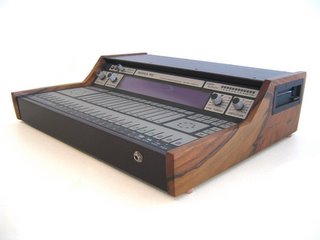
Snip from More on the Buchla 700:
"THE 700'S ARCHITECTURE includes four dedicated computers, each of a different nature, and each optimized to its particular function. The nerve center of the instrument is a general purpose digital computer. Responsible for user communication, data processing, and supervisory control, this "host" computer can be programmed to accommodate varied musical needs.
A second computer "massages" incoming data. It directs conversion of analog voltages into digital form, discards redundant information, and transmits essential data to the host computer.
Receiving instructions and data from the host, a third computer (called the multiple arbitrary function generator) directs the instantaneous progress of 190 acoustic variables, each with a time resolution of 1/2000 of a second. This facility enables specification of complex sonic detail and extends the possibilities for expressive control.
A fourth computer, essentially a pipelined digital signal processor (DSP), is responsible for producing the 700's twelve voices. Built into this computer are unusually powerful algorithms for sound generation, including frequency modulation, waveshape interpolation, and timbre modulation (unique to the Buchla, this technique significantly augments the electronic vocabulary."
Update: More on the Buchla 700

Snip from More on the Buchla 700:
"THE 700'S ARCHITECTURE includes four dedicated computers, each of a different nature, and each optimized to its particular function. The nerve center of the instrument is a general purpose digital computer. Responsible for user communication, data processing, and supervisory control, this "host" computer can be programmed to accommodate varied musical needs.
A second computer "massages" incoming data. It directs conversion of analog voltages into digital form, discards redundant information, and transmits essential data to the host computer.
Receiving instructions and data from the host, a third computer (called the multiple arbitrary function generator) directs the instantaneous progress of 190 acoustic variables, each with a time resolution of 1/2000 of a second. This facility enables specification of complex sonic detail and extends the possibilities for expressive control.
A fourth computer, essentially a pipelined digital signal processor (DSP), is responsible for producing the 700's twelve voices. Built into this computer are unusually powerful algorithms for sound generation, including frequency modulation, waveshape interpolation, and timbre modulation (unique to the Buchla, this technique significantly augments the electronic vocabulary."
HOME
© Matrixsynth - All posts are presented here for informative, historical and educative purposes as applicable within fair use.
MATRIXSYNTH is supported by affiliate links that use cookies to track clickthroughs and sales. See the privacy policy for details.
MATRIXSYNTH - EVERYTHING SYNTH
© Matrixsynth - All posts are presented here for informative, historical and educative purposes as applicable within fair use.
MATRIXSYNTH is supported by affiliate links that use cookies to track clickthroughs and sales. See the privacy policy for details.
MATRIXSYNTH - EVERYTHING SYNTH