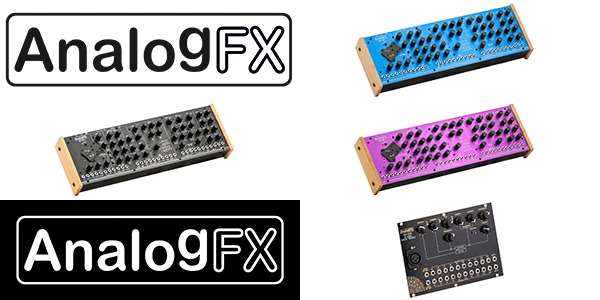
"The ProTone is a true analog synth from the mid-nineties for the modern MIDI studio. It is monophonic and features two analog oscillators, a beefy resonant filter, flexible LFO, MIDI and CV/Gate control, and a simple intuitive hands-on layout with every control parameter accessible from the front panel knobs and switches.
Each oscillator features saw and pulse waveforms with independent waveform selection, tuning and level. White Noise is also available from VCO1. The oscillators can be sync'd and Ring Modulation can also be dialed in. The filter section allows for either high or low pass filtering and 12 or 24 dB/oct slopes with the usual cutoff and resonance knobs. A fairly standard ADSR envelope can be applied to the voltage-controlled amp, but there's only a decay envelope (Accent) for the filter. The LFO is quite flexible, with six wave shapes plus random, noise or external input. The LFO can be set to modulate VCO1, VCO2, Pulse-Width on VCO1, filter cutoff and panning. A few remaining controls include a Panner, and Slide (portamento) effect.
The ProTone features MIDI I/O and traditional CV/Gate I/O for use with vintage gear. A little too much like vintage gear, however, the Pro Tone does not have on-board program memory. But with such a basic synth architecture and no hidden menus or parameters, the ProTone is a hands-on tweaker's synth - full of fat analog bass and synth sounds with a squelchy filter and competent LFO. Additional features include external VCO and LFO inputs, MIDI controlled volume and frequency cutoff, velocity sensitivity, and stereo outputs. The ProTone makes a cost effective, reliable and unique alternative to many other older vintage dual-VCO analog mono-synths."
""Ready to unleash more ferocious power with the Octave Cat? With the Retropolis for Octave Cat preset pack, you can tap into the true potential of this beastly synthesizer and discover a whole mew world of sound. Created by masterful sound designer James Dyson, Retropolis offers 100 new presets showcasing the Octave Cat's impressive duophonic mode, dual-step sequencer, additional clawsome analog leads, brass tones, modern polyphonic sounds, and more. Not only does Retropolis offer a glimpse into the past, but it also instantly provides unique modern sounds for the music producers of today. Don't wait to pounce on this treat - add Retropolis to your Octave Cat synthesizer and start making truly fierce music today!"
"Cherry Audio's Octave Cat is a virtual synthesizer instrument designed in collaboration with Carmine Bonanno, the original designer of the CAT synthesizer. The 1976 Octave Electronics CAT was an affordable alternative to expensive portable analog synthesizers of the day.
Adopt your Octave Cat today! https://cherryaudio.com/
Octave Cat retains all the growl of the original hardware's fat and savage duophonic sound and replicates the CAT's uniquely aggressive resonant four-pole 24 dB/oct filter. The Octave Cat feature set expands on the original with enhancements including 16-voice polyphony, sample and hold glide, and interchangeable skins.
A secondary panel view reveals dual eight-step classic-style sequencers and studio-quality effects featuring distortion, phaser, flanger/chorus, delay, and reverb. With support for MPE, over 300 expertly designed presets, and extensive MIDI mapping functions, Octave Cat will satisfy both vintage synth aficionados and professional modern music producers.
Octave Cat is provided in AU, VST, VST3, AAX, and standalone formats, and a free 30-day demo is available at https://cherryaudio.com/
macOS Requirements: macOS 10.13 or above. macOS 13 Ventura supported. 64-bit required. Native Apple M1 processor support, including Apple M1 Ultra. 3.4 GHz Quad-Core or M1 CPU with 8GB of RAM recommended.
Windows Requirements: Windows 7 or above (including Windows 11), 64-bit required. Quad-core computer with 8GB of RAM recommended.
Also available! Retropolis for Octave Cat Preset Pack (sold separately), featuring 100 new presets showcasing the Octave Cat's impressive duophonic mode, dual-step sequencer, additional clawsome analog leads, brass tones, modern polyphonic sounds, and more.
Octave Cat Features
- All aspects of the original CAT precisely modeled in exacting detail - Over 300 presets - Dual Panel Views with an authentic Main view for synthesis controls, and an additional FX/Seq panel with extended features - Monophonic, duophonic, and polyphonic (up to 16 voices) voice modes - Unison for mono and duo modes - Two distinct VCOs with discrete wave, modulation, S+H, and sub octave settings; VCO1 with saw, triangle, and pulse with PWM, and VCO2 with square and saw waveforms - Vintage-correct four-pole 24 db/oct filter, based on the original “cascaded OTA” SSM2040 filter with precise replication of The CAT’s unique resonance
Demo of the QUASIMIDI CARUSO digital synthesizer module from 1993 - The Most Impressive Soundscapes.
All sounds come from a single QM Caruso played live without additional effects and without any treatment - right from the stereo outputs. The general sound has something magical to it imho. All sounds are factory presets, which I chosed as "the best" of this instrument. Of course there are also a lot of accordion and organ sounds (the organs are not bad either, but not exactly my cup of tea). Some factory presets (mostly pads) are surprisingly good and they don't hide the fact that the Caruso has limited D/A converters, which makes the sound 'lo-fi' in general. It sounds quite nice - what do you think?
The Quasimidi Caruso is not very common outside Germany, very cheap nowadays, it's a good choice if you like lofi digital synth sounds from the early nineties!"
"I used Patrick Cowley’s Sequential Circuits Pro-One for a few of the sounds. It had remained unused since his death in 1982 until 2022 when Tone Tweakers refurbished it and added MTG Turbo CPU and MIDI (reversible mods). I also used the Roland Juno-60 I got from my friend Vince. The rest of the sounds I dialed up from scratch on basic Logic softsynths, except for the piano, which was a preset."
---
On the release:
"‘Don’t Say Goodbye’ is the fifth single from Jay Wires.
New York City based synthesist-songwriter Jay Wires dials up catchy electropop infused with human emotion - synthpop art with a human heart. With a long history of dealing vintage synths to serious recording artists, Jay Wires finally started releasing music of his own in August 2022 through Yes Trigger Music.
‘Don’t Say Goodbye’ is a true story about being ghosted by a narcissist during the isolation and loneliness of COVID lockdown, cleverly disguised as an upbeat synthpop ditty that some may find reminiscent of Yazoo or The Postal Service.
‘Don’t Say Goodbye’ was suddenly released on July 7, 2023 without any prior promotion.

 "The ProTone is a true analog synth from the mid-nineties for the modern MIDI studio. It is monophonic and features two analog oscillators, a beefy resonant filter, flexible LFO, MIDI and CV/Gate control, and a simple intuitive hands-on layout with every control parameter accessible from the front panel knobs and switches.