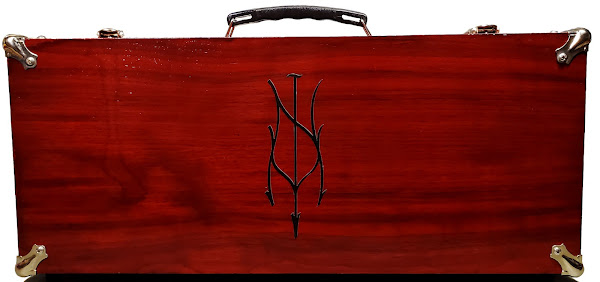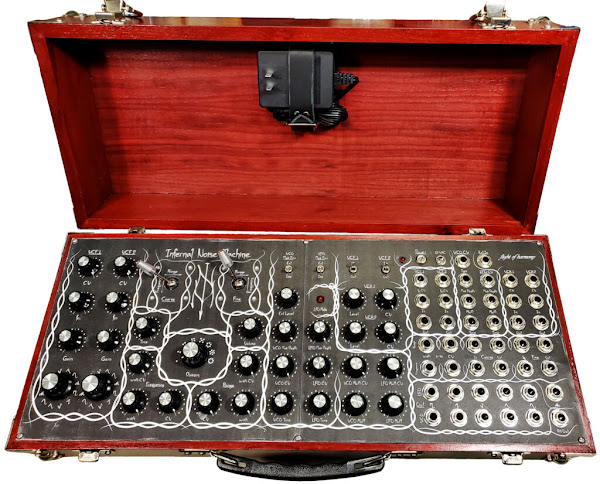
Blood Box road case: $2,740.00 -Material: Black Walnut (see note), stained, nickel-plated hardware. -Dimensions: 20″W x 10″H x 7″D (closed) -Weight: ~13lbs.
Minimal case: $2,490.00 (No hardware or stain, just four feet and a protective top coat.) -Material: Black Walnut (see note) -Dimensions: 20″W x 9″H x 4.5″D -Weight: ~10lbs.
*Note: Case sides are solid black walnut. Top & bottom are Black walnut plywood for dimensional stability (so the box won't split due to temperature or humidity fluctuation).
Both include a US AC adapter (12VAC 1500mA, 5.5mm x 2.1mm). For international orders, deduct $20 from the price and I will locate a compatible adapter in or near your country that you can order, if needed. Blood Box also includes the related tiedowns, anti-vibration pad, and leather strap.
"So, can the #RaspberryPI Zero 2 run a DAW and some #synthesizer and effect plugins? Here's a short improvisation running on Reaper with 7 plugins loaded: 2 x Dexed, 1x TAL Noizemaker, Drum synth and 3 x TAL Reverb III
I just let the camera run while improvising this. There's a bit of CPU stress near the end of this video, I guess Linux started swapping there, as the PI has only 512MB RAM."
"Utterly underrated classic - beautiful sound, wildly flexible, completely unique. Works great, and super capable with the Midipolis MidiPoly mod. Some wear on the cheeks, and the bag has definitely seen better days with rips in a couple corners and at one of the strap ends."
The Yamaha CS15D is part of the partially preset, partially variable monophonic analogue synth which was released by Yamaha in 1979. It has a very solid warm sound for a single VCO synth. The preset section is divided into two channels. Channel 1 has 15 sounds with the usual array of unrealistic instrument imitations and Channel 2 has 14 synth sounds plus a button to activate the 'manual' section of the synth. There is a slider to mix between the two channels and channel 2 can be detuned. The 'manual' section comprises 1 VCO with a variable control between pulse and saw waves. There are also controls for pulse width modulation, noise and footings (32' - 2'). The 12dB filter has cut-off and resonance plus a dedicated ADSR envelope with a control for envelope amount.
"Walkthough of a slow patch on the MakeNoise Collective and maybe a great soundtrack for a lazy sunday morning. For this patch I wanted to serialize my four Maths (and the 0-Coast) into a chain of events. The first half of the video is just about patching it up, hoping to inspire you to have fun with all your triggered LFO's, Envelopes and Function Generators. If they don't have 'end of whatever' triggers, you can use a gate sequencer and a weird clock (LFO, S&H) to push it forward in irregular patterns. I also wanted to share a bit of the fun of patching itself. Even without making any sound it can be a joy to just see the machine 'breathe' like a living organism. Then, sitting back, watching it move and thinking about which sounds to trigger."
"Testing the new Dual High Pass Filter rack FX built under license from E.M.S (Cornwall) by Digitana Electronics and Portabellabz. This filter was originally found in the E.M.S Synthi 100 synthesizer. The unit has the exact same form factor as classic E.M.S rack effects modules from the 1970s.
"This is a new 19” rack module built under license from EMS (Cornwall) by Digitana Electronics (UK/Italy) and PORTABELLABZ (Belgium). It is a 100% faithful reproduction of the Dual High Pass Filter (DHPF) section found on early versions of the legendary EMS Synthi 100 synthesiser. An original spare ‘Mk1’ DHPF PCB from a Synthi 100 was kindly loaned by Robin at EMS and then faithfully reconstructed using the same trace artwork/layouts, via modern PCB design software. The PCBs are very high quality with ENS gold plated card edge contacts and traces. The same components as found in the original circuit are used throughout.
The DHPF rack case was deliberately chosen to be the same design as those found in the classic EMS rack instruments from the 1970s such as the Random Voltage Generator, Pitch to Voltage Converter, Octave Filter Bank etc. These were created in CAD from original engineering drawings kindly made available by Robin at EMS. The 1U high chassis is formed from 3mm silver anodised front/rear panels which are connected by solid aluminium side blocks and then 2mm anodised aluminium top/bottom covers. This allows the rack to be safely mounted in standard 19” rack enclosures. The panel graphics use anodic digital printing technology which is far more resistant to wear than silk screened graphics. Original control knobs/coloured inserts/jack sockets made by Cliff Plastics are also used to meticulously maintain authentic EMS design.
An optional beautiful wood rack sleeve is available with the exact same design as found in vintage units. These are made from Afrormosia hardwood (now on the protected species list) just like the original. The wood is ethically sourced from existing historical stock.
Inside the DHPF, the only change compared to 1970s rack modules has been to use a modern (and safer) switch mode PSU. This also has the advantage of allowing a wider range of operating mains voltages (from 98v–220v AC).
The Synthi 100 was designed by David Cockerell and the high pass filter design itself is rather unusual compared to other high high pass filters found in synthesisers. It has CV control of frequency cutoff but also has a response control which can control feedback of the output, creating a resonant peak that at extremes pushes the filter into self-oscillation. The use of diode ‘strings’ in the CV control section of frequency is quite unusual and is reminiscent of the same principle he used in his (later) Synthi Hi-Fli design, although there the filters sections are used to phase shift the input signal.
The high pass filter is capable of easily removing the fundamental in any audio passed through and then the first harmonic as the cutoff frequency is increased. By increasing also the response, the higher frequencies are boosted in a mix and eventually the filter will self-oscillate.
The two filters in the module are identical and a central three-way toggle switch has positions series, off and parallel."
Essential DIY kits are available in the shop (you will need a midiphy SEQ v4+ or midiphy LoopA) to use the midiphy MatriX: https://www.midiphy.com/en/shop-detai...
Chapter Table: 00:03 Introducing the midiphy MatriX 00:50 Graphical Sequence Composition 01:44 Editing Notes and Joystick Composition 02:38 Clip Navigation and Grid Modes 03:34 High-Res Edits and Quantization 04:20 Isomorphic Keys: Pentatonic Intermezzo 04:51 Macro Screen (LoopA Comannd Center) 08:02 Force-To-Scale (and Note Color Labels) 09:01 Scale Mode 10:01 Isomorphic Keys Tip: Geometric Playing 10:48 Keys Mode Controllers 12:29 Outro: Six Track Jam
Thanks for watching! Best regards, Peter from midiphy.com"
"Download: https://drive.google.com/file/d/1C1uB... This is the Sequencer-Software i made with Flowstone for my Live-Performances. It should run on every Windows-PC and is written to
control Midi to CV-Devices like the Polyend Poly. It can Handle two different
Devices with 8 Midi-Channels. Maybe you can use it for your own Performances. It is completely free so i dont can give a guarantee for
everything. If you have the Flowstone-Software you can edit the source-
code-file called FL-Sourcecode in the Zip and change the Sequencer as
you like!
This Sequencer works extremly stable in performance and Timing
I normally work with analog sequencers but a Sequencer with the complete
Functions like this Software-Sequencer would take up more space in my room than i have"
"An assortment of 7 short improvised clips with the Soma Pulsar-23, all very techno, all with different configurations of gear. There's lot's to be said about the Pulsar-23, it is one of the most expressive machines I've come across in recent times. There is always something new to explore each time I turn it on. As an improvisational tool, this is amazing. Okay I'll stop gushing, you get my point. Vlad Kreimer is a genius and I put him in the same company as Don Buchla, Bob Moog, Roger Linn, Dave Smith and Tom Oberheim.
Each clip is recorded in a single take, with no editing or post production. I used a variety of clock sources and sequencers as indicated below. Some sections get rather crunchy and distorted, sorry! Pulsar23 runs into a Playdifferently Model1 mixer, that runs through an Elektron Analog Heat as the master bus.
00:00 Clip1 - Using internal clock source and looper-recorders, exploring kick and modulating effects.
02:10 Clip2 - Quadrantid Swarm audio running through the Pulsar23 and also modulated by the Pulsar. Beat Step Pro is the main sequencer.
03:52 Clip3 - Funky Techno with Beat Step Pro sequencing the Pulsar via MIDI.
06:21 Clip4 - Harder Techno jam with Beat Step Pro sequencing the Pulsar via MIDI.
07:08 Clip5 - TB-303 running through the Pulsar effects and filters.
10:04 Clip6 - Integrating with a Eurorack rack, using a combination of clock sources and Pulsar's looper-recorders. Crunchy and noisey!
10:56 Clip7 - Straight up Techno jam!
Gear featured in these clips:
Soma Pulsar-23
Arturia Beat Step Pro
Roland TB-303
EO Wave Quadrantid Swarm
Eurorack modular
Playdifferently Model1 DJ mixer
Elektron Analog Heat MkI
Follow me here:
http://www.instagram.com/_honeysmack_"