Tuesday, August 22, 2006
Moog Tribute by Simon James aka Corky Burger on CDM
Title link takes you to the post and mp3 on CDM.
Track list:
Walter Carlos, Spring, Columbia Records
Richard Hayman, The Windmills of Your Mind, Command records
Walter Carlos, Sinfonia to Cantata no 29, CBS
Tomita, The Earth – A Hollow Vessel, RCA
Gershon Kingsley, Did You Ever Take a Journey, Audio Fideltiy Records
Chris Swanson, Snow, n/a
Dick Hyman, The Minotaur, Command
Circulus, My Body is Made of Sunlight, Rise Above Records
C&K Vocal, Generace, Supraphon
Emerson Lake and Palmer, Lucky Man, Island
The Moog Machine, Aquarius/Let the Sunshine in, CBS
Marty Gold, Day Tripper, AVCO Embassy
Hugo Montenegro, You Got it Bad Girl, BMG
Clara Rockmore, Swan, n/a
Walter Carlos, Winter, Columbia Records
Dick Hyman, The Moog and Me, Command records
Devo, Mongoloid, Warner
Herbie Hancock, Earth Beat, CBS
Klaus Schulze, Mind Phaser, Bomb Records

Weltklang Electronic Music
 Title link takes you there. Scroll down the left column when you get there for more shots. Nice PPG in this shot.
via sequencer.de
The $500 Buchla
Title link takes you to a bit of Buchla history.
Excerpt:
"In contrast to Moog's industrial stance, the rather counter-cultural design philosophy of DONALD BUCHLA and his voltage-controlled synthesizers can partially be attributed to the geographic locale and cultural circumstances of their genesis. In 1961 San Francisco was beginning to emerge as a major cultural center with several vanguard composers organizing concerts and other performance events. MORTON SUBOTNICK was starting his career in electronic music experimentation, as were PAULINE OLIVEROS, RAMON SENDER and TERRY RILEY. A primitive studio had been started at the San Francisco Conservatory of Music by Sender where he and Oliveros had begun a series of experimental music concerts. In 1962 this equipment and other resources from electronic surplus sources were pooled together by Sender and Subotnick to form the San Francisco Tape Music Center which was later moved to Mills College in 1966.
Because of the severe limitations of the equipment, Subotnick and Sender sought out the help of a competent engineer in 1962 to realize a design they had concocted for an optically based sound generating instrument. After a few failures at hiring an engineer they met DONALD BUCHLA who realized their design but subsequently convinced them that this was the wrong approach for solving their equipment needs. Their subsequent discussions resulted in the concept of a modular system. Subotnick describes their idea in the following terms:
'Our idea was to build the black box that would be a palette for composers in their homes. It would be their studio. The idea was to design it so that it was like an analog computer. It was not a musical instrument but it was modular...It was a collection of modules of voltage-controlled envelope generators and it had sequencers in it right off the bat...It was a collection of modules that you would put together. There were no two systems the same until CBS bought it...Our goal was that it should be under $400 for the entire instrument and we came every close. That's why the original instrument I fundraised for was under $500.'
Buchla's design approach differed markedly from Moog. Right from the start Buchla rejected the idea of a "synthesizer" and has resisted the word ever since. He never wanted to "synthesize" familiar sounds but rather emphasized new timbral possibilities. He stressed the complexity that could arise out of randomness and was intrigued with the design of new control devices other than the standard keyboard. pp39-40"
Anyone else thinking Starkey? Coincidentally the recent Starkey went for $541 on the bay. Yeah, I know I'm stretching it...
via Peter Grenader on AH.
Excerpt:
"In contrast to Moog's industrial stance, the rather counter-cultural design philosophy of DONALD BUCHLA and his voltage-controlled synthesizers can partially be attributed to the geographic locale and cultural circumstances of their genesis. In 1961 San Francisco was beginning to emerge as a major cultural center with several vanguard composers organizing concerts and other performance events. MORTON SUBOTNICK was starting his career in electronic music experimentation, as were PAULINE OLIVEROS, RAMON SENDER and TERRY RILEY. A primitive studio had been started at the San Francisco Conservatory of Music by Sender where he and Oliveros had begun a series of experimental music concerts. In 1962 this equipment and other resources from electronic surplus sources were pooled together by Sender and Subotnick to form the San Francisco Tape Music Center which was later moved to Mills College in 1966.
Because of the severe limitations of the equipment, Subotnick and Sender sought out the help of a competent engineer in 1962 to realize a design they had concocted for an optically based sound generating instrument. After a few failures at hiring an engineer they met DONALD BUCHLA who realized their design but subsequently convinced them that this was the wrong approach for solving their equipment needs. Their subsequent discussions resulted in the concept of a modular system. Subotnick describes their idea in the following terms:
'Our idea was to build the black box that would be a palette for composers in their homes. It would be their studio. The idea was to design it so that it was like an analog computer. It was not a musical instrument but it was modular...It was a collection of modules of voltage-controlled envelope generators and it had sequencers in it right off the bat...It was a collection of modules that you would put together. There were no two systems the same until CBS bought it...Our goal was that it should be under $400 for the entire instrument and we came every close. That's why the original instrument I fundraised for was under $500.'
Buchla's design approach differed markedly from Moog. Right from the start Buchla rejected the idea of a "synthesizer" and has resisted the word ever since. He never wanted to "synthesize" familiar sounds but rather emphasized new timbral possibilities. He stressed the complexity that could arise out of randomness and was intrigued with the design of new control devices other than the standard keyboard. pp39-40"
Anyone else thinking Starkey? Coincidentally the recent Starkey went for $541 on the bay. Yeah, I know I'm stretching it...
via Peter Grenader on AH.
See dealers on the right for pricing and availability on gear.
LABELS/MORE: Analogue Systems, Buchla, events, MOOG
LABELS/MORE: Analogue Systems, Buchla, events, MOOG
Xpantastic ! - New Oberheim XPander Group
 It's XPantastic! Like the name? : ) Title link takes you to the new Yahoo! Group. If you have an XPander or Matrix-12 or are interested in them, feel free to join. I have no affiliation with the list. I just know the old Xpansions list seems to have dissapeared and somone created this one. BTW, if you know what happened to the Xpansions list, please comment. I think I'm subbed to it, but I'm no longer sure. : ) I haven't received an email in probably over a year, so... Not sure if I unsubbed and forgot or if it just died.
Sequential Circuits Studio 440
 Title link takes you to shots pulled from this auction.
Rare sampling drum machine with analog filters by Sequential Circuits. More on VSE.
via Matt
Secret of the Ancient Sampler on YouTube
Part 1 (audio comes it at 1:21)
Part 2
The Mellotron of course. Amazing to see how it actually plays in the first clip.
Via Tim. YouTube by btpro.
Part 2
The Mellotron of course. Amazing to see how it actually plays in the first clip.
Via Tim. YouTube by btpro.
Laser Harp on YouTube
via Tim. YouTube by Shayu.
The Polyphone & Hugh Le Caine
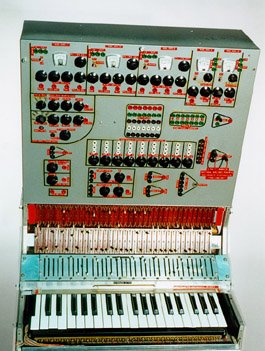 "The Polyphone (860004), an analogue polyphonic synthesizer, was built by Le Caine's National Research Council (NRC) lab in 1970, at the same time that the last two Sackbuts were being completed, and ten years before polyphonic synthesizers became commercially successful. Each key of its touch-sensitive keyboard had its own pitch control and wave form control. Essentially it was a bank of 37 key-operated oscillators, able to produce 37 separately defined tones.
Above the keyboard were several control devices that were typical of synthesizers at the time: low frequency oscillators, envelope generators, and filters, all of which could influence aspects of the overall sound produced by the instrument. Below the instrument was a pressure-sensitive pedal keyboard that controlled other aspects of the overall sound. The instrument provided extremely comprehensive resources and was potentially a very powerful tool; however, it was difficult to learn to play, a problem it shared with most synthesizers."
Title link takes you The Polyphone page on the Canada Science and Technology Museum website. Make sure to check out some of the other interesting bits while there.
 For more on Hugh Le Caine check out Hugh Le Caine.com. The following was pulled from the biography:
"Canadian scientist and composer Hugh Le Caine (1914-1977) has been called one of the "heroes" of electronic music. He was brought up in Port Arthur (now Thunder Bay) in northwestern Ontario. At an early age he began building musical instruments and experimenting with electronic devices. In his youth he imagined "beautiful sounds" that he believed could be realized through new electronic inventions."
"At home he continued to pursue his interest in electronic music and sound generation. He established a personal studio in 1945, where he began to work independently on the design of electronic musical instruments such as the Electronic Sackbut, a sophisticated monophonic performance instrument now recognized as the first voltage-controlled synthesizer. Le Caine later developed voltage-control systems for a wide variety of applications."
"Perhaps the most important aspect of Le Caine's designs for his instruments was the "playability" that he took care to build into them. His fixation with "beautiful sound" led him repeatedly to design electronic instruments capable of producing a nuance-filled expression typical of the orchestral tradition. He had an acute sense of what performers needed if they were to be able to create the performance gestures that he believed formed the essence of music.
Touch sensitivity was an essential ingredient in this, and was used in keyboards, mixers, and other components, applied mechanically, electronically, and through light sensitivity. Le Caine's designs were so advanced in this respect that some of the features that he developed found their way into commercial designs only in the late 1980s."
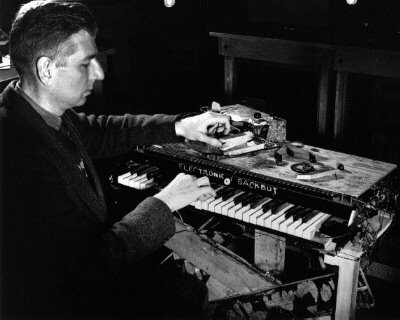 Image of Le Caine with the Sackbut.
via Frederic.
Update via slabman in the comments: "He did some pretty amazing stuff with the technology of the day - some of it still unmatched. For example, the Sackbut has a touch sensitive 2D timbral mixer control that balances various overtones & waveforms. Made the sound very controllable & dynamic, but also made the instrument more difficult to master. It's interesting to think of how there's a kind of Bell curve of synthesizer technology: one one end you have the laboratory instrument type approach (Buchla, Serge); at the other end, you have people inventing new instruments like the Sackbut & Theremin. Commercial gear mostly occupies the bump in the middle of the curve. It would be great to see some more activity at that 'new instrument' end."
See dealers on the right for pricing and availability on gear.
LABELS/MORE: Buchla, Sackbut, Serge, synth museums, theremin
LABELS/MORE: Buchla, Sackbut, Serge, synth museums, theremin
The MAESTRO - Russian Poly Analog
 Title link takes you to shots pulled from this auction.
Polyphony - 4 voices
Oscillators - 1
Preset sounds - 20 (sorted on category), registers 2',4',8',16'
Filter - 2-pole resonant lowpass 12dB/oct
Pitch - tuning, chorus
Modulation - vibrato depth, frequency
Amplifier - release, volume
Arpeggiator/tremolo - rate, up/down, single/double, note memory
Control - joystick pitch/modulation depth (X-Y)
Outs - line, phones(jack)
Weight - about 12kg
more on ruskeys
via frederic
Blevin Blectum
 Brian Comnes sent the following in after seeing this post on Women Take Back The Noise. The shots are of Blevin Blectum who is featured on the album.
 "Blevin Blectum, a local here is on it and here is a shot of her at last Year's SFEMF , there's a laptop running Live in 1 pizza box and I think a mixer in the other, the horse head is off the chart" Love the shoes as well.
Title link takes you to her site.

"I got this off of Blevin's site which also included a link to SFEMF archives with also some Zeena Parkins pictures -
see this link for more, actually there are some good shots of Zeena's harp , looks like guitar pickups on one side and some sort of ribbon controller on the other ..I don't see any MIDI output so I guess its just a harp"
"an as yet unreleased goody!" from Moog?
Someone in the comments of this post was surpised that no one caught a mention to "an unreleased goody!" from Moog Music in the following excerpt:
"Some time in November or December of 2004, Bob was introduced to Cyril Lance. As Winter NAMM was fast approaching, Bob kept telling me, 'I really want you to meet Cyril.' I just could not find the time until February, 2005. In the meantime, Bob had given Cyril a test project to work on (an as yet unreleased goody!). Needless to say Bob was very excited about what he saw – schematics, prototype, and (most importantly) thought process were all eerily similar to Bob’s way of working. Since then we have been truly blessed to have Cyril with us. He has poured his guts and all of his considerable brains into the Little Phatty; a project that would not have been possible without his efforts."
I completely missed this assuming that the reference was to the Little Phatty and the unreleased goody comment was a reflection of that point in time, but if that were the case it would have been worded differently [an unreleased goody at that point in time!]. Hmm... BTW, cheers to Cyril. Keep that torch burning.
"Some time in November or December of 2004, Bob was introduced to Cyril Lance. As Winter NAMM was fast approaching, Bob kept telling me, 'I really want you to meet Cyril.' I just could not find the time until February, 2005. In the meantime, Bob had given Cyril a test project to work on (an as yet unreleased goody!). Needless to say Bob was very excited about what he saw – schematics, prototype, and (most importantly) thought process were all eerily similar to Bob’s way of working. Since then we have been truly blessed to have Cyril with us. He has poured his guts and all of his considerable brains into the Little Phatty; a project that would not have been possible without his efforts."
I completely missed this assuming that the reference was to the Little Phatty and the unreleased goody comment was a reflection of that point in time, but if that were the case it would have been worded differently [an unreleased goody at that point in time!]. Hmm... BTW, cheers to Cyril. Keep that torch burning.
rekem1000 - Greatings from Australia
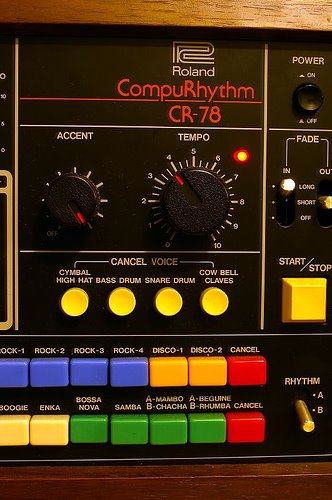 rekem1000 sent me a greetings from Australia along with a link to his flickr set. Title link takes you there. There are some amazing shots in this set so do check it out. Thanks rekem1000! Man I love the color in this shot.
Banana Frac Modular Progress - New Flickr Shot
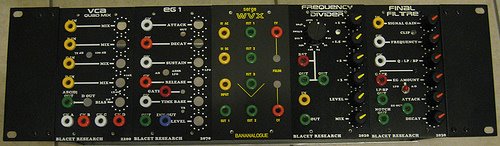 flickr by zonkout.
"Blacet modules assembled by Seth Nemec for my Banana-Franken-Fracan modular. Note the bananafied Bananalogue in the middle."
Love the look of this.
Starkey Hearing Science Laboratory - New Flickr Shot
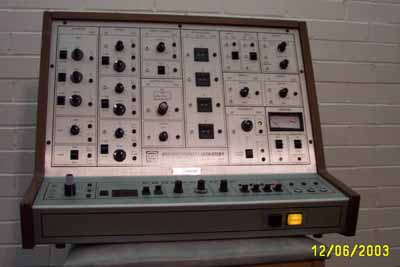 flickr by zonkout.
"Four oscillators, three multimode filters, two A/R envelope generators, digital gate sequencer, noise generator, phase shifter, external audio input...but no CV control. Uses mini-banana jacks. Built in 1977."
Trip. Never seen one of these before.
Update via the comments: "Tres cool. This thing originally came with a set of speakers (follow the link and chech top left on the record cover). Although it isnt a real synt (it has no cv input) you can use it as a really cool gate/trig-processor and a trig sequencer. You can also make some strange noices 'manually' on it. Check this link."
Update via gerald in the comments: link to more shots pulled from this auction. Looks like it went for $541.
Engineering Lounge - New Flickr Shot
 flick by Space Truckers. Title link takes you to the shot with mouse over info on each piece.
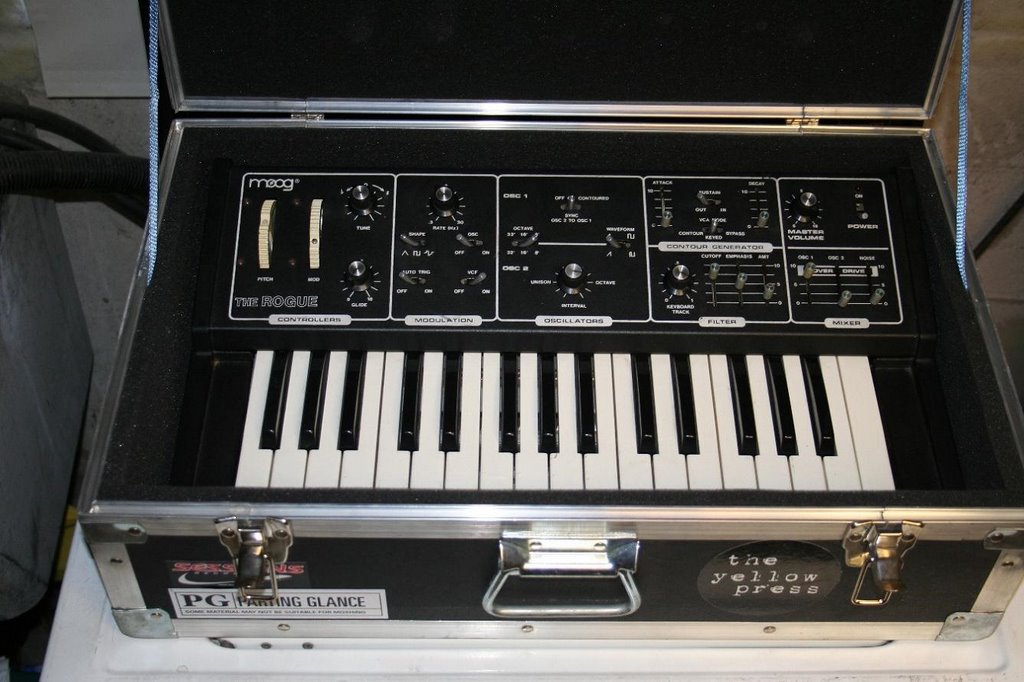
Women Take Back The Noise
 "The WOMEN TAKE BACK THE NOISE compilation, 3 years in the making, showcases a collection of 47 women artists worldwide who experiment with sound in various ways, ranging from ambient-organic to quirky-glitch-beat to harsh or extreme noise, as well as categories yet to be defined..."
Title link takes you there. Pretty cool.
Monday, August 21, 2006
The Bob Moog Memorial Museum
 Via The Bob Moog Foundation:
"We envision the Bob Moog Memorial Museum as both an information resource and a place to connect with Bob's spirit. The Museum will house Bob's personal and professional archives, which include: writings, photos, instruments, schematic drawings, articles written by and about him, an extensive collection of electronic music, and other Moog artifacts. The goal is to make this an educational, interactive museum open to students, researchers and music historians, and for all people interested in engaging with the Moog legacy. We are also considering an exhibit at the Rock & Roll Hall of Fame."
And via Ileana Grams-Moog on Caring Bridge:
"To preserve his home and workshop in Big Briar Cove, near Asheville, as a museum and archive of his life and work, as well as a nature preserve. It would be a place to connect with him as a craftsman (he partly designed the house, laid the floors, plumbed and wired it, arranged the spring-fed water system, and cut the wood to heat it), as a historian of electronic music (he left a remarkable collection of slides and records of electronic music), as a designer of musical instruments ( through an extensive archive of material about him, and in the building where he hand-built theremins for many years), and as a nature lover (the house is surrounded by old second-growth forest full of animals, birds, and plants native to Western North Carolina). This project is particularly dear to my heart. He loved Big Briar Cove, and it would be a place for his fans to connect with him on many levels."
Shot of Bob Moog's house via this post.
I can't wait to take my daughter there. She and I will finally get to see where all the magic came from.
See dealers on the right for pricing and availability on gear.
LABELS/MORE: Big Briar, BMF, MOOG, Native Instruments, synth museums
LABELS/MORE: Big Briar, BMF, MOOG, Native Instruments, synth museums
Moment of Moog: A Time for Reflection
 Such a great shot. Wish I was there.
 More from Moog Music:
"August 21st, 2006 is a difficult date for lovers of the synthesizer. It was one year ago on August 21st that Bob Moog, inventor of the synthesizer, passed away. This year, Moog Music is rallying the media world to honor the memory of Bob Moog with a special, 20-second “Moment of Moog.” During the Moog moment, Moog requests that radio stations and the online media play a short musical piece, recorded on one of Moog’s most famous inventions, the Minimoog® Voyager®. In doing this, the world of music will be paying tribute to one of the greatest legends in electronic musical instruments.
Radio Stations, Bloggers and Online Media Outlets, please download the Moment of Moog here. Join us by sharing this with your listening audience on August 21, 2006.
“Sometimes it feels as if he is still here; other times, he is sorely missed. One year ago his fate was sealed and the finality of his death certainly gave all of us pause. The ‘Moment of Moog’ is our way of honoring the tens of thousands of musicians who carry Bob’s legacy forward,” reflected Mike Adams, President, Moog Music.
Another organization is also set to honor and continue the Bob Moog legacy. The Bob Moog Foundation for Electronic Music will launch its Web presence on August 21st, 2006. The foundation will be online at www.bobmoogfoundation.org. The objectives of the Foundation are to create: endowed scholarships at University of North Carolina-Asheville, Berklee School of Music and Cornell University; a Memorial Museum in Moog’s name; an outreach/mentoring program that brings electronic music into disadvantaged schools; and to sponsor electronic music competitions and concerts that would foster innovation in the field.
Ken Soper, composer of the 'Moment of Moog' piece, said, 'These sounds remind me that Bob, like the Minimoog Voyager, is alive.'"
Indeed.
See dealers on the right for pricing and availability on gear.
LABELS/MORE: Audio, BMF, MOOG, synth museums
LABELS/MORE: Audio, BMF, MOOG, synth museums
Moog One Year Later by Mike Adams of Moog Music
 "As the anniversary of Bob’s death approaches, it is important to me to reflect back on the events surrounding his death. The truth is that it has been almost 16 months since Bob was at work. Sometimes it feels as if he is still here; other times, he is sorely missed. One year ago his fate was sealed and the finality of his death certainly gave all of us pause. In my reflection, I found some things that I would like to share with all of you."
"Bob died August 21st, his Memorial Celebration was held August 23rd and we [Moog Music] moved the next day; a day that can only be described as surreal. So not only was Bob gone but the place where we had all seen him work for ten straight years was devoid of all of Bob’s considerable artifacts (see the attached picture which I took one day when it was fairly clean!)."
Title link takes you to the full post by Mike Adams of Moog Music.
Vangelis & CS80 on YouTube
video upload by analoghell
I remember seeing this a while back elsewhere, but I lost the link. Looks like analoghell put it up on YouTube. That's THE CS80 sound. Wow.
Update via reed in the comments of this other post: "The only string sounds Vangelis used the CS80 for were solo-string type sounds. He mainly used the instrument for that brassy lead, low drones, the guitar patch & the bass patch. He always did strings with a string machine. Those big impressive string & choir swells in Blade Runner are nothing more than a Roland VP-330 & a volume pedal with the occasional CS80 note on top or bottom. The VP-330 was also the secret weapon in Chariots of Fire, Missing, Antartica and The Bounty. Before that he used the Roland Paraphonic 505, and before that it was Farfisa & Elka boxes. The choir sound in "Heaven & Hell" was a real choir.
The real key to the CS80 is the keyboard with poly aftertouch & the performance controls on the lower right, not the main patch."
synthSeduction
 Title link takes you to a video sent my way via Todd. Wow.
"the Voyager is providing the audio. It is one of 110 one-minute piece I did a year and a half ago: Moog Mars Musings (a new piece every day in response to the daily photos coming from Mars on the NASA site.)."
Virtuoso - The World's First Self-Playing Violin on YouTube
This Violin playes itself via MIDI. About as analog as you get. Title link takes you to the post on Analog Industries with a link to the product page.
Midievil - Greetings From Mexico
 midievil sent me a greetings from Mexico along with the following shot. Not a bad setup. Check out he P3 Sequencer on top. Title link takes you to his Flickr set with more shots. Thanks midievil!
Michelle Moog-Koussa and The Bob Moog Foundation
"On August 21, 2005 my father died. He was a great and gentle man who left
his mark on the world forever. During the past year my family and I have
discussed many ways in which we could carry on his work and his legacy.
We have decided to establish the Bob Moog Memorial Foundation for
Electronic Music, with a few carefully chosen objectives, each tied to his
life and work.
The Foundation has set forth the following as its initial objectives:
Endowed Scholarships
The Bob Moog Memorial Museum
Outreach Programs for Disadvantaged Students
Special Events for Electronic Music
Today, we invite you to join us. Please visit our new website
Sincerely,
Michelle Moog-Koussa
Director, The Bob Moog Foundation"
via Mark Pulver on AH.
"Love Ya' Bob..."
his mark on the world forever. During the past year my family and I have
discussed many ways in which we could carry on his work and his legacy.
We have decided to establish the Bob Moog Memorial Foundation for
Electronic Music, with a few carefully chosen objectives, each tied to his
life and work.
The Foundation has set forth the following as its initial objectives:
Endowed Scholarships
The Bob Moog Memorial Museum
Outreach Programs for Disadvantaged Students
Special Events for Electronic Music
Today, we invite you to join us. Please visit our new website
Sincerely,
Michelle Moog-Koussa
Director, The Bob Moog Foundation"
via Mark Pulver on AH.
"Love Ya' Bob..."
See dealers on the right for pricing and availability on gear.
LABELS/MORE: BMF, MOOG, synth museums
LABELS/MORE: BMF, MOOG, synth museums
A Moment for Bob Moog
 Today marks one year since Bob Moog's passing. Title link takes you to Caring Bridge. The site has been updated with a note in the Journal from Ileana Grams-Moog.
 "This is Ileana Grams-Moog. Tomorrow is the anniversary of Bob's death, and I know that many of you will be logging on to this site. I have not had the energy or the will to write entries till now, but I have been thinking of all of you who loved and felt connected to Bob, and I wanted to tell you a bit about how it's been." Click through for the full entry, and don't forget to play a little something for him today.
Here is a link to the Moment of Moog MP3. More on the background of the mp3 here.
Doepfer A-188-1 BBD Module and Samples
 Via Doepfer: "Module A-188-1 is a so-called Bucket Brigade Device module (abbr. BBD). BBDs have been used to delay audio signals before digital delays dethroned the BBD based effect units. But BBDs have some very unique advantages (or disadvantages dependent on the point of view) over the digital counterpart which result from the special properties of the BBDs. BBD circuits can be treated as a chain of Sample&Hold units (S&H) which pass on their voltages to the next S&H in the chain at each clock pulse. A more detailed explanation – including the different types of BBDs – can be found in following chapter.
 In any case the sounds generated by module A-188-1 are very special. Typical applications are: Flanger, Chorus, Analog Delay or Karplus/Strong synthesis. But as the A-188-1 has a lot of very unique features (voltage controlled clock rate / delay time with extreme range, polarity switches for the CV inputs, feedback and BBD out/mix, clock and CV output of the high speed VCO, BBD clock input, feedback insert, feedback up to self-oscillation) a lot of unusual applications can be realized with the module (e.g. delay controlled by ADSR, envelope, random or sequencer with positive or negative effect). The A-188-1 also has no built-in anti-alisaing filter in order not to limit the possibilities of the module. For this the CV out is intended."
Peter Grenader of Plan B/EAR and Buzzclick Music posted the following three samples on Ah in response to requests for examples of the A-188-1 BBD Module. I asked him what else was used and if I could post the samples here. He not only gave me the thumbs up but he took the time out to type up the details below. Very cool. Enjoy.
tests_mix8.mp3
testsmix9.mp3
s2.mp3
"Audio:
This patch is a single sine going through three parallel processes: Two Miniwaves and the Doep Wave Multiplier. It's then into the Model 13 ('both' setting). The EG opening the gate is also giving the freq of the sine a strong goose (freg CV) and it's very short - an A/R at zero everything. Model 13's make short EG very useful for percussive events. The output of the M13 goes into a mixer as well as a Doep. A188 Delay (1024) which goes into the same mixer. This adds to the ringing.
Control:
The control path is all about Milton. Bank one sets up the first four degrees of a major scale . Bank two adds an accellerado to the LFO driving Milton, bank three gives a little increase in amplitude (a button) to the last note in the four position sequence.
There are various Model14's combining signals which give some dynamic presence from the keyboard aftertouch and velocity outputs and set up the equal tempered frequency offset to the sine VCO..
A midi keyboard is used to start the sequencer and the it's own stage four gate out is used to stop it. This is the benefit of having separate start/stop controls, each with external trigger inputs - you can start the sequence with one signal and stop it with another. The EG opening the Model 13 ad giving the thwap to the VCO frequency is triggered by the Milton's Obedient Clock outputs. No pulse is passed unless the sequencer is running, so stopping it at stage four allows only four events to pass and they stop in time with the sequencer halt.
The same signal which starts the sequencer (midi keyboard trigger) is also used to reset it back to stage 1. So each depression of the keyboard yields a four-note phrase. But...it's retriggerable. If you fire another midi note before Milton reaches stage 4, it'll start over again at stage one. The gesturing is created by 'dancing' on the keyboard in that fashion - allowing the sequencer bounce as much as you wish. Sometimes allowing the entire phrase to complete, sometimes resetting before it does. Once you adapt to to the feel of the sequencer's speed, you can create this gesturing quite easily."
FAEMI Russian Poly Analog
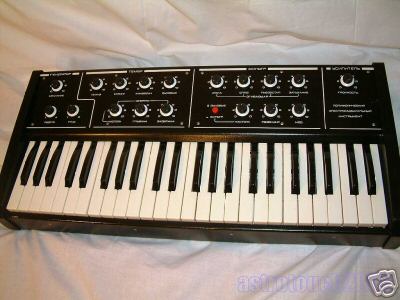
Found this looking for more info on the FAEMI after my last post. Click here for shots pulled from this auction. For more on the FAEMI, including samples (links below), check out Ruskeys.
samples1
samples2
samples3
Some info pulled from the auction:
"It was manufactured in 1982 by 'FORMANTA', a soviet military radio plant (Kachkanarsky radiofactory) at kachkanar, near sverdlovsk. The same one wich manufactured now legendary POLYVOX synths. This is a moog-type synth with an own character (a bit like polymoog/memorymoog). The sound is rich and soft – 100% pure analog!
The FAEMI - 1M has a keyboard of 4 octaves a main generator, infralow frequency generator, lowpass filter and amplifier. The control panel is divided into 5 sections: generator, timbre, vibrato, filter, amplifier. It has one normal VCO and one LFO.
All sections have the usual knobs but the TIMBRE section is what makes it so special. There you have knobs called PIANO, STRINGS, HARPSICORD, BRASS. Using this nkobs you can shape the sound in the unique way.
It is built like a rock, pure military technology, contacts will last forewer. The body is solid and the knobs feel nice. It runs on 220V AC (US customers will need an adaptor). The synth is in excelent looking and musical condition, has been fine-tuned to specs, all parts checked less than 3 months ago. Since then it has never left my smoke free studio.
It has 5-DIN output connections (adapter to 1/4 jack included)."


Sunday, August 20, 2006
Selfoscillate.de

Check out this monster modular consisting of Doepfer, Analog Systems, Analog Solutions, Blacet, Wiard, Voxglitch, Metalbox, Banalogue, Plan B, Livewire, Encore Electronics, Cyndustries and DIY modules. Via selfoscillate.de, where you'll find the full module list, samples, and more.
ARP Art
 ARP 2500 via PS Project.
Gorgeous.
My new wallpaper.
No title link, just this shot - click it for a bigger image.
PREVIOUS PAGE
NEXT PAGE
HOME
© Matrixsynth - All posts are presented here for informative, historical and educative purposes as applicable within fair use.
MATRIXSYNTH is supported by affiliate links that use cookies to track clickthroughs and sales. See the privacy policy for details.
MATRIXSYNTH - EVERYTHING SYNTH
© Matrixsynth - All posts are presented here for informative, historical and educative purposes as applicable within fair use.
MATRIXSYNTH is supported by affiliate links that use cookies to track clickthroughs and sales. See the privacy policy for details.
MATRIXSYNTH - EVERYTHING SYNTH