Showing posts sorted by date for query Percussion Interface. Sort by relevance Show all posts
Showing posts sorted by date for query Percussion Interface. Sort by relevance Show all posts
Tuesday, September 08, 2026
Shakmat Lancer's Lash : Demo
video upload by Shakmat
"The Lancer’s Lash is a dedicated snare drum synthesizer built to cover everything from tight classic hits to completely off-the-map percussion. Compact and focused, it explores several approaches to snare synthesis, giving you a wide palette of strikes, from clean and punchy to fractured and experimental.
Multiple models sit at the core of the module, ranging from analog-style synthesis to physical modeling, granular textures, and FM percussion. Each engine brings its own character, letting you dial anything from familiar drum machine snaps to strange metallic bursts and evolving hybrid snares.
To keep patterns alive, Lancer’s Lash includes an onboard randomizer for subtle variations or more adventurous rhythmic outcomes. Velocity sensitivity adds expressive dynamics, while 256 preset slots keep your favorite strikes ready to fire again via CV or Select Bus.
CHAPTERS
---------------------------------------------------
00:00 Sound Excerpts
01:35 User Interface
03:13 Main Menu
04:44 Models
10:31 Classic Engine
16:39 Randomizer
19:24 Velocity
21:54 Memory
25:21 Global Options"

Monday, September 07, 2026
MemoryTone by XILS-Lab
video upload by xilslab
"MemoryTone by XILS-lab unleashes a colossal three-oscillator-per-voice analog architecture—with 16-voice polyphony and up to 18 oscillators in unison—then propels it beyond its 1982 inspiration with expanded modulation, MPE, advanced arpeggiation, integrated effects, and modern sound-design capabilities."

via XILS-Lab
MEMORYTONE: THEY CALLED IT MAGIC.
MemoryTone is XILS-lab’s exploration of one of analogue synthesis’s most ambitious instruments — a sixteen-voice polyphonic architecture built around three oscillators per voice and a 24 dB/octave self-oscillating ladder filter.
With eighteen oscillators across sixteen voices, combinable waveforms, oscillator sync, pulse-width control and a deeply interactive signal path, its character begins long before effects enter the picture. Oscillators interact. Levels influence behaviour. Voices move. The filter responds to everything that came before it.
See dealers on the right for pricing and availability on gear.
LABELS/MORE: MOOG, New Soft Synths, News, Soft Synths, Updates, XILS-lab
LABELS/MORE: MOOG, New Soft Synths, News, Soft Synths, Updates, XILS-lab
Monday, July 27, 2026
Tape Fiasco 2 just got a lot more powerful
video upload by Jonas Eriksson
"Five new effects, deeper modulation, external sidechain control, clocked Stretch parameters, multiple themes, and more.
---
Over the last several updates, Tape Fiasco has grown into an even deeper sound-design effect with more ways to shape, animate, destroy, and rhythmically transform your audio.
Since v660, it has gained five completely new effects, deeper modulation, external sidechain control, clocked Stretch parameters, multiple themes, more distortion controls, better readability, improved Squash effect, better readability, and a much easier way to stay up to date.
Meet five entirely new effects
See dealers on the right for pricing and availability on gear.
LABELS/MORE: Jonas Eriksson, News, Soft Synths, Synth Effects
LABELS/MORE: Jonas Eriksson, News, Soft Synths, Synth Effects
Wednesday, June 24, 2026
Wildwood Lightning by Wildwood Soundworks
video uploads by Wildwood Soundworks

"Wildwood Lightning is a handmade digital sampler, sequencer and synthesizer designed and produced by Wildwood Soundworks in Penn Valley, California. It provides the following features:
Sampler - record your own samples or use standard WAVE files.
Sequencer - compose on up to 16 channels with channel mute and solo.
Synthesizer - produce polyphonic audio with a sample based synthesizer.
Touch Pads - play notes, select chord and drum patterns and strum with touch sensitive pads.
Display - view notes and channels or navigate menus to select from numerous features.
Multiple Views - create and update your songs using piano roll, song or step views.
Multiple Menus - discover features and create or edit your song with 14 menus.
Saturday, June 20, 2026
DS8 v0.3 Update! New: Sampler Slicing, Resampling, Step FX, Presets and more.
video upload by Intermynd Instruments
"DS-8 v0.3 Release Notes
Sampler (SP track) — Record from mic/line input or resample the engine output back into a sampler track. Waveform editor with trim/crop, slice editor with transient detection and grid mode, per-slice ADSR and reverse, tone controls (bass/mid/treble boost and low-pass/high-pass filter), one-shot mode.
4 new percussion engines — Tom 808, Tom 909, Zap, FM Hi-Hat.
Step FX — Per-step play conditions (every 1st/2nd/3rd/4th pass), ratchets with flat/fade/rise velocity shapes, and microtiming nudge (±6 ticks).
Preset browser — Save/load/preview/rename/delete presets (.ds8s format). Preview voice lets you audition without changing the track.
Resample recording — Bounce sequenced patterns into audio. Beat-sync arm on the downbeat, feedback prevention by excluding the armed track from the capture.
Rec monitor — Hear the mic through the main output while recording.
Track mute fades — Smooth fade-out when muting instead of abrupt cuts.
New and improved keyboard interface for saving Projects and Presets.
=====
DS8 Drumstream is still in active development. This is v0.2, so expect bugs, rough edges, and frequent changes.
Download:
https://intermynd-instruments.itch.io...
Feedback / bugs:
https://itch.io/t/6450352/feedback-bu...
#PSVita #Homebrew #DrumMachine #Groovebox #Synthesizer #FMDrums #DS8 #ElectronicMusic #Chiptune #MusicProduction #groovebox #drummachine #synthesizer #psvita"
See dealers on the right for pricing and availability on gear.
LABELS/MORE: Intermynd, New Updates, News
LABELS/MORE: Intermynd, New Updates, News
Saturday, June 06, 2026
DS-8 - An 8 Voice Drum Synth For The PS Vita [ Drumstream ]
video upload by Intermynd Instruments
"DS8 Drumstream is a homebrew drum machine and advanced groovebox for the PlayStation Vita, built around fast step sequencing, real-time drum synthesis, automation, and hands-on performance using the Vita’s physical controls.
DS8 turns the Vita into a compact drum instrument with eight drum tracks, up to 64 steps per pattern, real-time drum voice generation, per-step automation, insert/send/master FX, and pattern tools including Euclidean rhythms and random generation. The sound engine is synthesis-based, with no samples or wavetables.
The project is currently in active development and the first public build is available as v0.1 for homebrew-enabled PS Vita consoles as a free download."
You can find it here: https://intermynd-instruments.itch.io/ds-8


Additional details:
"DS8 Drumstream is a drum synthesizer and groovebox for the PlayStation Vita.
It turns the Vita into a compact drum machine for sketching ideas, building grooves, and performing anywhere. The app is built around eight drum tracks, a step sequencer with up to sixty-four steps, and direct control through the Vita’s physical buttons.
All sounds are generated in real time. No samples, no wavetables. Each drum voice can be shaped directly, with controls for tuning, decay, drive, pitch, noise, level, and more.
The sequencer supports mute, solo, per-step automation, pattern length control, step copy and paste, metronome, and pattern generation. Individual steps can have their own parameter changes, allowing for accents, ghost notes, tuned percussion, glitch fills, and evolving rhythms.
Pattern generation includes Euclidean rhythms, random patterns, alternating steps, every-N triggers, and preset templates.
DS8 Drumstream is currently in active development. This is an early v0.1 release, so bugs, missing features, performance issues, and interface changes should be expected."
See dealers on the right for pricing and availability on gear.
LABELS/MORE: Intermynd, New Makers, New Soft Synths, News, PSP, Sony
LABELS/MORE: Intermynd, New Makers, New Soft Synths, News, PSP, Sony
Friday, May 22, 2026
midiphy zetaSID: bassline engine (new firmware v1.5)
video upload by midiphy
"Introducing bassline engine: integrated, stereo-linked 303-style sequencing for zetaSID. Two modules on bass, two on percussion, some external FX in the chain.
What's in the patch:
two zetaSIDs linked via phybus carry the stereo bassline
patterns are switched live from the user interface. Sync To Measure stays active, so every pattern change lands cleanly on the next bar. The zetaSIDs stay step-locked across the polychain throughout
the joystick is spliced into LFO1 for hands-on modulation in real time
the fader is spliced into filter cutoff and forwarded to all zetaSIDs: live SID filter sweeps, no menus
two more zetaSIDs run the drums, triggered by gates from the modular, no MIDI used
What's new in firmware v1.5:
zetaSID bassline engine: 303-style 16-step sequencer, eight patterns per channel, per-step note / octave / gate / slide / accent / one freely assignable parameter, two LFOs and an additional envelope with curvature
three new input sockets per module: SEQ STEP, SEQ RESET, SEQ PATTERN. Splice them through phybus and your modular drives the sequencer directly with clocks, sequence reset triggers and pattern select CVs
pair two zetaSIDs over phybus for a true stereo bassline patch that stays step-locked
non-bassline feature: individual instrument attenuation for drum engine
non-bassline feature: 180° screen rotation support (mount your zetas upside-down, if you want :-))
Download the new firmware: https://www.midiphy.com/en/firmware
Test in our free web emulator: https://www.midiphy.com/en/zetasid-em..."
See dealers on the right for pricing and availability on gear.
LABELS/MORE: midiphy, New Updates, News
LABELS/MORE: midiphy, New Updates, News
Thursday, May 21, 2026
CHAIR Analog Waveguide | #Superbooth
video upload by CatSynth TV
"Max from CHAIR (Center for Haptic Audio Interface Research) joins us to talk about their new Analog Waveguide module. This module, which is based on a design by Michael Gerzon (inventor of Ambisonics) from the 1970s, combines BBD delay lines to create a two-dimensional resonator bank that can model a variety of percussion, string, and other sounds."
Patreon: / catsynth | https://shop.catsynth.com | https://ko-fi.com/catsynth
See dealers on the right for pricing and availability on gear.
LABELS/MORE: Chair Audio, eurorack, Superbooth
LABELS/MORE: Chair Audio, eurorack, Superbooth
Friday, February 13, 2026
Waldorf Music Introduces Attack 3 - A Classic Plugin Drum Synth Reborn
video uploads by WaldorfMusicChannel
Playlist:
1. Attack 3 Teaser
2. Attack 3 trailer + features
3. Attack 3 - Deep Dive Tutorial - with Waldorf CTO Rolf Wöhrmann
And a user demo:
Waldorf Attack 3: A Classic Reborn! (No Talking Demo)
video upload by Limbic Bits
"In this video, we’re diving into the Waldorf Attack 3 Plugin — Version 3 of that classic Drum Synthesizer PlugIn!"


Attack is back.
And it’s more powerful than ever.
We are proud to unveil Attack 3, the next evolution of one of Waldorf Music’s most iconic and longest-running instruments. A true classic reborn, Attack 3 redefines what a modern percussion synthesizer can be.
At its heart lies a mighty analogue-style synthesis engine, delivering 24 individual sounds per kit, with 12 sounds playable polyphonically as pitched instruments. From punchy kicks to melodic percussion, Attack 3 is built for rhythm that moves both bodies and speakers.
Attack 3 captures the unmistakable spirit of legendary 1980s analogue drum machines and the driving electronic club sound of the 1990s — and propels it boldly into today’s productions. It’s a future-ready instrument designed to shape the drum sounds of the next decade.
Every sound is alive
Every parameter can be tweaked in real time and fully automated in your DAW, inviting hands-on exploration and deep expression. While sampling capabilities have been expanded, Attack stays true to its philosophy: pure synthesis first, allowing you to create unique percussion sounds from scratch.
Redesigned for Faster Drum Creation
With a completely redesigned, scalable interface and a vastly expanded synthesis engine, Attack 3 proves that after more than 25 years, it remains the go-to tool for producers who want total control over their drums.
The new user interface adapts effortlessly to any screen size, while enhanced MIDI Learn lets you define minimum and maximum parameter ranges for expressive performance. Dedicated browsers for kits, sounds, samples, and MIDI mappings keep inspiration flowing without interruption.
Advanced Sample Playback
The oscillator section has been refined for absolute precision, featuring accurate phase control for synthetic waveformsand powerful sample playback options, including user samples, velocity mapping, round-robin playback, and flexible start positions. Whether you want surgical accuracy or organic variation, Attack 3 delivers.
See dealers on the right for pricing and availability on gear.
LABELS/MORE: New Drum Machines, New Soft Synths, News, Waldorf
LABELS/MORE: New Drum Machines, New Soft Synths, News, Waldorf
Thursday, January 29, 2026
15 minutes with Smoothie Audio Smear, a 98-pole allpass filter
video upload by Signal Sounds and Tom Churchill
"Tom takes a look at Smear, the debut module from Smoothie Audio. It’s a dual stereo 98-pole allpass filter, and it’s capable of some pretty mind-bending spectral effects.
Buy here:
https://www.signalsounds.com/smoothie...
More from Smoothie Audio: https://smoothieaudio.com/products/smear"

via Signal Sounds:
"We say...
It's not often that we come across something genuinely new and innovative in Eurorack these days, but Smear is just that - a pair of stereo 98-pole all-pass filters that open up all sorts of strange sonic territory. Brilliant!
Manufacturer's description
Smear is Smoothie Audio’s first Eurorack module - a dual stereo 98-pole allpass filter unlike anything else in your rack.
At its core, Smear takes a deceptively simple concept - the allpass filter, usually buried deep inside reverb algorithms — and refines it into a playable, sculptural processor. A single allpass subtly shifts the phase of incoming audio while passing the entire signal unfiltered. Stack 98 poles in series, and the effect becomes striking: frequencies across the spectrum are delayed by different amounts, creating a rich spectral delay that can smear, morph, and transform sound.
Smear can be become different effects, according to how you set the parameters:
Transient Smearing & Spectral Delay that reshapes transients, can add punch
Resonator & Percussion Voice for metallic, physical-modeling tones when pushed into feedback territory
Morphing filter & Phasor for animated timbral movement
Interface & Controls
The panel is laid out symmetrically, with two identical sections (Left and Right). By default, stereo audio flows left → right → out, but a dedicated Split Mode allows each side to process audio independently.
Each section offers three core parameters — Frequency, Resonance, and Stages — each with dedicated CV inputs. Frequency and Resonance have attenuverters for precise modulation. A global Feedback control (with CV) unlocks resonant, flanger-like, and physical-modeling behaviors.
The Stage sliders reveal Smear’s hidden depth: with LEDs indicating crossfade modes between filter poles, you can dive into complex notch filtering, animated flams, and evolving timbral movement. Modulate them, and the module comes alive with unpredictable, dynamic filtering effects.
Built on the Daisy platform by Electrosmith
CV inputs -5V to 5V
48kHZ sampling rate"
See dealers on the right for pricing and availability on gear.
LABELS/MORE: ALM, eurorack, JORANALOGUE, Mordax, New Makers, New Modules, News, oscilloscopes, Smoothie Audio, system80
LABELS/MORE: ALM, eurorack, JORANALOGUE, Mordax, New Makers, New Modules, News, oscilloscopes, Smoothie Audio, system80
Thursday, January 22, 2026
Multi Repetitor: Four-channel rhythm and accent sequencer
video upload by Noise Engineering
"Multi Repetitor is the next evolution of Noise Engineering’s classic rhythm sequencers, built for hands-on performance and fast, musical results.
Get your Multi Repetitor here: https://noiseengineering.us/products/...
0:00 What is it?
0:50 Panel and Controls
3:23 Patch: Exploring rhythm banks using Set switch
3:52 Patch: Using Set and Accent switches together
4:30 Patch: Adding CV to Factor and Prime fader inputs
5:08 Using Euclidian-derived rhythms with Prime fader
5:45 Configuring module for flipping module orientation
Inspired by Numeric and Zularic Repetitor, Multi Repetitor combines familiar rhythm banks with Euclidean-derived patterns, per-channel modifiers, and dynamic accent generation. With four trigger outputs, four accent outputs, faders on every channel, and CV control throughout, it’s designed to be played, tweaked, and explored in real time.
Whether you want classic grooves or evolving, unpredictable rhythms, Multi Repetitor keeps the immediacy of the originals while expanding the creative palette.
Join us on Discord! Invite link: / discord"
Press release follows:

Noise Engineering announces Multi Repetitor, an algorithmic percussion sequencer designed for performance.
Los Angeles, CA — Noise Engineering, known for their unique and compact utilities, has released Multi Repetitor, an algorithmic trigger sequencer and sequel to their classic Numeric and Zularic Repetitor trigger generators.
Multi Repetitor has been completely rethought from the originals, and takes the core features of the version one designs into a whole new realm. Rhythm generation starts with the three rhythm banks: choose from Zularic, Numeric, or the newly developed Euclidean-derived linear rhythms, then use the Prime fader to scroll through base rhythms on the fly. Like its predecessors, it features four trigger outputs, now with dedicated performance faders that modify the rhythm output.
The newly rethought – and reversible – interface based adds extra parameters for more control of all four outputs. While it keeps the clock and reset inputs, Multi Repetitor also features an internal tap-tempo clock for standalone sequencing. Finally, this version adds four accent gate outputs to the interface. The impetus for these changes, according to the team, was to make the module fit better into compact percussion systems while still being a fun generative sequencer for larger systems.
While it’s possible to get deep into rhythmic modification with the extensive patterns, modification algorithms, and accent options, Multi Repetitor is designed to be a plug-and-play rhythm sequencer. Noise Engineering said that one of their goals was to make it easy to tweak parameters by ear and jam with no preparation required.
Multi Repetitor begins shipping on January 22nd at https://noiseengineering.us and at retailers globally.
Features
• Standalone play: tap in a tempo, patch up the outputs, and you’ve got a groove
• Sequence triggers and accents for up to four voices in your systems
• Choose from Zularic, Numeric, or Euclidean-derived base rhythm banks
• Select different base rhythms from the banks using the Prime fader
• Use three different algorithms to modify each output’s rhythm with the performance faders
• Modulate your rhythms with full CV control over faders and banks, and keep things in sync with external clock and reset inputs
• Plug-and-play operation: simple interface designed for performance is easy to use out of the box
Availability and pricing:
Multi Repetitor: In stock. Shipping from Noise Engineering and retailers starting January 22nd, 2026; MSRP US$320
Product Page: https://noiseengineering.us/products/multi-repetitor
See dealers on the right for pricing and availability on gear.
LABELS/MORE: eurorack, MATRIXSYNTH Members, New Modules, News, Noise Engineering
LABELS/MORE: eurorack, MATRIXSYNTH Members, New Modules, News, Noise Engineering
Friday, January 02, 2026
WMD CLUTCH - How to customize your module's interface with the HIHAT.INI text file.
video upload by WMDevices
"WMD Clutch is a sample based hihat module with two layers of samples, lots of performance features, built-in effects, and loads of CV control making it a percussion powerhouse. It also features an editable text file which allows you to customize how the interface behaves, dial in the tone of the effects, and much more.
In this video, we go through how to interperate the file, and how to edit the parameters, giving examples and explanations along the way."
Thursday, January 01, 2026
"Racing the Edge at Mach GoGoGo" - Live MIDI synths. Akai MPX, iConnectivity mioXL.
video upload by Patrick Manderson
"'Racing the Edge at Mach GoGoGo'
This music was recorded live late afternoon on Saturday December 27 2025 using a MIDI sequencer and a room full of synthesizers.
Inspired by a 60's cartoon series.
Music was sequenced and automated with a Akai MPC X sequencer and a iConnectivity mioXL MIDI router.
Audio was mixed through a Midas Venice F24 mixer into a MOTU Ultralite mk5 audio interface.
The following devices were used to for drums and percussion layers.
Korg Radias, Roland SH4d, Electron Analog Rytm Mk II, Novation BassStation II."
See dealers on the right for pricing and availability on gear.
LABELS/MORE: Elektron, Korg, Novation, Roland, Studio Tours
LABELS/MORE: Elektron, Korg, Novation, Roland, Studio Tours
Thursday, December 11, 2025
Ult Sound DS 4 Percussion Synthesizer SN 812020
Note: links to listings are affiliate links for which the site may be compensated.

via this Reverb listing
 "Exactly that YMO sound!
The ULT-SOUND DS-4 was released by Toyo Gakki in the 1980s.
It is a 4-channel analog drum synthesizer that is very famous for being used by Yukihiro Takahashi.
It is a famous made-in-Japan synth drum machine with a simple interface, yet capable of creating a wide range of sounds.
It has 4 channels: CYMBALx2, SNARE, and NOISE. You can immediately enjoy old-fashioned synth drum sounds.
Sine wave and square wave can be selected, and the oscillator with wide frequency range allows you to create a wide range of sounds by adjusting sustain, sweep, and tuning.
Not only synth drums, but also Mario jumping and intense SE sounds can be generated.
The warm, analog-like sound is sure to make you fall in love with it once you hear it!
Please experience that sound that only ULT-SOUND can produce.
* To play the sound, it is necessary to connect a drum pad for Eledora, or to trigger each channel from Para Out on a rhythm machine, etc.
All parts have been maintained.
This unit comes with a copy of the manual and a non-genuine AC adapter.
* Lid is missing.
Product Rank: B: Fairly, scratches & signs of use, but no problems in normal use applications.
Serial number: 812020
Case: No case
Manual: Copy
Other accessories: Non-genuine AC adapter
Note: Other accessories are only those shown in the picture."

via this Reverb listing
 "Exactly that YMO sound!
The ULT-SOUND DS-4 was released by Toyo Gakki in the 1980s.
It is a 4-channel analog drum synthesizer that is very famous for being used by Yukihiro Takahashi.
It is a famous made-in-Japan synth drum machine with a simple interface, yet capable of creating a wide range of sounds.
It has 4 channels: CYMBALx2, SNARE, and NOISE. You can immediately enjoy old-fashioned synth drum sounds.
Sine wave and square wave can be selected, and the oscillator with wide frequency range allows you to create a wide range of sounds by adjusting sustain, sweep, and tuning.
Not only synth drums, but also Mario jumping and intense SE sounds can be generated.
The warm, analog-like sound is sure to make you fall in love with it once you hear it!
Please experience that sound that only ULT-SOUND can produce.
* To play the sound, it is necessary to connect a drum pad for Eledora, or to trigger each channel from Para Out on a rhythm machine, etc.
All parts have been maintained.
This unit comes with a copy of the manual and a non-genuine AC adapter.
* Lid is missing.
Product Rank: B: Fairly, scratches & signs of use, but no problems in normal use applications.
Serial number: 812020
Case: No case
Manual: Copy
Other accessories: Non-genuine AC adapter
Note: Other accessories are only those shown in the picture."
See dealers on the right for pricing and availability on gear.
LABELS/MORE: Auctions, Reverb, Ultimate Sound
LABELS/MORE: Auctions, Reverb, Ultimate Sound
Monday, November 24, 2025
WMD CLUTCH - Hi Hat Percussion Eurorack Module - In Depth Overview
video upload by WMDevices
As always, check with dealers on the right for pricing and availability.
"The long-awaited Clutch module is a dual sample player built specifically for creating dynamic, expressive hi-hat sounds through an immediately playable interface.
With two layers of samples, Clutch lets you blend dependable “bread-and-butter” built in hits with a massive library of sample pairs hosted on a memory card. The controls for the card based samples are always accessible and intuitively arranged, making it easy to dial in sounds quickly during performance or patching. And yes, you can load your own samples!
In this video, Alex goes through the module from top to bottom, demoing all of the controls and features Clutch has to offer. Starting with the connections, and ending with a jam using CV modulation, the built-in FX, and feel control to create a super unique groove in a matter of minutes. Clutch is a tool for creating the best quality and unique hihat and auxilliary percussion to your modular jams in a fun and intuitive way.
Chapters:
00:00 - Intro
00:10 - Quick overview
01:10 - Trigger inputs, mono output
03:20 - Surface A banks walk-through
06:24 - Pitch A
06:40 - Release
06:57 - A/B Blend
07:14 - Assignable knobs
10:30 - Effects Mode
14:00 - Feel Control
15:30 - CV Control / Jam Time
WMD designs electronic hardware for musicians longing for a balance of precision and exploration. Our quality control is the absolute finest, with service to match."
Update:
Performable, musical & “produced” sounding modular hi hats // CLUTCH from WMD
video upload by DivKid
"Here we have the eagerly anticipated CLUTCH from WMD. It's a dual layer, closed and open hi hat module based around the playback of samples. With 'samples' said ... you can swap them and turn this into a percussive sample player for non hi hats too - which we do in the video. There's built in FX, seriously impressive 'feel' and dynamics controls that are incredibly musical incredibly easily and a whole host of features to layer sounds, sit them in a mix and to perform with them."
Timestamps:
00:00 Hello & previews
01:35 What is Clutch?
02:43 Detailed feature run
Wednesday, October 22, 2025
The Florian Schneider Collection to Be Auctioned at JULIEN*S November 19
Note: links to listings are affiliate links for which the site may be compensated.

via JULIEN*S

 "THE FLORIAN SCHNEIDER COLLECTION
Auction to be held at Musician's Hall of Fame & Museum, Nashville, on November 19
An incredible collection of more than 450 artifacts from the life and career of Florian Schneider, co-founder of the pioneer electronic band Kraftwerk."
Pics and videos featuring some of the gear below, and his Lederhosen for good measure (thanks greg!).
Update: the post has been fully updated with all the synth related gear. This may just well be the longest post to be featured on the site. I wanted to capture all the pics for all of the details including notes, scuffs, and of course serial numbers. It's an interesting look into what he used, the condition he keped his gear, in some cases, how he actually used his gear. Note the phonetics on the keys of the Casio CZ-101 and DX-100. Note the Midi Switch Box with a built-in speaker? What's that about? Note the camouflage key strap on the Korg RK-100 Remote Keyboard. Did he pick it out himself or did the keytar just come with it? Note the repeat midi controllers and the MIDI saxaphones. Wind was his primary instrument. You'll find a ton of the acoustic gear he used in the other listings. This is a fascinating insight into both what and how he used his gear.
Side note: there is no affiliate compensation for this post. The note at the top automatically shows for all posts with the Auction label.
Rack Mount Sennheiser VSM-201 Vocoder
Starting Bid $5,000
Estimate $20,000 - $40,000 USD
A late 1970s Sennheiser VSM 201 Vocoder with no serial number from the personal studio and collection of Florian Schneider of Kraftwerk (see images). While it’s said that only a few dozen of these Vocoders were produced, a few examples made it into the hands of forward-thinking musical artists including Herbie Hancock, Daft Punk, and of course, Kraftwerk, who used a VSM-201 like this on their albums Man Machine (1978) and Computerworld (1981). The VSM-201 has an intelligible sound that has not yet been bested by modern gear. Includes power cable. This VSM-201 has been removed from its wooden enclosure (which bears the serial number plate) and modified with a metal rack mount casing, presumably for live use. Requires 240v, IEC power cable not included.
Dimensions: 19 x 9 x 9 inches
Category: Kraftwerk, Equipment
Provenance: PROVENANCE From the Estate of Florian Schneider

via JULIEN*S

 "THE FLORIAN SCHNEIDER COLLECTION
Auction to be held at Musician's Hall of Fame & Museum, Nashville, on November 19
An incredible collection of more than 450 artifacts from the life and career of Florian Schneider, co-founder of the pioneer electronic band Kraftwerk."
Pics and videos featuring some of the gear below, and his Lederhosen for good measure (thanks greg!).
Update: the post has been fully updated with all the synth related gear. This may just well be the longest post to be featured on the site. I wanted to capture all the pics for all of the details including notes, scuffs, and of course serial numbers. It's an interesting look into what he used, the condition he keped his gear, in some cases, how he actually used his gear. Note the phonetics on the keys of the Casio CZ-101 and DX-100. Note the Midi Switch Box with a built-in speaker? What's that about? Note the camouflage key strap on the Korg RK-100 Remote Keyboard. Did he pick it out himself or did the keytar just come with it? Note the repeat midi controllers and the MIDI saxaphones. Wind was his primary instrument. You'll find a ton of the acoustic gear he used in the other listings. This is a fascinating insight into both what and how he used his gear.
Side note: there is no affiliate compensation for this post. The note at the top automatically shows for all posts with the Auction label.
Rack Mount Sennheiser VSM-201 Vocoder
Starting Bid $5,000
Estimate $20,000 - $40,000 USD
A late 1970s Sennheiser VSM 201 Vocoder with no serial number from the personal studio and collection of Florian Schneider of Kraftwerk (see images). While it’s said that only a few dozen of these Vocoders were produced, a few examples made it into the hands of forward-thinking musical artists including Herbie Hancock, Daft Punk, and of course, Kraftwerk, who used a VSM-201 like this on their albums Man Machine (1978) and Computerworld (1981). The VSM-201 has an intelligible sound that has not yet been bested by modern gear. Includes power cable. This VSM-201 has been removed from its wooden enclosure (which bears the serial number plate) and modified with a metal rack mount casing, presumably for live use. Requires 240v, IEC power cable not included.
Dimensions: 19 x 9 x 9 inches
Category: Kraftwerk, Equipment
Provenance: PROVENANCE From the Estate of Florian Schneider
See dealers on the right for pricing and availability on gear.
LABELS/MORE: ARP, Auctions, Casio, Doepfer, Dynacord, EMS, exclusive, exclusive2025, Future Retro, Korg, MOOG, News, oscilloscopes, RHEEM, Roland, Sennheiser, SOVIET, synth humor, Updates, Yamaha
LABELS/MORE: ARP, Auctions, Casio, Doepfer, Dynacord, EMS, exclusive, exclusive2025, Future Retro, Korg, MOOG, News, oscilloscopes, RHEEM, Roland, Sennheiser, SOVIET, synth humor, Updates, Yamaha
Wednesday, October 01, 2025
Roland Introduces the TR-1000 Rhythm Creator w/ TR-808 and TR-909 Analog Drum Circuitry
video uploads by RolandChannel
The TR-1000 is available now for $2,699.99. Check with dealers on the right for availability.
"The TR-1000’s analog engine features 16 of the most coveted circuits from the TR-808 and TR-909, faithfully recreated from the original designs with detailed engineering and carefully selected modern components. Alongside the TR-1000’s analog voices are powerful digital sounds driven by Roland’s latest advancements, including 21 circuit-bent TR-808 and TR-909 models built with Analog Circuit Behavior (ACB) technology, FM percussion, virtual analog tones, and a deep PCM library for sonic exploration and fresh textures."
Playlist:
1. Roland TR-1000 Rhythm Creator | Egyptian Lover Performance
2. Roland TR-1000 Rhythm Creator | Everything You Need to Know
User videos followed by hi-res pics and the press release:
See dealers on the right for pricing and availability on gear.
LABELS/MORE: New Drum Machines, News, Roland
LABELS/MORE: New Drum Machines, News, Roland
Monday, August 11, 2025
Jugg Box DPM-48 1983 Manual
Note: links to listings are affiliate links for which the site may be compensated.

via this Reverb listing
"Brand New copy of the operating manual for the Jugg Box DPM-48 (also branded as Hammond DPM-48 and Sakata DPM-48). English language version, along with German language supplement. 86 pages, 6 inches by 9 inches in dimension, printed in black and white.
This book is also available from most Amazon online sites [https://amzn.to/3HsiZSw]
The DPM-48 programmable digital drum machine was first released in late-1983, and was available for sale in many countries under the brand names Nihon-Hammond, Sakata, Jugg Box, and Multivox.
Like several other drum machines that were available on the market at that time, the DPM-48 used digitally sampled sounds stored onto EPROMs. DPM stood for 'Digital Percussion Machine', and the '48' related to the 48 patterns that could be stored on the unit. Unusually, the DPM-48 used a special type of RAM cartridge for the storage of the patterns.
In mid-1984 an 'Electronic Drums' sound set of alternative EPROM chips featured on the DPM-48E model. The Electronic Set, along with Rock and Latin Percussion alternative sound sets became available for use with the DPM-48, along with a trigger interface that enabled electronic drum pads to use the Trigger Input located at the rear of the DPM-48 chassis. A MIDI-retrofit was also later made available, with the DPM-48 unit being discontinued in 1987 or so.
This Owner's Manual is an English-language limited edition publication, including a section on the MIDI capability for the DPM-48, info on the rare alternative sound sets, and a separate section at the rear with the original German language operating instructions for the DPM-48. (86 pages in total)."

via this Reverb listing
"Brand New copy of the operating manual for the Jugg Box DPM-48 (also branded as Hammond DPM-48 and Sakata DPM-48). English language version, along with German language supplement. 86 pages, 6 inches by 9 inches in dimension, printed in black and white.
This book is also available from most Amazon online sites [https://amzn.to/3HsiZSw]
The DPM-48 programmable digital drum machine was first released in late-1983, and was available for sale in many countries under the brand names Nihon-Hammond, Sakata, Jugg Box, and Multivox.
Like several other drum machines that were available on the market at that time, the DPM-48 used digitally sampled sounds stored onto EPROMs. DPM stood for 'Digital Percussion Machine', and the '48' related to the 48 patterns that could be stored on the unit. Unusually, the DPM-48 used a special type of RAM cartridge for the storage of the patterns.
In mid-1984 an 'Electronic Drums' sound set of alternative EPROM chips featured on the DPM-48E model. The Electronic Set, along with Rock and Latin Percussion alternative sound sets became available for use with the DPM-48, along with a trigger interface that enabled electronic drum pads to use the Trigger Input located at the rear of the DPM-48 chassis. A MIDI-retrofit was also later made available, with the DPM-48 unit being discontinued in 1987 or so.
This Owner's Manual is an English-language limited edition publication, including a section on the MIDI capability for the DPM-48, info on the rare alternative sound sets, and a separate section at the rear with the original German language operating instructions for the DPM-48. (86 pages in total)."
Friday, July 25, 2025
CG-Products XR 22VCO, Delay 1022, Peak + Hold, sound.report (Short explanation + 15 Min sounds only)
video upload by The Green Man(TGM) + sound.report by Heiner Kruse
https://www.cg-products.de/module/

XR22 VCO FT
VCO with Ring Modulation Input and FSK (Frequency Shift Keying)
Amplitude Modulation (AM) Input
Ring modulation
CV controllable sine/triangle volume
Advanced waveform generation by AM
Rgb-LED for optical control
FSK (Frequency Shift Keying)
Pulse and ramp generation
Switching between two different frequency CVs
Advanced waveform generation by FSK
LFO-, Bass-, High- Mode
Switchable Sync-Mode (from Rev.6)
The XR22 VCO FT is a VCO with amplitude modulation option – which can be used for volume control, or ring modulation of the oscillator’s sine/triangle output. The AM-input signal is added to a DC-voltage adjustable by knob ‘Gain’ (between ca. +/-5V) and the sum voltage is being internally multiplied with the sinewave/trianglewave The result is an oscillator amplitude depending on the ‘Gain’-DC plus AM-input signal. The applied AM-input signal can be mixed to the VCO output signal (modulated or unmodulated) too – a kind of ‘dry/wet’ control with the mix provided on the sine/triangle output. With no AM-input, the XR22 VCO FT behaves like a normal sinewave/triangle VCO, then its volume is controlled by knob ‘Gain’. Whereas with the knob ‘Gain’ in center position, the oscillator tone is becoming almost muted, and the input signal on ‘AM in’ controls the amplitude of the wave completely; thus the VCO can be used as a ring modulator.
The FSK (frequency shift keying) option provides two internally switchable different oscillator frequencies F1 and F2; each controllable by the two big-sized knobs (and their respective fine-tuning knobs and CV inputs). Switching between F1 and F2 can be done manually or by a logic signal (e.g. a gate signal) applied on input ‘FSK in‘. Further, it is possible to use the XR22 VCO FT‘s squarewave output for FSK switching. This will result in ramp or sawtooth (on the sine/triangle output) and pulse (on the squarewave output) waveforms. The falling and rising edges of the of the sine/triangle signal and the duty-cycle of the squarewave output are independently adjustable, and/or controllable via CVs of F1 and F2.
Furthermore, there is a switch for linking F1 to F2. In this case, the ratio between F1 and F2 is remaining the same, independently from the frequency, and ensuring properly 1V/oct. CV tracking.
A switch allowes to enable ‘sync mode’: An applied trigger will restart the wave always at the same point, useful for synced LFO applications and more.
For optical control, the XR22VCO FT has a full-color LED for AM visualization and a 2-color LED for FSK control.
See dealers on the right for pricing and availability on gear.
LABELS/MORE: CG Products, eurorack, New Modules, News
LABELS/MORE: CG Products, eurorack, New Modules, News
Friday, July 11, 2025
Ocean Swift Releases Myth Rhythm - A Deep Versatile NKS Percussion & Avant-garde FX Cell for Kontakt
Playlist:
1. Myth Rhythm - Versatile Percussion & Avant-garde FX Engine | 16 Cells, +4800 Sounds, Deep Synthesis
2. Myth Rhythm - Versatile Percussion & Avant-garde FX Engine | Snapshot Sound Example Demos 01
3. Myth Rhythm - Versatile NKS Percussion & Avant-garde FX Engine | Deep Dive Overview Presentation
Press release follows:


Ocean Swift Releases Myth Rhythm
An Avant-Garde FX & Percussion Powerhouse with 4,800+ Sounds for Free Kontakt Player
Intro offer - 33% off just €40 until August 10 2025:
https://oceanswift.net/product/myth-rhythm/
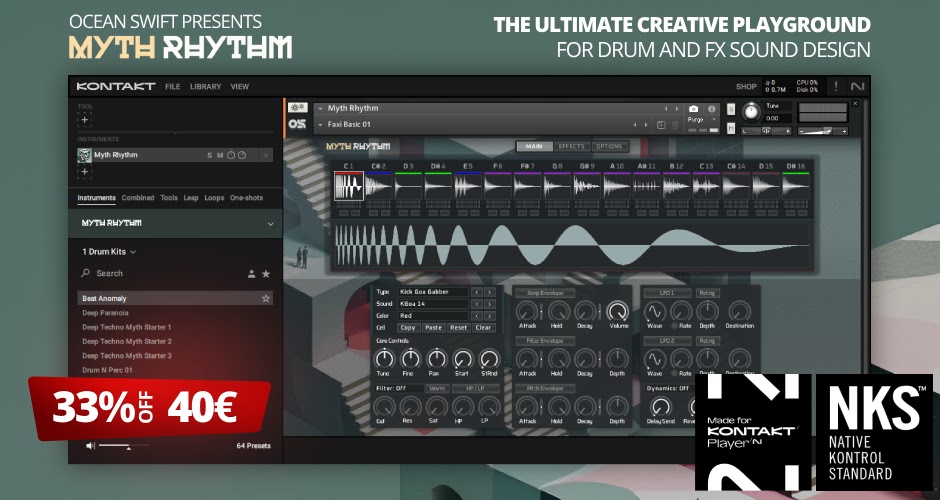
Myth Rhythm combines deep modulation, powerful effects, and avant-garde sound design in a seamless, NKS2-integrated multi-cell percussion and sound FX instrument.
Myth Rhythm is a versatile cell based instrument featuring 16 individual cells, each capable of holding one of over 4,800 included samples or a user-loaded sample.
Each cell offers extensive editing capabilities, including filters, envelopes, LFOs, dynamics effects, and send levels. Cells can be easily copied, pasted, and customized with key color settings.
Additionally, each cell supports extensive external modulation, utilizing velocity, polyphonic aftertouch, and pitch bend for dynamic performance control.
The instrument's main effects section provides a range of creative and modulation effects, along with various delay and reverb options for send returns.
Myth Rhythm also offers a unique seamless NKS2 experience, even allowing users to effortlessly program and customize their own NKS2 performance mode mappings directly through the interface.
The included sounds library offers a diverse array of avant-garde one-shot sounds, encompassing everything from classic drum sounds and vintage drum machines to spoken word, sound effects, and an eclectic mix of unconventional noises. This collection features a broad spectrum of unique elements, including tings, bleeps, blops, bells, whistles, animal sounds, cars, household items, synth stabs, modular effects, and much more.
Highlights:
Versatile Cell based Instrument - 16 individual cells
Massive One-Shot Library - Open library of over 4,800 sounds
Free Kontakt Player Compatibility
Instantly Playable, Infinitely Tweakable - Quickly play or dive deep
Genre-Defying Sound Design - Hundreds of presets
Deep Editing Power - Designed for creative flow
Seamless revolutionary NKS2 Integration - Streamlined workflow
Unprecedented control with MK3 Keyboards
Polyphonic Aftertouch Support - Subtle nuances and articulations
Perfect for Pad-Based Workflows - Finger drumming fun
1. Myth Rhythm - Versatile Percussion & Avant-garde FX Engine | 16 Cells, +4800 Sounds, Deep Synthesis
2. Myth Rhythm - Versatile Percussion & Avant-garde FX Engine | Snapshot Sound Example Demos 01
3. Myth Rhythm - Versatile NKS Percussion & Avant-garde FX Engine | Deep Dive Overview Presentation
Press release follows:

Ocean Swift Releases Myth Rhythm
An Avant-Garde FX & Percussion Powerhouse with 4,800+ Sounds for Free Kontakt Player
Intro offer - 33% off just €40 until August 10 2025:
https://oceanswift.net/product/myth-rhythm/
Myth Rhythm combines deep modulation, powerful effects, and avant-garde sound design in a seamless, NKS2-integrated multi-cell percussion and sound FX instrument.
Myth Rhythm is a versatile cell based instrument featuring 16 individual cells, each capable of holding one of over 4,800 included samples or a user-loaded sample.
Each cell offers extensive editing capabilities, including filters, envelopes, LFOs, dynamics effects, and send levels. Cells can be easily copied, pasted, and customized with key color settings.
Additionally, each cell supports extensive external modulation, utilizing velocity, polyphonic aftertouch, and pitch bend for dynamic performance control.
The instrument's main effects section provides a range of creative and modulation effects, along with various delay and reverb options for send returns.
Myth Rhythm also offers a unique seamless NKS2 experience, even allowing users to effortlessly program and customize their own NKS2 performance mode mappings directly through the interface.
The included sounds library offers a diverse array of avant-garde one-shot sounds, encompassing everything from classic drum sounds and vintage drum machines to spoken word, sound effects, and an eclectic mix of unconventional noises. This collection features a broad spectrum of unique elements, including tings, bleeps, blops, bells, whistles, animal sounds, cars, household items, synth stabs, modular effects, and much more.
Highlights:
Versatile Cell based Instrument - 16 individual cells
Massive One-Shot Library - Open library of over 4,800 sounds
Free Kontakt Player Compatibility
Instantly Playable, Infinitely Tweakable - Quickly play or dive deep
Genre-Defying Sound Design - Hundreds of presets
Deep Editing Power - Designed for creative flow
Seamless revolutionary NKS2 Integration - Streamlined workflow
Unprecedented control with MK3 Keyboards
Polyphonic Aftertouch Support - Subtle nuances and articulations
Perfect for Pad-Based Workflows - Finger drumming fun
See dealers on the right for pricing and availability on gear.
LABELS/MORE: MATRIXSYNTH Members, Native Instruments, New Soft Synths, News, Ocean Swift
LABELS/MORE: MATRIXSYNTH Members, Native Instruments, New Soft Synths, News, Ocean Swift
NEXT PAGE
HOME
© Matrixsynth - All posts are presented here for informative, historical and educative purposes as applicable within fair use.
MATRIXSYNTH is supported by affiliate links that use cookies to track clickthroughs and sales. See the privacy policy for details.
MATRIXSYNTH - EVERYTHING SYNTH
© Matrixsynth - All posts are presented here for informative, historical and educative purposes as applicable within fair use.
MATRIXSYNTH is supported by affiliate links that use cookies to track clickthroughs and sales. See the privacy policy for details.
MATRIXSYNTH - EVERYTHING SYNTH