"When people associate composer David First with his musical resume, anyone goes straight to his late 70′s avant punk band, The Notekillers and their influential 1980 single "The Zipper". Prior to his time in the basements of Philadelphia, he had already played in Cecil Taylor’s ensemble and after the Notekillers broke up he moved to New York City in the early 80′s, taking root in the downtown NYC avant garde scene. It was there that First honed his craft for experimental composition and ambient drone which still continues to the present day.
Though this narrative made sense, there was a piece missing in the puzzle of First’s musical background. In 1976, two years after playing with Taylor and the year before starting the Notekillers, he enrolled in a class in electronic music at Princeton in the department headed at the time by legendary electronic composer Milton Babbitt.
During his time at Princeton, First was introduced to the classical electronic music studio there, a lonely outpost of the famed Columbia-Princeton Electronic Music Center which housed one of the very first Buchla 100 series systems acquired by Vladimir Ussachevsky & Otto Luening.
Unfortunately, due to the introduction of digital technology within the music world, this system was left to languish in the studio unattended and nearly forgotten. First fell in love with this equipment and seized the opportunity to compose using the Buchla 100 synthesizer, at first experimenting only with electronic synthesis but later adding in his signature guitar stylings to make these compositions unique to the academic output typical of university music.
Thankfully, these compositions were recorded by First at Princeton on various reel to reel tapes and stored away for over 35 years. It wasn’t until the summer of 2012, when David First and Ryan Martin (of Dais Records) decided to revisit and transfer these reels to compile an album presented here as a selection of genuine, uninhibited exploration into modular electronic synthesis. Limited to an edition of 500 copies with liner notes by David First."
Although it went largely unnoticed at the time, the 2500 became one of the most famous synthesizers in history when it was featured prominently in the film Close Encounters Of The Third Kind, where it was used to communicate with an alien spaceship.
ARP instruments founder Alan Robert Pearlman was a Nasa scientist. Between 1970 and 1981 only 100 ARP 2500's were ever made, each a custom order, no standard configurations. ARP 2500 one of Jean-Michel Jarre's favourite instruments. All the sounds are completely unique. You pretty much need a degree in physics to operate one!
Pete Townsend "Mine plays six notes at once, can have 20 sets of preset control voltages available, six audio signals mixed and instantly usable at various levels. The most incredibly subtle tone colours can be produced
using the multimode resonator in conjunction with a normal filter, and the sequencer will provide exhilarating cascades of arpeggios."
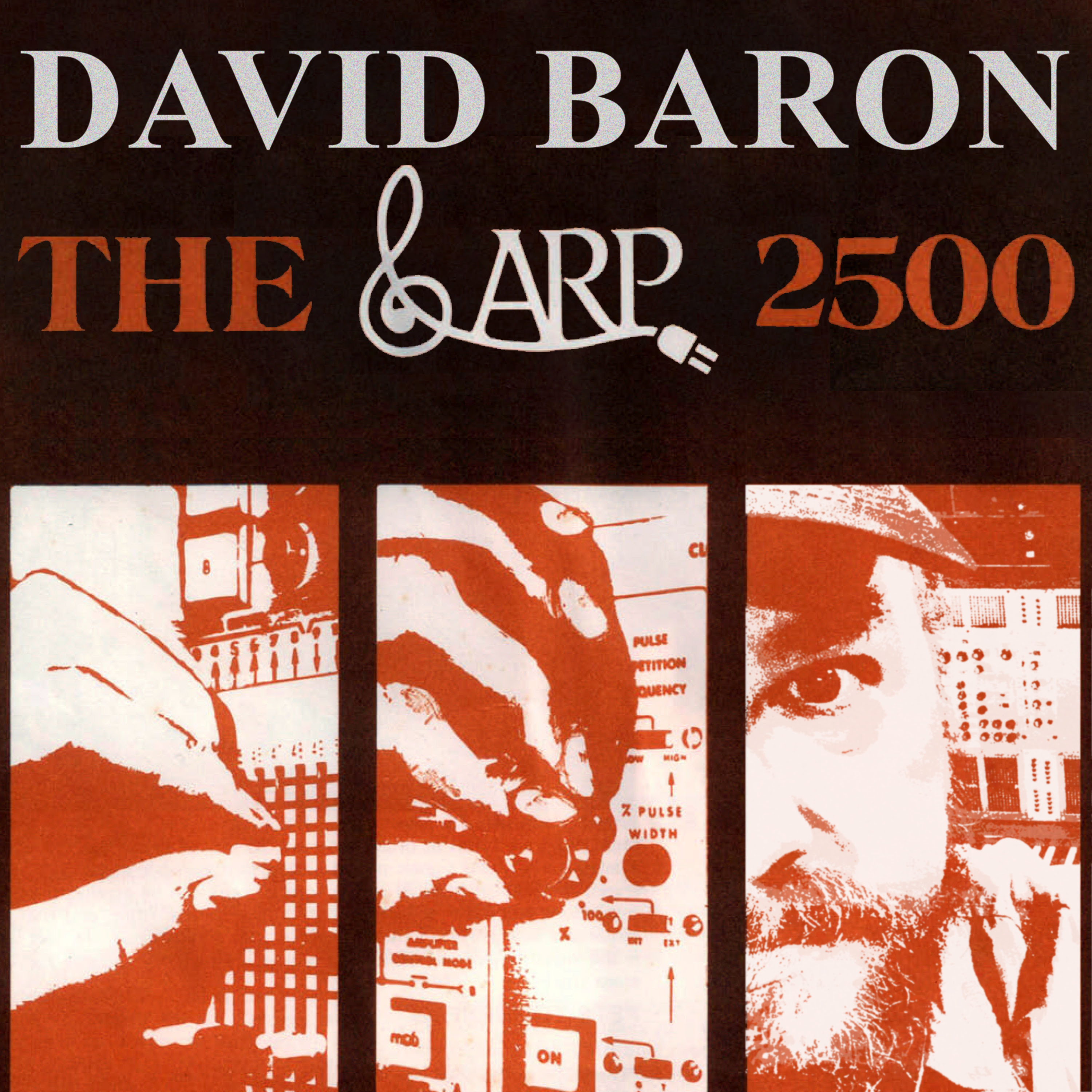
David Baron "The Arp 2500 was the only sound source. I sequenced one or two patches at a time and then built the compositions in layers. A lot of the audio FX were created through the use of pedals. The reverberation came from the Bricasti, EMT 240 Plate, Roland Space Echo 501, and a Vermona Spring Reverb. The Arp 2500 always ran through the Avedis Key Pre. I used very little dynamic compression/limiting. Time delay effects were mostly created ‘in the box’ but also with rack mount outboard including the AMS Tape Phase Simulator, an Eventide Instant Flanger, and a MXR Flanger/Doubler. The instrument stays in tune (for the most part). The filters can distort so some care has to be used when gain staging. The envelopes are very snappy. The sound is beautiful and creamy yet percussive and forward."
About David Baron
Record producer, film composer, musician, arranger, engineer located in the historic Woodstock, New York area. An avid collector of vintage analog synthesizers and recording gear. He owns a private recording studio called Sun Mountain Studios located on top of a mountain overlooking the Ashokan Reservoir.
Some artists he has worked with: Lumineers, Shania Twain, Jade Bird, Shawn Mendes, Vance Joy, Meghan Trainor, Lenny Kravitz, Jeremiah Fraites, Josin, Matt Maeson and Lana Del Rey.
He blends retro and modern, orchestrated and raw. The contrast that brings out the emotion of a scene or in a song.
Album cover designed by Dina Pearlman-Ifil derived from an old ARP 2500 brochure originally designed by Margaret Shepherd in 1970 for Tonus, Inc / ARP Instruments.
Photograph courtesy of the Alan R Pearlman Foundation alanrpearlmanfoundation.org
About the Alan R Pearlman Foundation
The ARP Archives & The Alan R. Pearlman Foundation is a small, 501(c)(3) non-profit organization.
Our mission is to celebrate the legacy of inventor, musician, entrepreneur and engineer Alan R. Pearlman,
by making his innovative inventions publicly accessible, and by inspiring future generations to imagine and create.
"Seventh Window - A track from the album Imaginator by Dave Bessell and Liam Boyle. You can find the full album here https://davebessellandliamboyle.bandc...
Released on Groove Unlimited.
"Dave Bessell and Liam Boyle first met on Facebook through an interest in Node. Liam has a very wide range of mu-sical interests and skills including the classical avant garde so Dave invited him to a performance of one of his classi-cal modernist pieces for orchestra at Plymouth University. The two hit it off and first collaborated on a track called Theme One from Dave’s solo electronic album ‘Black Horses of the Sun’. It was always on the cards that these two would collaborate further and in 2020 the opportunity arose which resulted in this latest album ‘Imaginator’ their first on Groove Unlimited.
Liam has produced a number of film socres for american independent films as well as recording multiple electronic albums such as ‘Off World’ and more recently ‘Waveforms’ He continues to explore electronic sound design, visuals, guitar and classical compositions
Dave Bessell, founder member of synth group Node, has been releasing a series of fascinating solo and collaborative EM albums over recent years, mainly on DiN records. He also has a lengthy back story involving session playing programming and arranging for a variety of artists and labels including Killing Joke and Suede. Along the way he also picked up a Phd in classical orchestration from the Royal College of Music.
This latest collaboration is the first full album with versatile soundtrack and EM composer Liam Boyle. It is also the first release for these artists on Groove Unlimited. The musical emphasis here is on both melody and sonic explora-tion with an atmospheric soundtrack feel throughout. Not surprising really considering both artists have seperately worked on soundtracks - from independent films to TV. The music is detailed and multilayered repaying close and repeated listening and is realised entirely with analogue hardware, plus a little heavily treated and disguised guitar. Dave also uses an unusual instrument on a couple of tracks called an Aum guitar which is designed to be played with an ebow and sounds nothing like a guitar!
BOWIE STYLOPHONE - Limited Edition video upload by
Stylophone
"⚡NEW LIMITED EDITION BOWIE STYLOPHONE - OUT NOW ⚡
We are very proud to announce this unique collaboration with @davidbowie
celebrating a career long association between the legendary musician and
Stylophone.
The Bowie Limited Edition White Stylophone with analog sound comes with a
booklet celebrating David Bowie's career and featuring exclusive photos."
Update: the press release:
David Bowie celebrated with limited-edition Bowie Stylophone
David Bowie’s career-long association with the world’s first ‘pocket synthesizer’ is being celebrated with the launch of a Bowie Stylophone.
The limited-edition Stylophone commemorates Bowie’s longstanding association with the iconic instrument, which famously featured on his breakthrough 1969 single “Space Oddity” which was composed around the Stylophone’s unique sound.
The launch is the result of a collaboration between The David Bowie Archive and Dubreq, the British company that makes the instrument. Together they have released a selection of pictures of the music legend using the Stylophone. Whilst legendary American record producer Tony Visconti, who worked closely with Bowie over many years, has gifted the team a Bowie photo from his private collection. (Pictures available here)
“Space Oddity” appeared on Bowie’s second album which was produced by Tony Visconti – who recalls how the young Bowie was ecstatic to be chosen by the makers of the Stylophone to receive a complimentary unit.
Mr Visconti said: “He was one of the first to own one and to discover this new, quite radical way of making music. He immediately put it to work and wrote a song around the unique sound of the instrument, which was of course, Space Oddity.
“For many years to come Bowie and Stylophone were names that were matched in the same breath. He would be very proud of this new incarnation named after him.”
Regarded as one of the most influential artists of the 20th century, Bowie continued to use the instrument throughout his career. As late in his career as 2002 he recorded with the Stylophone for the song “Slip Away” on his Heathen album.
The limited-edition Stylophone goes on sale from www.dubreq.com on 17th September for £29.95/ €34.95/$39.95 and is accompanied by a commemorative booklet that explores Bowie’s music.
John Simpson, managing director of Dubreq, the British company that makes Stylophone said: “There’s a big resurgence in interest in the mini synthesizer from young musicians. This limited edition Stylophone is a great way to commemorate David’s affection for the instrument and to inspire the next generation of musicians to create even more great music with the Stylophone.”
Ground control to Major Tom: introducing the limited-edition Bowie Stylophone, a stylish reimagining of the original pocket synthesizer.
The ultimate collectible for any Bowie fan.
Limited-edition David Bowie-inspired synthesizer
Special white design featuring embossed Bowie logo
Full colour booklet celebrating David Bowie’s work and featuring exclusive contributions and archive photographs
Compact & battery-powered 3 way Octave switch / Vibrato switch Built-in speaker & headphone socket for playing on the go Batteries required: 3 x AA (not included)
"A discussion with Arp Instruments Dave Fredericks on the song Stinger from the 'Red' Arp demo record. This conversation between David Frederick and his father David Frederick Sr. (Dave Fredericks) discusses the origins of this song, recording the iconic song on the Arp "Red" demo record, and using the Arp 2600, Arp Odyssey, and Arp Pro Soloist in the performance. A great conversation on this song, Arp history, synthesizers, and more!
Interview note & correction: "East Meets West" was recollected to being in 5/4 time signature when in fact, it was in 4/4. At the time of recording this interview, East Meets West was recorded 56 years ago!"
"My dad who was one of the original founders of Arp Synthesizer, VP of Global Sales and Marketing, and visionary behind such Arp synths as the Odyssey, Pro Soloist, String Ensemble, Omni, Explorer, Axxe, and Little Brother, wrote this song back in the late sixties around the time I was born. He initially released it on his first album "Mr. Talent - Dave Fredericks" where he played the organ and my uncle Bruce played the drums.
My dad reintroduced Stinger on Arp's "The ARP Family of Synthesizers" record (the red record), using the Eminent Organ, Arp Pro Soloist, Arp Odyssey, and Arp 2600 with Cleve Posar on Drums.
One day I decided for fun and nostalgia to quickly whip up a new 21st-century arrangement of my dad's song and I thought I would share.
Hope you dig it! David
TRACK NOTES David Frederick - Keyboards - Arp 2600, Hammond B3, Steinberg Horns, Steinway Grand Piano, Roland Jupiter 8 (pads), Spitfire Audio Drums, and Kontakt Percussion.
Recorded: Direct into Steinberg Cuebase, processed and mastered with Waves Abby Road Mastering Chain."
In 2003, I flew to Paris for my second visit with the legendary French electronic music pioneer, Jean Jacques Perrey. I was working on an solo electronic music album of my own, and I had asked Mssr. Perrey to play his Ondioline on my version of a tune he had once recorded in 1960, called "Chicken on the Rocks". I brought the new backing track with me, that I had previously started in my home studio, and David kindly agreed to record JJ's Ondioline in his own home studio. I filmed part of the session with my little camcorder. After we had finished the song, I traveled with JJ to his home in Lausanne, Switzerland, and on the train trip there he told me, "I would love to record an entire album with you!" So, I saved this song for our first duo album, "The Happy Electropop Music Machine", which was released in 2006 by Oglio Records in Los Angeles. A few years later, the song was used in an episode of "South Park", which brought in a substantial amount of money for all involved. That led to JJ and my performing many concerts, both in Europe, Canada and America. This video documents the start of it all!
See the Ondioline label below for additional posts featuring the Ondioline.
The Ondioline was first concieved by Georges Jenny in 1939. Via Wikipedia on the Ondioline: "First conceived by Jenny in 1939, he continued refining and reconfiguring the device, producing dozens of variant models up until his death in 1975."
Be sure to see the MATRIXSYNTH exclusive further below!
FM EXPLORATIONS AND MICROTONAL DRONES FROM NYZ (AKA DAVE NOYZE, DAVID BURRASTON, NOYZELAB, BRYEN TELKO)
This is the first release by NYZ and is a superb musical collection of research areas classified to internal Noyzelab operations. Not even .MEDS label were informed of the secret processes underlying its creation, excepting that we know it involved Frequency Modulation (FM) synthesis! We have not been given any information regarding when this work was recorded, but we suspect the material spans at least a decade of David's FM algorithm research on numerous synthesizers, as well his own custom built ear deceiving gear...
According to one reviewer of David's previous musical output he "gleefully disrupts just about every standard convention of musical form you could think of, including those of so-called experimental musics."
Other reviewers have written that :
"His music is a bizarre, yet compelling journey investigating the outer realms of music generated on ancient & contemporary machines." "It's strikingly original audio that doesn't really sound like anything else I can think of." "Utterly sublime. So there you go, a life-affirming slab of mind-altering sound to reawaken you to the terrifying possibilities of creation."
MATRIXSYNTH recently asked NYZ why he put together this new album of FM synthesis based explorations, and whether he would discuss some of the process behind it. The declassified information below has been put together by NYZ especially for a MATRIXSYNTH exclusive.
***BEGIN NYZ DRN4 DECLASSIFICATION REPORT***
DC REPORT STATUS: PARTIAL DECLASSIFICATION ONLY
PARTIAL DC STATUS: INCOMPLETE CELLULAR BINARY SPACETIME
PARTIAL DC LEVEL: SEMI-PICTORIAL_TEXTUAL_HIGHLIGHTS
FUTURE DC STATUS: _PENDING
The main reasons for making this album were an interest in FM synthesis in both analogue modular and MIDI/digital mediums. I had worked with digital FM synthesis since getting a Yamaha TX81Z when they came out back in 1987 (which I still have, along with another backup machine with a very hummy mains transformer which bleeds onto the outs). How me and another synth friend used to cry with drunken laughter at preset D11 Hole in 1... :) But after initially wondering whether I had just wasted about 350 UK pounds on an utter piece of shit... I quickly warmed to its better presets, and its very different approach to synthesis yielded enough interesting results early on for it not to get outed.
"FYI: As will happen sometimes in live performances, we had some technical difficulties (i.e. the internet decided to be erratic several times in the beginning...). David Van Pelt was a true trooper, though our hostess could have chilled a bit. We will publish an edited version in the next few days!
ARPCHIVES LIVE! is back! Our first guest of the year is David Van Pelt who also plays synthesizer in Acolyte*, a prog band from Australia.
We'll have an interview, some video and demos and talk about the recent addition to his synth family, how he got into ARPs in the first place, his beautiful music, band and the synth scene in Australia.
"In this video, I explore an extremely rare electronic instrument called the Touché, created by Buchla and Associates in 1980. Filmed at the Buchla Archives in Vancouver, this is a rare opportunity to hear and see an instrument that very few people have ever encountered firsthand. Only around five Touchés are known to have been built, and very few remain functional today. Because of this, the instrument has remained largely absent from public performance and documentation. This video helps bridge that gap by sharing the Touché’s sound, design, and historical context.
While Don Buchla is best known for his modular synthesizers such as the 100 and 200 Series, he also created a number of non-modular, computer-based instruments that explored new relationships between performance, software, and sound. The Touché is one such instrument. Conceived by Don Buchla in collaboration with composer David Rosenboom, it is a bi-timbral, eight-voice polyphonic keyboard instrument that combines digital sound generation, analog processing, and computer-mediated control.
The video begins with a historical overview of how the Touché grew out of Buchla’s computer-controlled instruments of the 1970s, including the 300 Series systems. From there, the video moves into a detailed walkthrough of Touché’s sound architecture, including many musical demos.
This video was created in collaboration with the Buchla Archives, an organization dedicated to the thorough and thoughtful documentation and preservation of Donald Buchla’s work.
Special thank you to Ryan Gaston and David Rosenboom for research assistance."
"This video, shot informally in the Ensemble Room at Mills College in 1983, contains the only footage known of David Rosenboom playing his 1981 composition Nova Wind from Future Travel. In it, he plays the legendary Touché—digital/analog keyboard instrument produced in collaboration with Donald Buchla in 1979-1980—, violin, piano, and ancillary electronics. A complete studio recording of Future Travel was released first on a vinyl LP by Street Records in 1981 and later on a double-CD from New World Records in 2007."
Node vintage modular, Paddington Station and Master rock studio 1994 video upload by David Bessell
"Full album available here https://din.org.uk/album/singularity-...
Retro video footage taken from a live performance on Paddington Station and recording sessions at Master Rock studios London in 1994. The footage from Master Rock was filmed by Mat Osman of Suede. The track 'Continental Drift' appears on the latest DiN release of material from the 1994/5 Node archive. Previously unreleased apart from the track Terminus it features the original line up of Node which included Gary Stout. alongside Dave Bessell, Ed Buller and Flood."
"Singularity is the legendary “lost” Node album. Recorded at the same time as their original sessions in 1994 this has DiN stalwart Dave Bessell join Ed Buller & Flood alongside original member Gary Stout. Presented here for the first time, mastered to modern standards but otherwise untouched and in its original form, recorded to two track with no overdubs. As a bonus the track “Terminus” is included with this release. A fascinating insight into one of the bands that helped spark the analogue revival back in the mid 90's. Mainly unreleased material sees them formulating their take on the classic Berlin school sound using their trademark mountain of vintage analogue modulars. Intriguingly this could almost be an early take on Berlin style techno in places too. An influential group of producers setting their controls for the heart of the sun.
Available now on limited edition Digipak CD (with 8 page booklet) in the DiN Bandcamp Store
"Film Composer / Synthesist Amin Bhatia announces the release of 'Virtuality', the long-awaited sequel to his synth orchestral epic 'The Interstellar Suite', on the anniversary of synthesizer pioneer Bob Moog's birthday, May 23 2008.
The album is dedicated to Moog, who was a friend of the composer and is endorsed by the Bob Moog Foundation. Michelle Moog-Koussa, Executive Director and daughter of the late Bob Moog says:
'My father's genius and passion was taking the synthesizer out of the laboratory and making synthesis accessible to musicians, and through them, to the world. Amin Bhatia’s 'Virtuality' is another fine example of that accessibility.'
True to Bhatia’s obsession with orchestral music and science fiction, the first half of the album explores the micro-universe that exists inside the computer. Titles like 'World Wide Web', 'Virus' and 'Second Life' portray aspects of our modern virtual world through music and sound design. Artwork was provided by the award winning digital artist Alexander Preuss.
The second half of the album features 'Bolero Electronica', a one-of-a-kind journey through 75 years of synthesizers through an innovative realization of Maurice Ravel’s 'Bolero'. In Bhatia’s version, instruments as early as the Ondes Martenot and Theremin begin the work, and the piece progresses through generations of synthesizers from Moog, Roland, Yamaha and others chronologically. The work builds in size and power decade by decade ending in present day virtual instruments and technologies. Guest artists include veteran keyboardists Steve Porcaro and Patrick Moraz. Many of the instruments used were from the Cantos Music Foundation. The album was recorded and mixed by award winning producers David Greene and Jeff Wolpert.
Bob Moog had been scheduled to provide a special feature narration track for “Bolero Electronica” but sadly that recording never happened. True to Bob’s mission to document, celebrate and teach innovative thinking, Amin instead employed noted synthesizer historian Mark Vail to create additional liner notes. The result is an illustrated guide which allows the listener to follow along stanza by stanza through Bhatia’s elaborate rendition, complete with a timeline chart of every synthesizer used.
'The Timeline of synthesizers in Bolero Electronica looks like the Moog Legacy to me and I only wish Dad were around to hear this project come to fruition', says Michelle. 'I think he would be delighted in the artistry Amin used to employ so many different instruments.'
Says Amin 'Electronic music to me is like animation. It’s a portrayal of reality through an innovative use of non-reality. When done right it creates beautifully animated images in the mind of the listener. And Bob was the greatest animator of them all.'
'Virtuality' will be released via CD and download on the anniversary of Bob Moog's birthday, May 23rd 2008. A portion of each sale will be donated to the Bob Moog Foundation."
My Notes:
I have been fortunate enough to listen to the CD in full. I have to say the experience of listening to "Bolero Electronica" while viewing the "Timeline of Synthesizers" is an extremely rare and satisfying treat. I literally could not stop smiling throughout the piece. I do not want to spoil this track for anyone, but let's just say there is nothing I have experienced quite like it. The intro delivers in a way that is simply beyond cool and it just keeps on giving. It is an absolutely brilliant composition for the synth enthusiast. Trust me, you will be able to appreciate this one like no one else. Be sure to click on the timeline image in this post.
If you know "Bolero," it is a piece that starts with just a few instruments and then builds with layered instruments into a triumphant finish. When you listen to "Bolero Electronica" and watch the timeline, you instantly make the connection and realize that this isn't just Bolero done with synths, but literally a redefinition of Bolero as the triumph of synthesizers over time. "Commercial synths" essentially began with MOOG, Buchla, EMS and eventually grew into the myriad of synths we have today. Click on the image in this post that looks like a track listing. That is the actual progression of the piece. When you listen to it, you can literally listen to the evolution of synthesizers over time. Utterly amazing. There are very few tracks that will go down as pivotal in the history of synths. I honestly believe this will be one of them considering what it conveys, the history it speaks. You simply have to hear it to experience it in full. You will find yourself going back to focus on different synths and sound evolution through time via synthesis. It is simply just brilliant.
The Making of The Interstellar Suite
Directed and produced by Byron Kent Wong
Additional Interviews directed by Saul Pincus
This 18-minute featurette of Amin Bhatia's epic album The Interstellar Suite features interviews with noted artists and engineers:
Steve Porcaro, Patrick Moraz
Frank Morrone, James Porteous, David Greene and Mark Vail
Roland’s esteemed president, the late Ikutaro Kakehashi
The Carolina Crowns Drum Corps!
and many others…
This video is a bonus feature from the The Interstellar Suite Anniversary Limited Edition
Remixed by Frank Morrone from the original multi-tracks.
Under exclusive license from Capitol Records, Inc.
Publishing Bhatia Music Inc.
DVD & Blu-ray Dual Pack and Companion Guide Book available only until May 7, 2017 at http://aminbhatia.com/is25mayday/
You'll often see videos with references to "Krell" patches. Where did the reference come from? The 1956 film Forbidden Planet and specifically the sounds created for it by Bebe and Louis Barron. The Krell was the intelligent alien race in the film. The above is a playlist I found of various Krell style compositions starting with "Louis & Bebe Barron - Ancient Krell Music." The actual style of composition is considered Musique Concrete which began in the 1940s, much earlier than the film.
"Musique concrète (French pronunciation: [myzik kɔ̃.kʁɛt], meaning 'concrete music') is a genre of electroacoustic music that is made in part from acousmatic sound, or sound without an apparent originating cause. It can feature sounds derived from recordings of musical instruments, the human voice, and the natural environment as well as those created using synthesizers and computer-based digital signal processing. Compositions in this idiom are not restricted to the normal musical rules of melody, harmony, rhythm, metre, and so on. Originally contrasted with 'pure' elektronische Musik (based solely on the production and manipulation of electronically produced sounds rather than recorded sounds), the theoretical basis of musique concrète as a compositional practice was developed by Pierre Schaeffer, beginning in the early 1940s."
And on the soundtrack for Forbidden Planet via Wikipedia:
"Forbidden Planet 's innovative electronic music score, credited as 'electronic tonalities,' partly to avoid having to pay any of the film industry music guild fees,[citation needed] was composed by Bebe and Louis Barron. MGM producer Dore Schary discovered the couple quite by chance at a beatnik nightclub in Greenwich Village while on a family Christmas visit to New York City; Schary hired them on the spot to compose his film's musical score. While the theremin (which was not used in Forbidden Planet) had been used on the soundtrack of Alfred Hitchcock's Spellbound (1945), the Barrons' electronic composition is credited with being the first completely electronic film score; their soundtrack preceded the invention of the Moog synthesizer by eight years (1964).
Using ideas and procedures from the book, Cybernetics: Or, Control and Communication in the Animal and the Machine (1948) by the mathematician and electrical engineer Norbert Wiener, Louis Barron constructed his own electronic circuits that he used to generate the score's 'bleeps, blurps, whirs, whines, throbs, hums, and screeches'.[12] Most of these sounds were generated using an electronic circuit called a 'ring modulator'. After recording the basic sounds, the Barrons further manipulated the sounds by adding other effects, such as reverberation and delay, and reversing or changing the speeds of certain sounds.[21]
Since Bebe and Louis Barron did not belong to the Musicians Union, their work could not be considered for an Academy Award, in either the 'soundtrack' or the 'sound effects' categories. MGM declined to publish a soundtrack album at the same time that Forbidden Planet was released. However, film composer and conductor David Rose later published a 7" (18 cm) single of his original main title theme that he had recorded at the MGM Studios in Culver City during March 1956. His main title theme had been discarded when Rose, who had originally been hired to compose the musical score in 1955, was discharged from the project by Dore Schary sometime between Christmas 1955 and New Year’s Day. The film's original theatrical trailer contains snippets of Rose's score, the tapes of which Rose reportedly later destroyed.[22]
The Barrons finally released their soundtrack in 1976 as an LP album for the film's 20th anniversary; it was on their very own Planet Records label (later changed to Small Planet Records and distributed by GNP Crescendo Records). The LP was premiered at MidAmeriCon, the 34th World Science Fiction Convention, held in Kansas City, MO over the 1976 Labor Day weekend, as part of a 20th Anniversary celebration of Forbidden Planet held at that Worldcon; the Barrons were there promoting their album's first release, signing all the copies sold at the convention. They also introduced the first of three packed-house screenings that showed an MGM 35mm fine grain vault print in original CinemaScope and stereophonic sound. A decade later, in 1986, their soundtrack was released on a music CD for the film's 30th Anniversary, with a six-page color booklet containing images from Forbidden Planet, plus liner notes from the composers, Bebe and Louis Barron, and Bill Malone.[21]"
So now when you see a Krell patch posted here on MATRIXSYNTH, you'll know exactly where the reference came from; Bebe & Louis Barron, in 1956, for the film Forbidden Planet.
The Seventh Wave Festival of Electronic Music: Number Sixteen
Music festival delivers one of its best line-ups yet!
Edition 16 of an Electronic Music Festival established in 2016 takes place in Birmingham in October of this year.
In October 2025 the sixteenth ‘The Seventh Wave Festival of Electronic Music’ takes place across three days at The Castle and Falcon.
For a relatively small festival The Seventh Wave continues to get some of the biggest names in electronic and progressive music.
The stellar line-up for #16 includes Plaid, Ultramarine, Richard Norris (The Grid), Mark Van Hoen/Locust, White Noise (featuring the legendary David Vorhaus) & much more.
Tickets can be purchased for individual events at Skiddle and SEE tickets.
Check out this auction list while it's up. There is a slew of old analog synth records. I saved off the album covers, titles and any details given for each; title link takes you to one monster htm file. I listed the albums below as well for anyone that wants to search for them in the future.
-Moog Synthesizer, The Essential, Perrey & Kingsley -Moog Synthesizer, Moog Indigo by Jean Jacques Perrey -Amazing New Sound of Jean Jacques Perrey -Spotlight on the Moog; Kaleido-scopic vibrations -The in sound from way out, Perrey - Kingsley -First Moog Quartet by Gershon Kingsley -Yankee Transdoodle; ARP 2600 + Obenheim equipt. -Giorgio; 1977, exclusively electronic keyboards -It's about time, Tonto -White Noise / An Electric Storm -Plugged in Joplin, Minimoog and EMS Synthi AKS, 1974 -Firebird by Isao Tomita -Ragnarok; Electronic funk by Paul Beaver and Bernard L. Krause -Skylab; Electronic butterflies play instrumental hits -Electronic Music for Jean Dubuffet's Coucou Bazar by Ilhan Mimaroglu -All Good Men by Beaver and Krause -Beyond the sun, the planets Patrick Gleason and the Eu Polyphonic Synth -Electric Love Moog synthesizer and strings -Good morning Starshine with Moog synth by Tartaglia -Mother Mallards Portable Masterpiece Co recorded at R.A. Moog ! -Short Circuits by Ruth White / Moog Synthesizer -Moog synthesizer album, Everything you always wanted to hear on the Moog but were afraid to ask -Music to Moog by Gershon and Kingsley -Quadradisc Highlights - quadraphonic record album -Electronic Hair Pieces Mort Garson with Moog synthesizer -Copper Plated Integrated Circuit - 1969 -Switched On Gershwin - Moog synthesizer -White Noise 2 David Vorhaus, 1975, Concerto for synth -Popcorn Gershon Kingsley's First Moog Quartet -Apollo 100 Masterpieces includes Popcorn -Hot Butter with Stan Free at the Moog synthesizer -Realistic Life Mechanical Sound Effects record album -Flowers Of Evil
Some great synth spotting in this one including I believe the eowave Persephone and a mixed synthesisers.com based modular. Those of you that have been coming to MATRIXSYNTH for a while will recognize Mattias of RothHandle Studio from his numerous gear videos here on MATRIXSYNTH. On a synth trivia note ABBA's white Minimoog resided at RothHandle (see these posts). I'm not sure if it is still there.
Music video by Martin Gustafsson (www.vimeo.com/gusse)
This is the first video from Necromonkeys debut album, Necroplex.
Necromonkey consists of David Lundberg (Gösta Berlings saga) and Mattias Olsson (Änglagård, Pineforest Crunch, Roth Händle studios).
In this video you can also see two of musicians that are heavily featured on the album Einar Baldursson (Guitar) and Michele Benincaso (Bass and Moog Taurus pedals).
The band is currently working on a series of four eps that will later on be compiled to an album. There are also plans for more videos and live concerts.
If you are interested in getting a copy of the album please drop the band a line at Necromonkeyness@gmail.com."
One of my favorite Bowie tracks. Anyone know what's under the Prophet-5 in the end?
"The third track to the Musikladen Extra television show broadcast in Germany 1978,
Carlos Alomar
rhythm guitar, backing vocals
Adrian Belew
lead guitar, backing vocals
Simon House
electric violin
Brian Eno
piano, string ensemble, backing vocals
Roger Powell
keyboards, synthesiser, backing vocals
George Murray
bass, backing vocals
Dennis Davis
drums, percussion
"Heroes" is a song written by David Bowie and Brian Eno in 1977. Produced by Bowie and Tony Visconti, it was released both as a single and as the title track of the album "Heroes". A product of Bowie's fertile 'Berlin' period, life in the city was crystallized into a tale of two lovers who come together in the shadow of the 'Wall of Shame' (though here "the shame was on the other side"). While not a huge hit at the time, the song has gone on to become one of Bowie's signature tunes and is well known today for its appearance in numerous advertisements. It has been cited as Bowie's most covered song after "Rebel Rebel"
The title of the song is a reference to the 1975 track "Hero" by the band Neu!,whom Bowie and Eno admired. It was one of the early tracks recorded during the album sessions, but remained an instrumental until towards the end of production.The quote marks in the title, a deliberate affectation, were designed to impart an ironic quality on the otherwise highly romantic, even triumphant, words and music.Producer Tony Visconti took credit for inspiring the image of the lovers kissing "by the wall", when he and backing vocalist Antonia Maass embraced in front of Bowie as he looked out of the Hansa Studio window.Bowie's habit in the period following the song's release was to say that the protagonists were based on an anonymous young couple but Visconti, who was married to Mary Hopkin at the time, contends that Bowie was protecting him and his affair with Maass. Bowie confirmed this in 2003.
The music, co-written by Bowie and Eno, has been likened to a Wall of Sound production, an undulating juggernaut of guitars, percussion and synthesizers.Eno has said that musically the piece always "sounded grand and heroic" and that he had "that very word - heroes - in my mind" even before Bowie composed the lyrics.[1] The basic backing track on the recording consists of a conventional arrangement of piano, bass guitar, rhythm guitar and drums. However the remaining instrumental additions are highly distinctive. These largely consist of synthesizer parts by Eno using an EMS VCS3 to produce detuned low-frequency drones, with the beat frequencies from the three oscillators producing a juddering effect. In addition, King Crimson guitarist Robert Fripp generated an unusual sustained sound by allowing his guitar to feed back and sitting at different positions in the room to alter the pitch of the feedback. Tony Visconti rigged up a system of three microphones to capture the epic vocal, with one microphone nine inches from Bowie, one 20 feet away and one 50 feet away. Only the first was opened for the quieter vocals at the start of the song, with the first and second opening on the louder passages, and all three on the loudest parts, creating progressively more reverb and ambience the louder the vocals became."
via Pink Floyd.com "Richard Wright 15 Sep 2008 The family of Richard Wright, founder member of Pink Floyd, announce with great sadness, that Richard died today after a short struggle with cancer.
The family have asked that their privacy is respected at this difficult time.
via BBC News "Pink Floyd keyboard player and founder member Richard Wright has died aged 65 from cancer.
Wright appeared on the group's first album, The Piper at the Gates of Dawn, in 1967 alongside lead guitarist Syd Barrett, Roger Waters and Nick Mason.
Dave Gilmour joined the band at the start of 1968 while Barrett left the group shortly afterwards.
Gilmour said: 'He was such a lovely, gentle, genuine man and will be missed terribly by so many who loved him.'"
Two video documentaries to remember his impact by:
The Making Of The Dark Side Of The Moon Part 1 - 6
YouTube via foresthillier
Pink Floyd - Behind the Wall 1-7
YouTube via sabeltann "This documentary looks at the conception, design and live shows of The Wall performed by Pink Floyd in 1980 and 1981. It features in-depth 1980s era interviews with Roger Waters, David Gilmour, Richard Wright and Nick Mason and shows footage of The Wall performed at Earl's Court in 1980. It also features archival footage of the Syd Barrett era Pink Floyd and discusses how David Gilmour was brought into the band to initially augment their live shows when Syd became unreliable due to his drug problem and how Gilmour ultimately replaced him. A short retrospective of Pink Floyd post-Syd in included. The documentary also discusses is how Roger Waters' concept of The Wall came about and how Pink Floyd, the band, were on the verge of breaking up while performing The Wall concerts. Included are interviews with Mark Fisher (stage designer), Jonathan Park (stage designer), Gerald Scarfe (animation designer and director) and Bob Geldof and Alan Parker in relation to the making of The Wall Movie."
This post will remain on top out of respect and memory of Richard Wright. See below for new posts throughout the day. Originally postedd 9/15/08 11:15 AM at 11:50 AM.
We are back working on a new album that will be released hopefully later in 2013. One song is mixed and finished, plane. Now we are working on a rack called Earbrow.
If you are interested in getting a copy of our first album Necroplex (that will be released officially in february) Please send us an email to Necromonkeyness(at)gmail.com"
Thought this video was pretty cool. I wasn't sure what to expect the Taurus to sound like in the mix. It's an interesting timbre that sounds familiar but not exactly synthetic. Although thought it was interesting seeing him play the Taurus with his hands which I think many of us would be better at than using our feat.
HD version. Non HD version Previously posted here.
"Latinsizer : "Celoán"
Album : "110"
Label: "Staticdiscos"
Music by Pepe Mogt
Latinsizer:
atinsizer basically is a bunch of sincroniced drum machines and synths controlled by pepe mogt.
Started around 1999 and with one Album and 12 inch records(ritmo 55 CD and NOMADA EP 12 inch), a combination of the melodic work of early synth Pop classics and the grit of urban Tijuana.
110 is the second latinsizer Album( August 2008) an electronic disco pop digitalized with analog machines. first debut for Static Discos.
Pepe Mogt has released material with his diferent alias on Because Music(france), Nacional Records(US), Palm pictures label (Tijuana Sessions vol 1), Mil records, Sonic 360 and Nettwerk labels, and has also done remixes and colaborations for Ennio Morricone for a Compost Records, Experimental music pioner Pauline Oliveros, Beck, Toby Dammit, Jessie Evans, Lucrecia(Colombia), Lenny kravitz, Rigo Tovar, 1 Giant Leap, Alan Parsons, David J (Love and Rockets) and Mambotur among others.
Static Discos:
Static Discos is a Mexican independent label based in Tijuana. They are a small group of people bent on bringing forward Mexico's electronic music and their releases focus on minimal techno, dub, electro and IDM. (Murcof, Fax, Carre, Terrestre, Antiguo Automata Mexicano and others)"
YouTube via bellerob | February 02, 2011 | Tony Allgood of Oakley Sound "Takla Makan is the artist name of Tony Allgood. Tony has been producing music for three decades. His main influences are Jean Michel Jarre, Mike Oldfield and Tangerine Dream. However, over the years inspiration has come from many sources including the late 80s rave scene, classical works and film soundtracks. This mix and match of musical genres has come together in a style that is distinctly Tony's and won him considerable acclaim from listeners and EM critics all over the world. He has produced five albums and the last four are available as CD-Rs from the artist's website. For a long time Takla Makan had problems finding a home on a commercial label. Many have been approached but the difficulty in tying his music down to a particular genre has scared all too many of them. Even so, Tony has been selling CD-Rs direct to the public for many years. Nowadays his music is alo available through synthmusic direct. "Y garreg wen"is from Tony's brilliant album "1632". ( 2003 ) http://www.oakleysound.com/music.htm http://www.oakleysound.com/
Dafydd y Garreg Wen is a traditional Welsh air and folk song. David Owen, the famous blind harper and composer, lived near Porthmadog in Caernarfonshire, Wales in the first half of the 18th century, who was known locally as Dafydd y Garreg Wen, (English: David of the White Rock). The epithet Y Garreg Wen (English: The White Rock) was the name of the farm near Morfa Bychan in which he lived. Tradition has it that as Owen lay on his death bed, he called for his harp and composed the haunting air. He died at the age of 29 and was buried at St Cynhaearn's Church near Porthmadog.[1] The words were added nearly a hundred years later in by the poet John Ceiriog Hughes.
lyrics in Welsh: 'Cariwch', medd Dafydd, 'fy nhelyn i mi, Ceisiaf cyn marw roi tôn arni hi. Codwch fy nwylo i gyraedd y tant; Duw a'ch bendithio fy ngweddw a'm plant!' 'Neithiwr mi glywais lais angel fel hyn: "Dafydd, tyrd adref, a chwarae trwy'r glyn!" Delyn fy mebyd, ffarwel i dy dant! Duw a'ch bendithio fy ngweddw a'm plant!'
English translation: 'Bring me my harp', was David's sad sigh, 'I would play one more tune before I die. Help me, dear wife, put the hands to the strings, I wish my loved ones the blessing God brings.' 'Last night an angel called with heaven's breath: "David, play, and come through the gates of death!" Farewell, faithful harp, farewell to your strings, I wish my loved ones the blessing God brings.'"