Follow-up to this post. Some additional details from Uli Behringer:
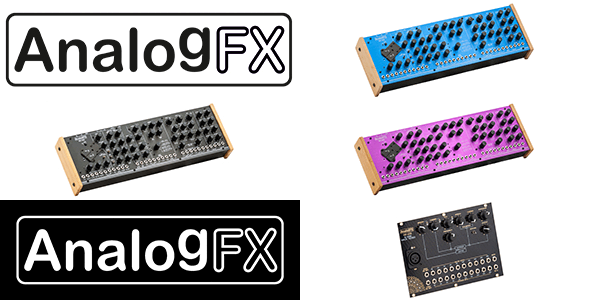
“These are 13 MID’s or concept documents we create for every single product as part of our PLM (Product Lifecycle Management) process before we hand them over to our R&D departments for development,” he notes. “We haven’t decided yet which of these modules we will actually produce as it is important that we achieve a certain production volume.”
“This is just the beginning,” he adds. “Our Vision is to build both legacy modules but also come up with innovative solutions which we have demonstrated with the DeepMind or the Neutron.”
We are equally excited to cooperate with creative module makers and many have already contacted us. We believe that such co-operations are mutually beneficial and I am convinced that our efficient supply chain can help these makers to get their products into the hands of lots of people. We are looking forward to meeting as many designers as possible at SuperBooth.”
All modules and specs:
165 Dual Portamento Controller for Eurorack
Legendary 165 dual Portamento Controller module from the ‘80’s
Authentic reproduction of original “System 100M*” circuitry
Artist roster includes world’s most famous pop, rock and jazz musicians
Dual Portamento Controllers with 2 controls and On/O switch
Each controllers has CV, Portamento and MPX inputs plus CV outputs
Eurorack specs: 16 HP, XX mA +12 V, XX mA -12 V
6 controls and switches give you real-time access to all important parameters
"Learn more about Midicake ARP: https://midicake.com
Here's the Patch Settings (Just the changes from a blank patch
Track 1 - Infinite Melody Velocity Pattern: XXX-X-XX (40) Velocity Pattern Length: 7 Gate: 16 Ticks Octave: 1 Time Factor: 4 Steps: 13 Bounce: LADDER Chop: 1 Chop Pattern: --XX-XXX (19) Chop Pattern Length: 5 Fx Amount: 24% Fx Target: Octave Fx Repeat: 5 Bars Mod A Amount: 7% Mod A Target: Note Offset Mod A Rate: 3 Bars Mod B Amount: 24% Mod B Target: Time Division Mod B Rate: 8 Bars
Track 2 - Simple Bass Velocity Pattern: XX-XX-XX (36) Velocity Pattern Length: 4 Gate: 1/2 Bar Octave: -2 Time Division: 2/1 Time Factor: 4 Steps: 9 Direction: Up Down Up Bounce: PINGPONG MIDI Channel: 2"
"Demonstration of some synths (modules) that you can find in the SunVox distribution.
SunVox is a small, fast and powerful modular synthesizer with pattern-based sequencer (tracker). It is a tool for those people who like to compose music wherever they are, whenever they wish. On any device. On any system."
v2.0 (23 jan 2022): * iOS 11+: SunVox Audio Unit (AUv3) can now send MIDI notes and MIDI CC to other AU modules; * iOS 13.4+: full USB/Bluetooth keyboard support (like on desktops); * multiple module selection (see changelog_details.txt) + ability to save several selected modules to a sunvox file; * timeline: supertracks (see changelog_details.txt and simple_examples/supertracks.sunvox); * improved import of old tracker formats (XM and MOD); * new module - FMX: 5-operator Frequency Modulation synth; * new module - FFT frequency transformator; * sound engine optimization; * the name of the current file is now visible in the title bar of the app window; * module and timeline editor: "Select All" has been changed to "Select/Unselect All"; * timeline menu: new option "Vertical mode"; +shortcut * timeline menu: new functions "Load" and "Save" to load/save selected patterns from/to a sunvox file; * timeline menu: new function "Detach" to convert the clones to the normal patterns; +shortcut * module editor menu: new function "Detach" to detach the selected modules from the rest; +shortcut * module editor menu: new function "Make MetaModule" for packing the selected modules into a single MetaModule; +shortcut * now it is possible to delete modules, but keep the links; * pattern properties: X and Y fields - exact coordinates of the pattern on the timeline; * module properties: X and Y fields - exact coordinates of the module; * module visualizer: "Phase Sync" oscilloscope option has been added; activate it to see a single waveform cycle; * module visualizer: new buttons "reset", "apply", "copy", "paste"; * ADSR->Sustain: new value "Repeat" (repeat the envelope until the module is stopped); * ADSR->Smooth Transitions: new value "volume change" (the volume will change smoothly, but the envelope start is not smoothed); * Amplifier: new controller "Bipolar DC Offset"; * Analog Generator: the "Freq2" controller has been ranamed to "Osc2" (pitch deviation of the additional oscillator); * Analog Generator: new controller "Osc2 volume" - additional oscillator volume; * Analog Generator: new controller "Osc2 mode" - mixing mode of the additional oscillator with the main one (add;sub;mul;min;max;bitwise AND;bitwise XOR); * Analog Generator: new controller "Osc2 phase" - starting phase of the additional oscillator; * Analog Generator: new option "Increased frequency computation accuracy"; * Delay: new controller "Delay multiplier"; * Delay: new "Delay unit" values: sec/44100, sec/48000, sample; * Delay: max delay length has been increased to 60 sec; * Delay: new controller "Feedback" (for sound and events); * Echo: new controller "Right channel offset" (how much to shift the right channel relative to the left in time); * Echo: new controller "Filter"; * Echo: new controller "Filter frequency"; * Filter Pro: new modes "stereo + smoothing" and "mono + smoothing" for additional parameter smoothing; * Filter Pro: new types "LP 6dB" and "HP 6dB"; * LFO: new controller "Sine quality"; * MetaModule->Play patterns: new values "on (repeat, endless)" and "on (no repeat, endless)"; * MetaModule: number of user defined controllers has been increased to 96; * MetaModule: controller color can now be changed by adding "@X" to the beginning of the name, where X is the group number from 0 to F; group colors (c_cgp0, c_cgp1, etc.) can be changed in sunvox_config.ini; * MultiSynth: new option "Output port number = round-robin (cyclic)"; * Sampler: new option "Increased frequency computation accuracy"; * FM, SpectraVoice, Kicker, DrumSynth: clicks removal algorithm has been implemented - it is useful when the volume changes quickly or there are not enough polyphony channels; * FM: the "M.Feedback" controller has been renamed to "M.Self-modulation"; * Vocal Filter: new controllers "Random frequency" and "Random seed"; * Vocal Filter: new controllers "Vowel1", "Vowel2", "Vowel3", "Vowel4", "Vowel5"; * effect 1С will work a little differently if you fill in its parameter as 10YY - this means that the velocity will be reset to 0 after YY ticks; (normal parameter 00YY means Note OFF after YY ticks); * new pattern effects (column EE): * 1A - fine velocity slide up/down (XX - up speed; YY - down speed); once at the beginning of a line; * 33 - slot sync (for sv_sync_resume() in SunVox library); * 34 - set (XX) or reset (YY) project options: 1 - no portamento on the first tick; 2 - no velocity slide on the first tick; (for compatibility with old tracker formats); * 3C - copy track XX from from the pattern YY; for example, if XXYY = 0023, then the first track will be copied from the pattern named "23"; * 3D - write a random value to track YY; min value, max value and column must be in track 0, starting from line XX; see example "pat effect 3D random value"; (columns: 0 - NN; 1 - VV; 2 - MM; 3 - CC; 4 - EE; 5 - XX; 6 - YY; 7 - XXYY); * corrected Mute/Solo algorithm for modules; * OpenGL accelerated versions for Windows and Linux; * new options in sunvox_config.ini: controller group colors c_cgp0, c_cgp1, etc.; * new options in sunvox_config.ini: module layer colors c_layer0, c_layer1, c_layer2, etc.; * new options in sunvox_config.ini: c_pbtn, c_pbtn_op, c_pscroll, c_pateditor_level, c_pateditor_cursor, show_sel_btn, show_sbars, edit_mode; * new curves in curves/MultiSynth/curve3 for different equal temperament systems (for example, ET19 - 19 tones per octave); * new modules in the instruments/ and effects/ folders; * new examples (SunVox Compo 2021.02 winners): Logickin - Mech Haven, So_ingMachine - Some of our tracks cant be covered, kiberaver - electric dreams; * new examples: NightRadio - Afterglow, NightRadio - Winter Is Coming; * updated version of SunVox library for developers: https://warmplace.ru/soft/sunvox/sunvox_lib.php * bug fixes.
"Twentieth visit to the Garden. Composed for Virus TI, Little Phatty and Blofeld"
"The twentieth piece of the HR cycle. To celebrate this number, I decided to use various means of composition. After a small introduction with the Virus TI, the first part goes on with Little Phatty solo lines, 00:41 to 6:11, with a small touch of Virus TI, 0:59 to 1:17, and some drops of Wiener Philarmonik Steinway, 5:00 to 5:53.
From that point, some Virus TI elements of the 19 previous pieces appear in a new configuration to develop at the same time echoes and brand new musical forms. It runs during the second part - with a short background call,(as a night bird call), of Doepfer coming from HR XVII, between 1:39 and 1:45. At 5:27, the Virus Ti vanishes and the end of this part is exclusively composed for Blofeld. I wanted to do something special for this twentieth composition of the HR cycle, and I will of course go on this work in progress since this issue gave me many new ideas."
Hadikat Raja XX, Deuxième Partie
Published on Jul 23, 2012 by RADIOKLOW
"Second part of the Twentieth visit to the Garden. Composed for Virus TI, Little Phatty and Blofeld"
"Sound examples of the DIY synthesiser Jeannie with the new firmware V 3.xx.xxx
You already know Jeannie from previous videos. New is now the firmware version V 3.xx.xxx . for Jeannie
This includes various new oscillator models, e.g. from Braids , Shruthi / Phoenix and Ambika ."
What's New
Version History
Jul 29, 2018 Version 1.9.4
* user files are now available through the Files app;
* partial USB/Bluetooth keyboard support (no key release, no Home/End, no F1/F2/...);
* improved iPhone X display support;
* sound engine optimization;
* indicating the modules whose controllers are tied to the MIDI;
* additional slider for scrolling the controllers when there is not enough space on the screen;
* spectrogram has been added to the to the spectrum analyzer;
* detailed settings of the spectrum analyzer are now available through the main menu -> Preferences -> Modules;
* Amplifier: new controller "Gain" for high amplification (x100, x1000 and higher);
Never seen one of these before. The following is the description in Dutch followed by Googlish:
"Voordat Quasimidi legendarische synthesizers uitbracht, maakten ze sound expansions voor een aantal duur segment keyboards van onder andere Roland.
Deze expansion is daar een toppunt van. 512 styles en begeleiding patches voor de E-serie keyboards van Roland. Roland heeft zelf een reeks kaartjes uitgebracht onder de types TN-SCx-xx waar maximaal 8 styles op zijn opgeslagen. Dit kastje heeft er dus 512. Deze 512 zijn opgeslagen in blokken van 8, waar via het menu telkens een andere 'kaart' kan worden ingeladen.
Ik heb zelf de E-70 gehad en er best lol van gehad. Vooral de Peter Gunn style waar dat bekende intro van Emerson, Lake and Palmer perfect wordt nagebootst en je heerlijk op kan varieren.
Dus als je nog een Roland Intelligent Synthesizer E-nogwat hebt die TN kaartjes slikt, ik raad 'm 100% aan!
De Giga-card is bij voorkeur op te halen in Zaandam, daar het een wat ouder stukje techniek is. Testen kan helaas niet want ik heb geen E keyboard meer. Verzenden is uiteraard mogelijk, maar zijn alle risico's voor de koper."
Googlish:
"Before Quasimidi released legendary synthesizers, they made sound expansions for a number of expensive segment keyboards from Roland, among others.
This expansion is the pinnacle of that. 512 styles and accompaniment patches for Roland's E-series keyboards. Roland has released a series of cards under the types TN-SCx-xx where a maximum of 8 styles are stored. This box therefore has 512. These 512 are stored in blocks of 8, where a different 'card' can be loaded each time via the menu.
I have had the E-70 myself and had quite a bit of fun. Especially the Peter Gunn style where that famous intro of Emerson, Lake and Palmer is perfectly simulated and you can vary wonderfully.
So if you have another Roland Intelligent Synthesizer E-something that swallows TN cards, I recommend it 100%!
The Giga-card can preferably be picked up in Zaandam, as it is a somewhat older piece of technology. Unfortunately, testing is not possible because I no longer have an E keyboard. Shipping is of course possible, but all risks are for the buyer."
Playlist:
KORG DW-8000 - Synth King "vintage analog" sounds
Roland JX-8p - Vecoven Super Flash ROM & PWM upgrade
Yamaha CS70m - first contact
Yamaha CS70m - loading patches from magnetic cards !!
Oberheim Matrix-12 -- first contact !
Oberheim Matrix12 - one song - one synth
Rhodes Chroma - one song - one synth
Rhodes Chroma (ex KRAFTWERK Kling Klang Studios) - first contact !
Oberheim OB-Xa - 15 minutes pure analog sounds - part 3/3
Oberheim OB-Xa - 15 minutes pure analog sounds - part 2/3
Oberheim OB-Xa - 15 minutes pure analog sounds - part 1/3
Oberheim OB-Xa - one song - one synth
Oberheim OB-Xa improvisation
Oberheim OB-Xa - first contact
Roland SH-2000 - one song - one synth
Roland MKS80 - one song - one synth
Korg Polysix - one song - one synth - free patches !!!
Roland JX3P - one song - one synth
Roland Juno 106 - one song - one synth
Roland Jupiter 4 & Promars MRS-2 - one song - one synth (ok 2)
Roland Jupiter 6 - one song - one synth
Roland Super JX10 - one song - one synth
64 new sounds for Roland JX10/MKS70 Vecoven PWM 4.xx update
64 new sounds for Roland JX10/MKS70 Vecoven PWM 4.xx update
Fender Chroma Polaris - one song - one synth
Fender Chroma Polaris Sound Demo (132 patches)
"The XX intro [Cover] The Korg Volca FM is used for the main part, this took a total of 12 slots on the FM to play all parts, switchng between the main part which was 8 parts and the second which was 4 parts, the tricky bit was trying to keep the FM in chain mode [and sync] when switching from the 8 to 4 [which is why I only did it once!] Some heavy reverb is added the FM from the Korg Mini KP 2.
As always the track is played 'live' in one take - with no DAW, editing or post production."
"Made in Japan, for an Akron Ohio firm. Another very rare machine - they are certainly coming out of the woodwork for this auction. This has probably the worst made-up name/number I've ever seen... XX-100 would be better on a rocket ship. BUT... it is beautifully made, in super condition for its age, and it has some very appealing sounds. As usual Bossa is one of the most useable, but they are all cleverly designed, and the whole thing is definitely at the tasteful and well-executed end of the tackiness spectrum. Buttons manually playing eight extra sounds. The only thing to stop it being near-mint is that the back hinged cover looks like a utilitarian (plain ply) replacement. Very nice indeed, though." VEMIA - Click on Auctions, Search, and search for 5911.
And that's it folks. Be sure to check out VEMIA for everything else I did not put up. There is much, much more listed.
I want to thank Peter Forrest for being kind enough to give me the go ahead to put these up. Yes, the auctions get exposure, but once they are over and gone, the images and info will remain. BTW, be sure to click on the images for the full size shots. You can click on the VEMIA link below to bring up all VEMIA posts.
YouTube Uploaded by zamisers7k on Aug 31, 2011
"Sorry for crud video but hope its good enough to show what is going on.
Have a track with the Vari Effect turned up on it and the Vari effect set to 097
Talk Mod.
Go in to Edit Mode [Enter] key on number pad then press Insert [F3].
Put in the event time where you'd like it examp 001:3:011
[F1] rotary over to event type Exclusive.
Then Enter hex code f0.43.10.6A.01.02.02.00.XX.F7
where XX = 00 - 04 I think, a/i/u/e/o
Repeat insert event at different times.
Or, perhaps the faster way but harder to explain...
This is how I figured this out and you can do it I suppose with any event or
knob tweek that shows up when the Midi Out light flashes.
Put a midi cable from the RS's Out A to the In.
Select a blank tack, mute all tracks to keep from other midi data recording,
press Effect twice [#5] press REC then Play, start turning the F1 knob. The Hex
code will record as events in the events list. Press Stop.
If the events aren't changing the Vowel, remember to unmute
the track you recorded it on. You can mute and unmute it from doing it, the RS
blows my mind yet again."
"(Scotts Valley, CA, December 17, 2019) — Rossum Electro-Music has announced the release of Software Version 2.0 for their Assimil8or Phase Modulation Sampler Eurorack module.
Designed to provide a powerful, flexible sampling engine for modular synthesis, the Assimil8or Multi-Timbral Phase Modulation Sampler module is the latest incarnation of Dave Rossum’s decades-long pioneering of affordable professional sampling technology. Assimil8or 2.0 software brings a host powerful new features and major workflow enhancements. Taken together, they result in Assimil8or's evolution into an even more powerful and easy-to-use sampling module.
via this auction
"1970`s Olson XX-100 Rhythm Beat.This unit is getting harder to find all the time.It is in nice, slightly used condition and comes with it`s origional sholder strap.It measures 5 1/4 inches tall,11 3/4 wide and 10 inches deep.It is a component type unit, needs to be hooked up to an amp.The locking rhythms range from waltz to cha-cha, with adjustable volume and tempo speed from fast to slow.The playable, or non locking selectable buttons add bass drum, tom-tom,conga,claves,snare drum,maracas and cymbals . It works fine, ready to make noise or a good piece for the collector. it is a real flashback to the days gone by."
"Roto-Control is a motorized MIDI controller for software and hardware. Roto-Control can extend the creative capabilities of synths, drum machines and any compatible MIDI hardware or software in MIDI Mode. In this video we show you how to set-up and pair Roto-Control (in MIDI Mode) with an Elektron Syntakt, and how to use the Motion Recorder as a performance enhancing tool. We show how easy it is for Roto-Control to MIDI learn and map 8 mutes and 8 different parameters from the Syntakt to Roto-Control's buttons and knobs. This method can be applied when using Roto-Control with other Elektron devices.
🎛️ Here are key steps to setting up both devices:
1. Connect Roto-Control MIDI Out to Syntakt MIDI In, and Roto-Control MIDI In to Syntakt MIDI Out, via 2 different MIDI cables.
2. Choose MIDI Mode on the Roto-Control.
3. Check Syntakt settings page and sub menus:
• Settings - MIDI Config - Port Config - Encoder Dest INT + EXT
• Settings - MIDI Config - Port Config - Receive CC/NRPN
• Settings - MIDI Config - Sync - Clock Send and Transport Send
4. Map Syntakt parameters to Roto-Control buttons and knobs:
• Press LEARN on the Roto-Control and select the knob or button want to assign. The LEARN button will flash and the MENU window will display what knob or button you have selected.
• On the Syntakt move or press the button you want to control. Roto-Control's display will immediately display the MIDI channel and MIDI CC.
• Press LEARN to confirm and exit.
The default labels on Roto-Control will display the MIDI channel and CC value as "CH:xx/CC:xx". Further customization of controls can be done with the Roto-Setup App - change labels and colors that reflect parameters on the Syntakt.
🖥️ Download the Roto-Control Syntakt MIDI Setup used in this video here, import it and try it with your Roto-Control: https://tinyurl.com/483cbnbx
Motion Recorder:
Check the Motion Recorder settings on the Roto-Control. We want to synchronize the Motion Recorder and playback from the Syntakt as the the master clock. In MIDI Mode, press FUNC and select MIDI EXT CLK for external clock. Also select Motion Recorder length on the same page, in this video we are using 64 steps. Press FUNC to confirm and exit.
⚡️HOT TIP: On the Roto-Control or the Roto-Setup App change the minimum and maximum values via the MIN VALUE and MAX VALUE for the button mutes. MIN Value = 0 and MAX Value = 1, this will ensure fast bidirectional muting between the Roto-Control and the Syntakt.
Roto-Control is a motorized MIDI controller for software and hardware. Roto-Control brings Melbourne Instruments' motorized technology to a MIDI controller in a powerful, portable, affordable tool for studio and live applications.
Unlike anything seen before, rethink software and hardware interactions via fully assignable motorized touch-sensitive knobs, user definable haptics for detailed control, high-res screens providing easy-to-read labels for every control, and internal memory with storage for thousands of assignments. Powerful, compact, and portable, Roto-Control features three main modes of operation: MIX, PLUGIN and MIDI with Motion Recorder."
You've seen the videos, we now have full details on the upcoming anAmoNo X synth in directly from Gotharman. You'll find the full details on a new anAmoNo X site here, and captured below for the archives. Take a look at the specs. This is going to be one powerful synth, complete with swappable filters and more.
"Modular synthesizer with memory, swappable analog filters, sampler and granular effects.
Please notice: anAmoNo X does NOT work with the expansion box series. Instead it has replacable analog filters.
The most flexible Gotharman synthesizer ever!
I was really happy with the flexibility of my Eurorack system, but since I spend most of my time running Gotharman's, and do not have very much time for playing music, I was not really happy with the lack of preset storage on this. I always ended up spending a huge lot of time tweaking knobs and rearranging cables, and not really getting any tracks composed (inportant or not :-)). This actually became a bigger and bigger annoyance to me, and in my Christmas holidays 2015, I decided to do something about it.
At first I started to design a module with 32 audio inputs, 32 CV inputs, 32 audio outputs, 32 CV outputs, 64 knobs, a display and memory. The idea was to connect everything of all my eurorack modules to this (hmmm...actually I am not sure if this module would have had enough connections...), connect the modules via an internal cross-bay, and adjust all the CV and audio levels on the 64 knobs. It did though, pretty soon, become clear to me, that this module would be huge and really expensive to produce. On top of that, not all parameters are CV controllable on all modules, so it would require quite a bit of soldering to get this connected to everything.
So I took a few days of brainstorming with myself, and came up with a new idea: The most important sound shaping thing (to my opinion), is the filter. So if I just could scramble things a bit down, and make a box with oscillators, VCA's, modulation sources, and maybe some effect modules, and just made the filters replacable, it would theoretically give almost the same possibilities as my eurorack system, but with added patch storage. And if I one day got tired of its sound, I would just have to replace one or both of its filters, and then I would get new sounds, without having to design or purchase a completely new synth. The design of anAmoNo X began...
synergyII timbres Uploaded on Sep 5, 2010 xenmaster0
s 2 demo 1 441 final 320x240stream Uploaded on Sep 5, 2010 xenmaster0
Warning: this is a long post and can't be paged with the "click for more" link otherwise the videos will not load. Also, no time to parse the entire listing, so everything captured below for the archives.
WITH KAYPRO II & SYNHCS 3.182 PROGRAMMING SOFTWARE, 14 FLOPPY DISCS OF SYNERGY TIMBRES, and 3 SYNERGY ROM CARTRIDGES
This is the legendary Synergy synthesizer. It comes with the Kaypro II CP/M computer I bought with the Synergy and the SYNHCS software used to program the Synergy. Three Synergy ROM cartridges are included, WC-1 and WC-2, the Wendy Carlos Voice cartridges 1 and 2, and the VCART 4 cartrdige, along with a null modem cable that you use to connect the Synergy synthesizer with the Kaypro II computer.
Using the Kaypro II computer running the Synergy Host Control System software (SYNHCS), you gain access to the full capabilities of the Synergy synthesizer. With the Kaypro II computer + SYNHCS software, you can program the Synergy synthesizer to generate any kind of sound you can imagine. Then you can save the timbres you create on floppy disk and organize those timbres into banks of sounds, and send them to the Synergy synthesizer. (Originally the Synergy was sold with ROM cartridges but with the Kaypro you don't need 'em because you can send new timbres to the Synergy from the Kaypro. I am, however, also including one original Synergy ROM cartridge.)
You will also get the complete set of 13 Synergy voice library banks on floppy disk, L1 through L13 (on 7 floppy discs) as well as the 6 Synergy VCart voices banks 1 through 6 (6 floppy discs). You also get the WC-1 and WC-2 voice banks on floppy disc. Each synergy ROM cartridge or CRT file holds 24 timbres. So you get the complete set of 20 x 24 voices, or 480 Synergy voice library timbres. This is the complete set of timbres that were offered for the Synergy II+. You also get the Wendy Carlos WC-1 and WC-2 voice cartridges (these are duplicates of the WC-1 and WC-1 voice banks on floppy disc) plus the VCART4 cartridge. The VCART4 cartridge has been disassembled so that you can resolder the socket to use a ZIF (zero insertion force) socket if you prefer, and burn your own ROMs and swap them out in the ZIF socket. I'll include information on how to do that. As a practical matter, the Kaypro II computer can transfer voice files to the Synergy II as fast as swapping out EPROMS, but it's nice to have the ability.
The SYNHCS control program included with this Kaypro is the latest version, from October 11 1985, version 3.182. You can see the version number in one of the photographs of the Kaypro II screen. It's later than the version 3.15 SYNHCS that sold with most Synergy/Kaupro II combos. SYNHCS V 3.182 fromOctober 1985 is the final version of SYNHCS, and includes menu options the earlier SYNHCS didn't have -- the earlier version 3.15 dates from September 1983. This later version October 1985 version 3.182 of SYNHCS has features the earlier SYNHCS didn't have, and it's not generally available. I got it from Stony Stockell. I'm pretty sure that only a handful of other people have this latest final version of SYNHCS from 10/11/85.
There are 18 floppy discs all told: 7 discs containing Synergy voice banks 1 through 13 (2 banks per disc, so 7 discs there total) and Vcarts 1 through 6 (6 discs there) and the Wendy Carlos 1 and 2 Vcarts on a single floppy disc. along with the Kaypro CP/M 2.2 boot disk to boot up the Kaypro II computer and a disc of CP/M utilities, like UNERASE and some other very useful utilities. That makes 16 floppy discs. I've also included a CP/M 2.2G boot disc in case you want to use another model of Kaypro II. The boot discs differed depending on whether your Kaypro II had ROM 81-149C, ROM 81-232, or ROM 81-292. All that is spelled out in detail in one of the information sheets I'm including with this Synergy II+. I'm also including SYNHCS V 3.12, the earliest versionof SYNHCS, in case you pick up another Synergy II with older ROMS.
Some of these Synergy voice banks were designed by Wendy Carlos, and all of 'em sound gorgeous.
The Synergy synthesizer boasts a unique sound, unlike that of any other synthesizer. It can caress your ears with silken delicacy or hammer you with brutal rancor. The Synergy can sound raucous or subtle, and it can change from one to the other as you hit the keyboard harder. There's a reason for this: it has arguably the most complex and sophisticated synthesizer architecture ever created, unparallelled evern today. The Synergy's amplitude envelopes are more complex, its oscillators are arranged in a more sophisticated way, and its advanced features like digital noise source, quasiperiodic vibrato and digital formant filter still have not been fully duplicated by any other digital synthesizer -- even today."
"THE BELL LABS DIGITAL SYNTHESIZER AND THE SYNERGY II+
The Synergy is based on the Bell Labs Digital Synthesizer designed by Hall Alles. The Bell Labs Digital Synthesizer used a remote computer to program the synth, with access by a different kind of port (RS-488 serial port, then common for programming lab equipment over a serial link). The remote computer at Bell Labs had to use software written by the composer (Laurie Spiegel, for example, whowrote programs on a DEC minicomputer in the then-new C programming language to control the Bell Labs Digital Synthesizer) to program the synth. When Digital Keyboards licensed the design of the Bell Labs Digital Synthesizer, they also built an 8-bit microcomputer that could program a version of the Synergy called the GDS.
About 700 Synergy I synths were sold all told, but less than 100 are still working today. A small handful of (I believe no more than 6) GDS systems were built in addition to the originl non-programmable Synergy I synths: GDS stands for "General Development System." These were versions of the Synergy with 16 front-panel digital sliders to control parameters of the synthesizers that hooked up to an associated CP/M computer thta used 8-inch floppy discs. With the GDS, you could program the Synergy and store voices on 8" disk via an S-100 buss CP/M computer based on the Ohio Scientific Challenger. Wendy Carlos bought a Synergy General Development System, Stockell kept one in his basement, Klaus Schulz had one, and someone else reportedly bought one (I don't know who).
When Kaypro started producing the Kaypro II CP/M computer in the early 1980s, Stony Stockell, the lead engineer on the Synergy synthesizer, saw an opportunity to replace the cumbersome General Development System with a cheaper setup for programming timbres on the Synergy, so he hired someone to write the Synergy Host Control Program in Z80 assembly language to program the Synergy using the Kaypro II instead of the S-100 buss IEEE 696 CP/M computer used with the GDS.
The new SYNHCS software was much more straightforward and didn't require any programming on the user's part. The Kaypro II was a standalone computer running CP/M, once again easy to use (unlike the Bell Labs minicomputers, which the user had to program to get anything out of 'em, even to send a note to the synthesizer!) and the Kaypro used a simple null modem cable linked to the RS-232 serial port in the back of the Synergy to program timbres, download and upload voice banks, and control the synthesizer's many subtle functions from the Kaypro.
The general method of programming involves pressing a specific button on the front of the Synergy to access a given function, then typing in a value in the Kaypro II to adjust the synthesizer parameter. Once you get the sound you want, you save it on the Kaypro floppy disk as a single .VCE file. Then you can load the VCE file off the Kaypro floppy disk and send it to the Synergy to recreate that timbre whenever you want. The SYNHCS program lets you arrange timbres defined by VCE files into banks which get saved as a single large files called a .CRT files, so SYNHCS combines the functions of synth programming and a synth librarian (and remember that this was back in 1981-1982!).
There was no such thing as the MIDI protocol when Hal Alles designed the Bell Labs Digital Synthesizer in 1974-1975, and no such thing as a finalized MIDI spec when Stoney Stockell adapted Alles' design into the Synergy in 1978-1980 for Crumar's Digital Keyboards subsidiary.
MIDI became a big deal between 1981 and 1984, so Stockell retrofitted the Synergy synthesizer with an add-on circuit board that added full MIDI in and out capabilities. This was the Serial I/O board, which Crumar sold for owners of the original Synergy I synth to upgrade to a fully programmable Synergy II+ along with the SYNHCS software and the voice library discs and the Kaypro II. These new modified versions of the Synergy were called the Synergy II+. This Synergy II+ of course includes a MIDI IN and OUT port, along with the RS-232 serial port for programming the timbres via the Kaypro computer.
The last and most sophisticated version of the SYNHCS software was version 3.182, which is the version I'm including with this Synergy II+ synthesizer. To quote from the manual PRELIMINARY OPERATION OF THE SYNERGY II WITH COMPUTER, "The SYNHCS version 3.xx significantly extends the capabilities of the Synergy II+ synthesizer even beyond the original General Development System." Yes, this combination of the Kaypro II plus null modem cable plus Synergy II+ plus the final SYNHCS version from 1985 gives you more abilities than Wendy Carlos had when she programmed the Synergy voices for her albums Digital Moonscapes and Beauty In the Beast.
"What's New in Version 1.7.3
* added Virtual MIDI Port;
* support of Audiobus;
* support of JACK Audio Connection Kit for iOS;
* support of 4-Inch display;
* improved Compressor algorithm;
* default base note for WAV/AIFF samples is C5;
* SunVox file is now includes additional information: timeline cursor position, current module, current pattern;
* sound engine optimization;
* added options for the MultiSynth: Use static note C5 (treat all received notes as C5); Ignore notes with zero velocity;
* new Pattern Editor function - Slice by cursor;
* added MIDI import; now you can load any MIDI files directly through the Load Song dialog;
* added support of the following MIDI commands: Start, Continue, Stop;
* number of MetaModule User Defined Controllers can be changed from 0 to 13;
* added MIDI Omni Mode (all MIDI channels will be accepted);
* new option in the Preferences->Interface: Show virtual keyboard; use it to show or hide virtual qwerty keyboard; * scrolling when highlighting in the Sample Editor;
* per-pattern Mute/Solo (Timeline menu -> Toggle mute / Toggle solo);
* Vorbis Player is now supports the sample offset commands (09 and 07);
* added ability to create a new pattern by double clicking on an empty area of the Timeline;
* new Timeline function - Slice Pattern(s) (knife position = current playing position);
* new std. pattern effect 23 - set controller value to the random number with range from XX (00..FF) to YY (00..FF);
* new std. pattern effect 1F - set BPM;
* new songs: Manwe - Early Fall remake (original by Tangrine), kostya_m - Midnight, take_my_hand, follow_the_sun;
* new simple examples: metamodule_test, metamodule_with_automation, random_ctl_values_with_range, trance, compressor2;
* new instrument (pads): moving_pad, vocal_synth, filter_slide_up, analog, analog2, analog3, analog_distorted, space, violin, violin2, violin3, violin4;
* new instrument (keyboard): analog10, fm2, bell2;
* bugs fixed.