This one sent my way via fred. Check out the cable. : ) Title link takes you to more shots.
Tuesday, May 02, 2006
Korg Cake
This one sent my way via fred. Check out the cable. : ) Title link takes you to more shots.

Roland CMU810 on YouTube
Uploaded on Apr 30, 2006 f mass
"Roland CMU810 hooked up with a triplet of Roland System sequencers. The CMU810 is part of a wider Apple IIe/Roland Compu-Music (CMU800+CMU810) system that I finally finished to collect!"

This one in via fmasseti. "I have managed to hook up the roland cmu810 (part of a wider apple IIe/CMU800 set up) with my roland system 100m sequencing section." The Roland CMU810 is basically a Roland SH-101 minus sequencer and arpeggiator, but adds CV in. You can find more on the CMU810 on Sequencer.de and SOS. Note the image on Sequencer.de appears to be the CMU800.
Update: I sent this into AH. Brandon Daniel noted it also had some features of the MC-202. "But it also appears to have the LFO delay of the 202... with the noise
from the 101, but the 202's single waveform LFO. So somewhere between a
101 and 202, I guess."
Rhodes Chroma Poly-aftertouch
 Title link takes you to a new addition to the Rhodes Chroma site - the original documentation from Fender on the Rhodes Chroma Poly-aftertouch. BTW, if you haven't checked out the Rhodes Chroma site, do it. It's probably the most comprehensive and active sites dedicated to a given synth.
 "The Pressure Sensor is a fully programmable, polyphonic, after-touch, pressure sensor. With it, the performer can effect one or more notes, independently of each other, in a number of programmable ways. The degree of the effect is controlled by the amount of finger pressure applied to one or more keys after they have been struck. The Pressure Sensor can be used to bend the pitch, add vibrato, control sweep speeds, accelerate attack times, accelerate decay times, modulate wave shape width, add or subtract brilliance, and/or control loudness. Any one effect or a combination of several effects may be used in a program. The Pressure Sensor is truly polyphonic; only the note sounding from each pressed key will be affected. Also, the effect can be latched if the key or keys are released rapidly. For example, if a note is bent sharp and the sustain pedal is depressed and the key is quickly release; the sustaining note will stay at the bent pitch."
Unfortunately most Chromas do not have polyphonic aftertouch. Even without, it is one of the most expressive synthesisers ever made.
SCI Remote Prophet
 Just a couple of shots pulled from this auction. You could strap this on for some keytar control of you Prophet 5. "This is a remote controller keyboard for the Prophet 5. It interfaces with the later Rev. 3 machines and allows you to strap it on and control your Prophet."
Electro-Music 2006 - June 2-4, 2006 Philidelphia
 Title link takes you to more info.
"The scope of this festival is very broad, covering all aspects of electro-music, experimental electronic music, including circuit bending, computer music, electro-jazz, modular synthesis, musique concrete, improvisation, noodles (generated or automatic music and algorithmic composition), multi-media, visual art and much more. The focus will be on participant involvement, sharing, community development, audience education, and great music."
ASM-1 at AHNE 2006

Apparrently this beauty was at AHNE 2006. It's an ASM-1. Title link takes you to the ASM-1 homepage.
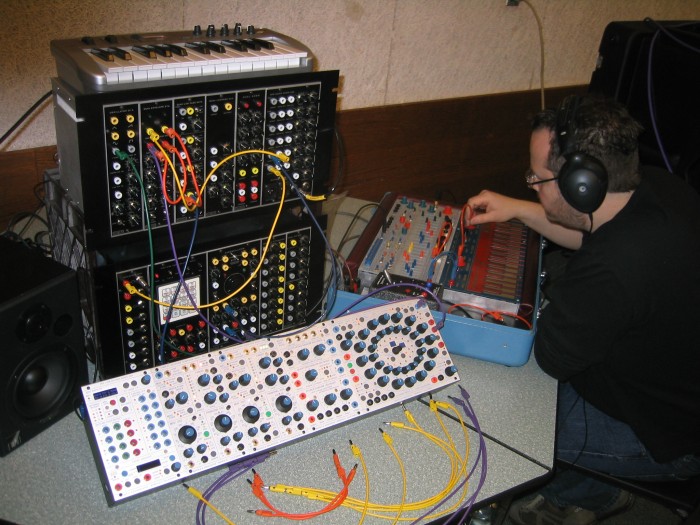
Dave Smith Mono Evolver - New Flickr Shots
 flickr by nourogg. Title link takes you to more including a nice one with a Indigo Redback (click through to the right).
Hartmann Neurons For Sale

Update via the comments worth noting. But the keyboard version is just too damn sexy.
"We have been servicing them since we we're the U.S. Distributor for a while but only to our customers. But while there are still some spare parts around but some things there are not. So while the insides are essentially just a computer and a sound card you're still gonna have some problems depending on what knob/switch/display you break.
You should pick up a VS instead, they have almost almost every feature the hardware did and the controller is simple enough to probably be repaired by anybody. They were selling in Germany for like $150 for a while."
Title link takes you to shots pulled from this auction. Details below. Note that there are 10 available with a Buy it Now of $3,832.00. As usual, I no affiliation with this sale, just saving it for the archives of synth history... Via Melissa's Blog.
"Neuron's synthesis engine is powered by the technology found in neural networks (for more on this, see the section "Neural Networks"). It uses models as the basis for sound generation. In conceptual terms, these models are comparable to samples, and they are derived by analyzing audio samples. This means that in principle, any auditory event can provide the raw material for creating and processing sound in Neuron. It ships with some 100 of these models on its internal hard disk. Though this is a huge store of sound design resources, you are free to analyze audio resources (samples) of your own, using our proprietary ModelMaker software, and archive them in the form of user models. These models contain the actual sound as well as the parameter sets that were captured during neural analysis. Parameter sets are subdivided in up to three levels, and they may be manipulated via the resynators' sticks. That makes Neuron the first synthesizer offering dynamic parameter assignment tailored specifically to the sound that you select for processing.
The Human Interface
The ergonomic design of many modern electronic music instruments comes courtesy of company founder Axel Hartmann's creative urges. His experiences with musicians and manufacturers flowed into the operating and handling principles that help make Neuron so special.
The Neuron's extraordinary user interface is a crucial feature alongside its innovative sound generation system. Our philosophy dictates that every Hartmann instrument is easy to understand and use, that it handles intuitively, and that makes discovering new technology fun. To live up to that promise, we were compelled to invent several new control features. The tactile experience of generating sound via Neuron is something entirely apart from what users have encountered with conventional synthesizers.
The control features feel like what they are - different, unprecedented. Powerful yet subtle sound-sculpting tools, they throw the window to a new and unexplored sonic vista wide open. Starting with great legacy sounds, the musician ventures forth on a quest for unknown sonic treats by cutting, tucking, snipping and sewing these time-tested sounds. He can do this with the delicate touch of a neurosurgeon or the harsh hand of a butcher. The intelligent Snapshot function lets him take pictures of every and any stop along his auditory journey. This lets him backtrack should he get lost or want to return to a "Kodak Moment".
All dynamic parameters are controlled via rotary encoders with an infinite control range. The displays and indicator panels provide direct visual reference to the settings for the current program even when switching sounds.
The technical specifications of Neuron
Template driven Multi-Component Particle Transform Synthesis with realtime controllable synthesis model parameters | ANN (Artificial Neural Network) controlled adaptive sound analysis for the parametric transformation of musical monophonic and polyphonic sounds | Glide | 2 Resynators with 3 parameter layers per Scape/Sphere, stick recording function, 1 ADSR modulation envelope per Resynator, 1 amp envelope per Resynator (ADSR), 1 definable envelope (4 levels/4 times, also definable as pitch envelope) | Slicer for the generation of multi-dimensional, cyclic modulation | Silver unit with multi-mode filter with 3 parameter levels and a maximum of 3 ADSR envelopes (1 per parameter level), 2 Part Multi-FX processor (1 x Time FX / 1 x Frequency FX) | Surround unit with Stick-control (recordable) | Extra high-end delay (with tap function) and reverb
32bit internal signal path | digital signal processing with 32bit/64bit | floating point precision | high speed-CPU | 256 MB internal RAM | 20GB hard Disk
3 Cross-X-displays with Stick-controller and 4 back-lit LCD displays with 3 digit parameter level and 8 digit parameter name | 1 Control Center with 2x16 digit back-lit LCD display, X/Y stick and endless dial (encoder) with push/enter function | 12 endless wheels (encoders) with visual displays, 6 endless dials (encoders) | Controller unit with self centering, bi-directional stick-controller for pitch and modulation control (definable) | 1 definable endless-wheel (encoder) with visual display, 1 definable endless-dial (encoder) | Master volume dial | Large, backlit central on/off switch at rear of instrument | 5 octave (61 key) velocity sensitive, lightly weighted keyboard with channel aftertouch
Units shipping with app. 250 models / 200 sounds in memory / room for more then 200 setups | 4 times multimode | Amount of voices is dependent on the chosen neural synthesis model (up to 24) | Memory assignment and organization is achieved using a 10 button keyboard with up/down and 10's hold | Snapshot function for easy access to cache and instant saving and recall of edited sounds
Freely definable outputs (max. 6x Mono / max. 3 Stereo / 5.1 Surround) | Midi In / Out / Thru, USB port for external backup devices (CD-writers, Hard-Drives, Memory sticks etc.) and connection to a network | S/PDIF In / Out (digital, 44.1 kHz / 24bit), Stereo In, headphone connector, sustain pedal, freely definable switch and continuous controller connection
Power consumption: 250W | Dimensions: 952mm (w) x 98mm (h) x 373mm (d) | Weight: 17.5kg"

Monday, May 01, 2006
Casio CZ-101 Demo
Title link takes you to another one synth sample by memo on VSE, also saved here for posterity. Great sample.
Roland SH-09 Track
Title link takes you to a cool track made solely with the Roland SH-09, sent my way via Chris.
"Thought this might make you smile, it 's from my Roland SH-09 project page. I tried to see if I could capture the feeling of an early, cheesy synth composition ( i.e. Bruce Haack and miss Nelson which I love ). The track was made entirely on my modded SH-09, recorded and multi tracked in logic. I added a little tape delay and vintage spring reverb and the voice samples were a finishing touch. Hope you enjoy.
Chris"
I did. Thanks Chris!
"Thought this might make you smile, it 's from my Roland SH-09 project page. I tried to see if I could capture the feeling of an early, cheesy synth composition ( i.e. Bruce Haack and miss Nelson which I love ). The track was made entirely on my modded SH-09, recorded and multi tracked in logic. I added a little tape delay and vintage spring reverb and the voice samples were a finishing touch. Hope you enjoy.
Chris"
I did. Thanks Chris!
TR-808.com
 Title link takes you to TR-808.com where you will find specs, pics, mods, samples, the manual and more. Via Music Hardware.
AHNE 2006 Maplin
 Shot of the Maplin via AHNE 2006. Description below by Eric (alt-mode).
"It's a 4 oscillator monosynth with a pin matrix for patching (the pins are not compatible with EMS synths). It has some unusual routings in that there are no oscillator outputs on the matrix. All of the oscillators go into 3 different mixers that then can be routed to other modules.
It has two filters and a phaser as well as some LFOs, I think. It sounded pretty good in my limited use. It did have some very odd EGs with multiple segments and different terminology. I didn't have time to wrap my brain around the EGs.
The real issue with Maplins is that they were sold as kits so the quality is based on the skills of the builder. David was telling me that this particular unit was assembled by someone who was very very good. He said there are wires that go across the chassis, as part of the design. Each wire is tagged on each end so there is no need to trace the wires. All of the soldering is exceptional and given that it is working today after 20+ years is testament to good construction skills.
Eric"

Nice Lawn
 Shot of 5 Yamaha CS80s sent the the CS80 list by Kent.
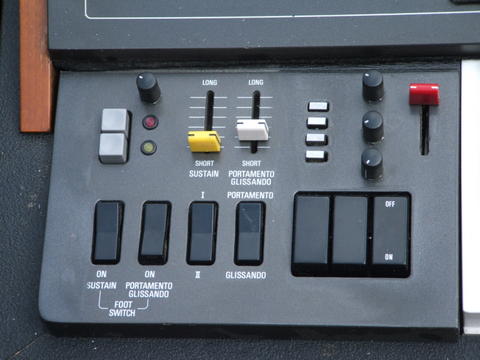 Check out these mods on one of them:
"The knobs and sliders on the mod panel is the Dynamic Unison, Dimension C and Phase Shifter controls.
The Dynamic Unison is a auto switching mono to poly controller using the old on/off, chorus and tremolo buttons.
Then there is a Dimension C chorus/ensemble like the Boss CE1. These use the four silver buttons for the different fx amounts. And the on off is the old wha button.
The Phase Shifter is a four, eight and twelve stage unit with stepping and rise only and fall only.
Other mods on it include midi in ,through and out. Yes that's right midi out :)"
I asked, and yes, it does transmit poly-aftertouch.
Update via nkdent in the comments: "Well the Dimension C has those tiny silver buttons and is much more compact so I'd say he probably mounted the board for one inside. The history is that the Dimension D came first and the C is a budget but still guitar pedal version that's analog and comes pretty darn close. A big difference is the D has stereo or mono balanced ins and stereo outs. The C has only a mono in and a choice of mono or stereo outs and is unbalanced with a much tighter packed circuit board that's a fraction of the size of the D.
The settings are pretty similar (there is no variable speed on either, just presets of increasing intensity) though at least one is more different than the other 3 if you compare the 2."
OB-1 Resurrected
 This one in via Brian Comnes.
"There has been a burst of Email recently on AH list extolling the Bay Area's synth tech Greg Montalbano aka Klosmon so I thought I'd get you in the mix. I was so happy that he brought my OB-1 monosynth back to life from leaky battery hell a couple of months ago that I put together this little graphic to commemorate the event. The battery damage was like the Eveready Bunny, it just kept going and going and going.....but then Greg kept replacing and replacing and replacing, and voila - phatt bass lines redux."
Sunday, April 30, 2006

Florian Schneider's Roland System 700

"The unit up for action was formerly owned by electronic music legend Florian Schneider of Kraftwerk (proof available). It has recently been fully calibrated, restored, and cleaned by analog synthesizer specialist Sebastian Niessen (SND)." Title link takes you to shots pulled from this auction. Via Moogulator.
Details of auction saved for posterity:
They don't come any nicer or more prestigious:
You are bidding for Roland System 700 Main Unit. The System 700 was Roland's flagship synthesizer in the late 70s and early 80s and is probably the most elaborate modular synthesizer ever made.
The unit up for action was formerly owned by electronic music legend Florian Schneider of Kraftwerk (proof available). It has recently been fully calibrated, restored, and cleaned by analog synthesizer specialist Sebastian Niessen (SND).
All modules are in pristine, near perfect condition and fully original (no modifications). The case and its tolex is also in very good condition (no cuts, only a few very minor scratches).
The red and white toggle switch caps have been removed for purely aesthetic reasons, as has the red envelope trigger button, which was replaced by a black one. The original parts are included and can easily be put back into place.
The system's configuration is fully original and contains the following modules (some of which are grouped together):
3 voltage controlled oscillators (full range)
2 voltage controlled oscillators (low frequency)
1 clock oscillator
1 reference oscillator
1 noise generator
1 voltage controlled low-pass filter (24dB/octave, voltage controllable resonance)
1 voltage controlled multimode filter (12dB/octave, low-, band, and high-pass)
2 voltage controlled amplifiers (for insiders: the good ones using the BA662 chip, not the CA3080)
1 ring modulator
1 voltage controlled phaser w. lfo
1 spring reverb
1 3-channel stereo output-mixer
1 3-channel audio/cv-mixer w. bipolar outputs
1 preamplifier
1 envelope follower
1 lag processor
1 sample & hold
2 multiple jacks
The unit's power supply is currently set to 240 volts. It can internally be switched to 100, 115, 220, and 240 volts. Serial number is 090173. For more information check vintagesynth.com/roland/sys700.shtml.
Shipment worldwide, please ask me for shipment fee BEFORE bidding. Shipping and insurance is not included in the price.
This is a private auction. There´s no warranty and I won´t take it back again! Happy bidding!
AHNE 2006 Shots
 Title link takes you to some pics via Steve from this year's AHNE.
 You are looking at a shot of some homebrew drums. Click for a bigger image. Absolutely gorgeous work.
Via this post on the-gas-station.
Update: The following are notes via Steve on AH. I thought the Buchla 200e comment was kind of funny.
" Highlights for me..
-Getting a sound out of the 200e
-Using the spectacular JKJ CV3 MIDI/CV to finally let my P3 and modular play together. : )
-Seeing some amazing DIY work. circuits, panels, cabinets.. bravo guys!
-20 solid minutes of EMS AKS patching/tweaking. Now I serioulsly want one of these!
---Wish I could have patched the Serge a bit!! aargh, maybe next year."
The Breadboard Band
 Another via Brian Comnes. "The Breadboard Band is a performing band that uses breadboards made of freely constructed electronic circuits to play music. We produce audio and visual expression through the most minimal, fundamental elements in the form of showing the electronic components of an instrument while directly touching and forming the electronic circuit by hand." Title link takes you there.
Siel DK600
 Just a shot of the Siel DK600 sent my way via Brian Comnes. I always wanted one of these for some reason. Brian also pulled the following from the sale details. "The DK-600 is Siel's unique Italian take on the mid-eighties programmable polysynth with MIDI implementation (badged as the Opera-6 in the UK). Just like the Juno-106 and Poly-61 of the time, the Siel is a 6 voice synthesizer with straight forward programming, simple effects and digitally controlled analog oscillators (DCO's). However, the Siel, having dual oscillators per voice sounds thicker than the Juno or Matrix because it's got 12 oscillators! And because they're DCO's, you know they'll always remain stable and in-tune even though they are analog in nature.
 The DK-600 has many other nice features such as complete MIDI implementation. There are 3 LFO's for extreme modulation. Both the filter and amplifier have standard ADSR envelope sections. And like similar synths, all the sliders and buttons are intuitively placed on the front panel for hands-on real-time programming."
Sounds thicker because it has 12 oscillators? Um... Yeah... It's still only two per voice. The Matrix also has 12, two per voice, and the 106 has a sub osc, although you can't detune the sub osc.
Waldorf Microwave I Samples and Manuals
Title link takes you to a page with a ton of samples of the Microwave I by Dr. Georg Müller. You can find the manuals courtesy of Georg here.
Shot of the limited green Microwave
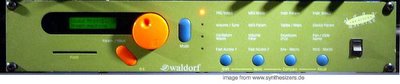
Shot via this post via sequencer.de.
Shot of the limited green Microwave
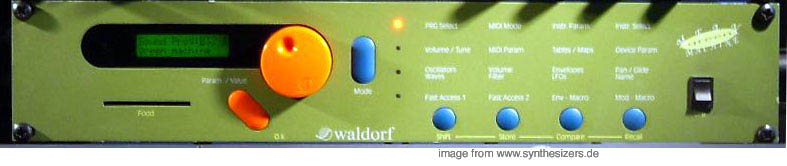
Shot via this post via sequencer.de.
Pro One Modifications
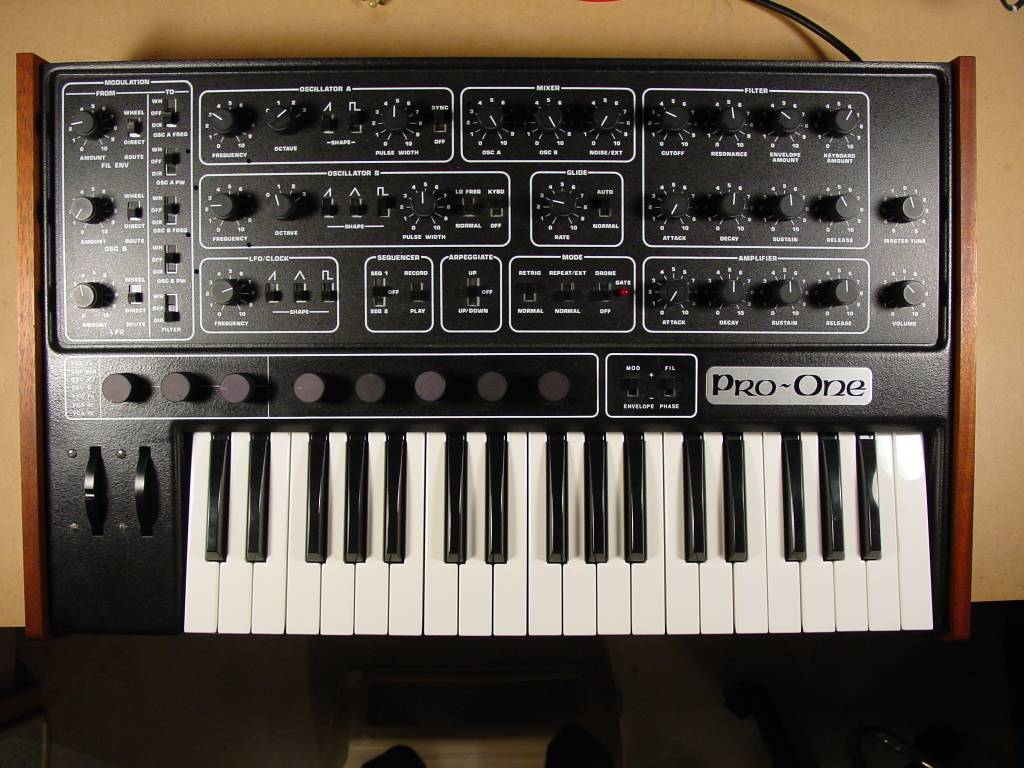 Title link takes you to more details, pics, and samples. Do listen to the samples. That Sample and Hold one is absolutely sick.
"Modification Summary:
Replaced the white noise source with a new circuit that provides white, pink, red, and infra-red noise. A rotary switch selects the noise colour.
The new noise source can act as a modulation source in addition to its role as an audio signal. A pot sets the noise level fed to the buses. A rotary switch selects whether the noise signal feeds the Direct or Wheel modulation buses.
Added a Sample & Hold circuit. The new noise source is the signal input to the Sample & Hold. The LFO square wave is the clock. The Sample & Hold output can be used as a modulation source.
The pulse width of the LFO signal can be adjusted from 0% to 100% with a pot.
The LFO signal can be inverted. A rotary switch selects LFO non-inverted, LFO inverted, or Sample & Hold as a modulation source.
Added a triangle wave for oscillator A. A pot allows manually mixing between the triangle and sawtooth waves.
Filter resonance can now be used as a modulation destination. A rotary switch selects from either the Direct or Wheel modulation buses as a source.
The filter envelope can be inverted. Inverted and non-inverted envelopes can be applied to filter frequency and the Direct or Wheel modulation buses via two slide switches.
The filter frequency signal from the Kenton MIDI interface can be assigned to the Direct modulation bus. A pot sets the signal level fed to the bus."
Guess the Synth on Sunrise.de
This one sent my way via Dr. Georg Muller. I remember this back in 2002. Title link takes you to a page with 33 samples of the same type of sound playing the same thing. Warning: if you click on the answer for a given sample you will be taken to all the answers. Forget about the challenge unless you are into that sort of thing. Instead, just check out how these synths compare to eachother for a given sound. Synths include Andromeda, CS-50, CZ-1000, D-550, DW-8000, EHX Mini Synth, JV-1080, K1r, K3m, Luna Blue Synth, Luna Miniscope, Luna Modular, Luna Pro One, Luna Saturn, Luna uknow 007, Matrix-1000, micro Q, MKS-70, MS 20, MicroWave, MicroWave II, Pro 52, Pulse, Rack Attack, Reason Substractor, Sid Station, Soundforum Synth, TG77, VL-1, VZ-1 into 4 Pole.
Saturday, April 29, 2006
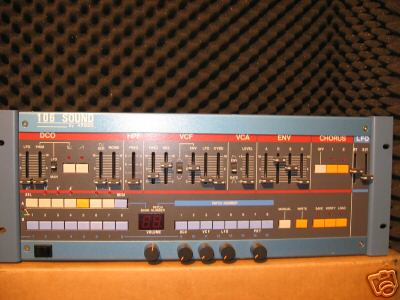
MEK Arpeggiator
Interesting. According to this post on VSE the manual for the MEK includes a section on an Arpeggiator. The PEK and Evolver do not have this.
"Arpeggiator
As a last-minute addition, a simple arpeggiator was included as a hidden function. As
a hidden function, the operation is a little less than obvious, but the assumption is that
it’s nice to have anyway.
Note: The Arpeggiator settings are not saved as part of the Program.
Basic operation is simple: while holding the RESET switch, simply hit the Sequencer 1
switch for an Up direction arpeggio, Sequencer 2 for Down, 3 for Up/Down, and 4 for
Assign, which remembers the order the keys are held. The sequencer switch LED
will blink indicating which mode is currently selected.
Note: You can change modes at any time while playing, or while the keys are
latched.
The Sequencer clock determines the speed, which means it also takes into account
the Clock Divide value. This gives a very wide range of speed, and also enables
swing timing on the arpeggio. And, it can sync to MIDI.
To latch an arpeggio, simple hit the WRITE switch, and the notes will be held when
you remove your fingers from the keyboard. If you then hit another key, it will also be
latched. Hit the WRITE switch again to un-latch.
Note: You can hit the WRITE switch with no keys held, and then just start hitting
the keys you want in the arpeggio, and they will be latched.
Hit the RESET switch to clear the latched notes.
Note: You can only have any specific key played one time in the arpeggio; ie if
you are latching keys, and hit the same note twice, it will only latch the most
recent hit.
To stop the Arpeggiator, simply hit the START/STOP switch."
"Arpeggiator
As a last-minute addition, a simple arpeggiator was included as a hidden function. As
a hidden function, the operation is a little less than obvious, but the assumption is that
it’s nice to have anyway.
Note: The Arpeggiator settings are not saved as part of the Program.
Basic operation is simple: while holding the RESET switch, simply hit the Sequencer 1
switch for an Up direction arpeggio, Sequencer 2 for Down, 3 for Up/Down, and 4 for
Assign, which remembers the order the keys are held. The sequencer switch LED
will blink indicating which mode is currently selected.
Note: You can change modes at any time while playing, or while the keys are
latched.
The Sequencer clock determines the speed, which means it also takes into account
the Clock Divide value. This gives a very wide range of speed, and also enables
swing timing on the arpeggio. And, it can sync to MIDI.
To latch an arpeggio, simple hit the WRITE switch, and the notes will be held when
you remove your fingers from the keyboard. If you then hit another key, it will also be
latched. Hit the WRITE switch again to un-latch.
Note: You can hit the WRITE switch with no keys held, and then just start hitting
the keys you want in the arpeggio, and they will be latched.
Hit the RESET switch to clear the latched notes.
Note: You can only have any specific key played one time in the arpeggio; ie if
you are latching keys, and hit the same note twice, it will only latch the most
recent hit.
To stop the Arpeggiator, simply hit the START/STOP switch."

1100 Little Phattys Sold
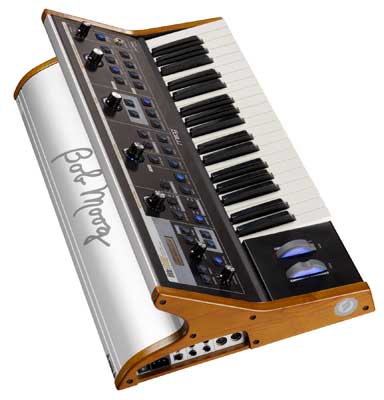 Title link takes you to the news post on Sonic State.
 “We expected our core customers to be very excited about owning a new Moog synth that is also a tribute to Bob. Our Moog Authorized dealers anticipated this as well and have absorbed 90% of our planned limited edition model. We are very pleased with the market’s reaction to the Little Phatty, and I am confident musicians will be thrilled with the product when they hear it. It’s definitely a Moog.”
Friday, April 28, 2006
Thomas Dolby Video Blogs
 Title link takes you there.
"Hey, I’m thinking it might be nice to add an occasional vidblog/podcast to the site. I dashed this one off as a trial. It’s a clip from my song The Flat Earth at last February’s TED Conference (Technology, Entertainment and Design) and I’ve added a voiceover explaining what I’m doing–a bit like a ‘Director’s Cut.’"

New Waldorf Products to be Announced Winter NAMM 2007

Click here for a Google translated interview of Joachim Flor of Waldorf. Replace "Whale Village" with "Waldorf" when you get there. : ) Here's a link to the original in German. This one sent my way via Dr. Georg Müller.
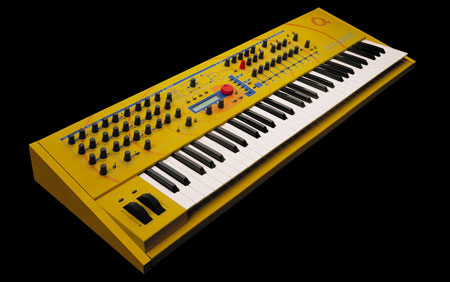 "AMAZONA.de:
What might we expect from the new Waldorf?
JOACHIM FLOR:
Of course there will be new Waldorf products... the future developments will be characterised by innovation, unmistakable sound, optimal ergonomics, excellent design, user friendliness and all that the name Waldorf stood for, stands and will continue to stand. But we'll let you be surprised. Our first goal is the winters NAMM 2007 in Anaheim!"
I can't wait. Something tells me Winter NAMM 2007 will be the most hyped NAMM in a long, long time. : ) Thanks for sending this one in Georg!
Update via Mr. Array in the comments:
"Wheee!
Here is another message, this time from Stefan Stenzel where he more or less confirms that there will be paid OS updates for legacy Waldorf products:
http://lists.waldorf.synth.net/pipermail/user-forum/2006-April/004774.html"
"Since we are not a legal successor of the preceeding waldorf companies,
we cannot provide further upgrades for free. However, rest assured that
the price we will charge for future upgrades will be reasonable."

Andromeda A6 Pads and Strings
 Tomislav Babic sent the following samples to AH. I asked him if I could put up a post on them and he said yes. Here there are. Enjoy. Title link takes you to Tomislave Babic's website.
http://www.babic.com/SYN/A6/clc_A6-BerlinPad.mp3
http://www.babic.com/SYN/A6/clc_A6-MeltsInYourMouth.mp3
http://www.babic.com/SYN/A6/clc_A6-NotchPWMPad.mp3
http://www.babic.com/SYN/A6/clc_A6-VintageStrgs.mp3
What Makes a Moog Punch
 "Looking at the Minimoog's amplitude envelope (Fig. 1) reveals that even with the sustain set to minimum, there's about 20-30 milliseconds where the sound stays at maximum level before the decay begins. There is no way to eliminate this short period of full volume sustain; it's part of the Minimoog's characteristic sound. It's also what happens to percussive sounds when you clip, limit, or compress them."
Title link takes you there.
Eurorack Modular - New Flicrk Shot
 flickr by unrest. Title link takes you to a few more. Note Eurorack refers to the physical dimensions of the rack modules not the manufacturer.
WEM Nightshade

via this auction
"Vintage WEM Nightshade analog synth form the '70.
This item is VERY RARE. Sonic Boom (Spacemen 3, EAR) tell me that only 180 was produced from wem. WEM is almost know for their amps or analog echo used by Pink Floyd in the '70. This synth is VERY FAT sounding!!! It is monophonic. 2 osilators with many sound options.... see the foto for spec. 220/110V. In pristine conditions with original cover and power cable (not pictured), full working but sold as is due to its age."
Thursday, April 27, 2006
Soviet Synthesizers Sample Collection
 Hmm... I had this one ready to go on 4/18, but I missed publishing it. Oh well... Here it goes. I'm not big on posting sample collections, but this one does look interesting. Title link takes you to SoundEngine.com's Soviet Synths page with sample links on the bottom. They have a sample disk of over 1000 samples of Soviet made synths. Check out the pdf for the synths used including images and details.
"More than 600Mb of analog synthesizer samples are available - fat bass lines, warm pads, aggressive razor leads, smooth classic waveforms, space FX, sounds of noises and machines, percussion, original real time phrases and much more...Thanks to unique architecture and powerful resonant filters, Soviet-made synthesizers have inimitable color in their sound; you get a lot of cool stuff for creating killer patches!"
CDM Site Issues
If you've notice problems getting to Create Digital Music, here's why.
"Due to avoidable circumstances with Create Digital Music's web host,
1and1.com, CDM is currently inaccessible (and has been since about
11:30am yesterday, Eastern time). We are moving the site to an
upgraded server to restore service immediately, and will take measures
to make sure this doesn't happen again. Thanks for your patience."
The unofficial line: 1+1 screwed me over and took my site hostage,
moving it without warning to an "auxilliary server" that they knew
wouldn't handle the load so they could ransom out a more expensive
dedicated server account, even though my server logs suggest I was
using a fraction of my available bandwidth and there was no major
traffic spike yesterday.
I'm working now on rescuing the site, but that's the situation. You
can bet once my site is safely off 1+1's server, I'll have a thing or
two to say about webhosts; for now, I have to keep silent.
Peter"
"Due to avoidable circumstances with Create Digital Music's web host,
1and1.com, CDM is currently inaccessible (and has been since about
11:30am yesterday, Eastern time). We are moving the site to an
upgraded server to restore service immediately, and will take measures
to make sure this doesn't happen again. Thanks for your patience."
The unofficial line: 1+1 screwed me over and took my site hostage,
moving it without warning to an "auxilliary server" that they knew
wouldn't handle the load so they could ransom out a more expensive
dedicated server account, even though my server logs suggest I was
using a fraction of my available bandwidth and there was no major
traffic spike yesterday.
I'm working now on rescuing the site, but that's the situation. You
can bet once my site is safely off 1+1's server, I'll have a thing or
two to say about webhosts; for now, I have to keep silent.
Peter"
MEK #6 Arrives
 They are officially shipping. This is the first one I've heard of being delivered. It belongs to Jason Proctor. Title link takes you to more shots. Gorgeous under the Prophet VS. According to Jason, "the thing is cute beyond belief and sounds lovely. i thought it would cross over a lot with my VS, but the sonic character is different altogether."

Midiweb.de
 Bookmarking this one for my own reference. Title link takes you there. Midiweb.de makes the following software editors:
Korg EM-1 Editor (pictured)
Tyros - Magic Voice Generator
XG - Wizard
XG - Gold
via Moogulator.
Mark Pulver's Time - The Olde Days
Click here for a 7.25M mp3 Mark Pulver sent to AH. Below are the notes on the track also sent to the list after quite a few people asked. I asked Mark if I could put this up and he say yes. It's a fascinating piece. Thanks Mark!
"The track was done in 1979 (possibly early 1980) and is called "Time". The setup was the SIUC (Southern Illinois University - Carbondale) music lab - which is sadly no longer there.
The lab was "cool" in the sense of what a lot of us olde tymers here would consider cool. Homebrew quad system, _PLATE_ reverb, modified Hammond tank reverb, upright piano with the back torn off for access to the harp ("prepared piano" for you olde folkes), an AKS, a bunch of tape decks, microphones, patch panels and... a nicely outfitted Moog modular. It was a System 55 with an extra top cabinet, two voice keyboard and a ribbon.
ahhh... my first love. :)
When I showed up, I brought along my (then brand new!) Rev 2 P5 and a MXR digital delay. The MXR was the first digital piece in the lab. :)
Anyway.. "Time" is around 25 tracks of stuff... noises, pads, pans, textures, etc. About 80% of what you hear as polyphonic is - it's the P5. The other 20% is multitracking from the Moog, or a single big honkin' multi-oscillator/multi-output patch.
"highlights" (ewww!) might include the constant atmosphere that's walking around left & right sides. That's the Moog driven by the 960. A killer combo that I DEARLY miss - the aural effect of the sequence changing is actually just from starting/stopping/triggering the 960 at different points or with different filter accents, speeds, etc. It's the same sequence.
There are a couple of big poly slides into oblivion - that's an old trick on the P5 (set unison, set glide, hold a note, kill unison, hit a chord - I think that's how it worked).
The ambience is generally the hacked Hammond tank, though the MXR is in there as well, usually _after_ the tank so that you get the smear.
Compression is courtesy of analog tape. The levels were pretty hot during some of the "tracks"... saturation is king. Digital today can't really touch something like this.
The piece used to be longer - about 11 minutes. I dunno that I still have that version. The front end was a bunch of babble over noises... nothing really exciting.
-------- start of typing while listening
The "Pink Floyd" sounding leads are all P5... The chordal undertone is P5. The airyness is courtesy of the Moog's fixed filter - VERY underutilized module. The "noise sparkling" that flutters around on top of the ping-pong sequence is P5.
If you can't tell, there was no "composition" to the piece. It's all vamping. I don't really remember where I started - if I had to guess it would be the P5 poly work... that was what I was into during that time.
The rushing and noise swirls to the end are both the Moog and P5. If it sounds deep and "OMG!" that's the Moog. That ringing tone is all Moog.
One thing about the bouncing around at the end and at a couple of spots in the middle... If you listen to it on speakers, and put yourself in the point of an equilateral triangle (based on the distance between the speakers) then you should be able to pick out a hidden 3rd channel. Along this time I was doing some work with burying a track by flipping it's phase across the L & R channels. if the L/R level is the same, and if you're at the point, then the track disappears. Move your head a bit and it'll show up.
Yes, this has been done a lot, but remember - this was 1979. :)
Anyway.. It's nothing big, but it's in there. I have NO idea how compressing this into MP3 would whack this around.
Oh! Love the tape noise at the end? There're a LOT of bounces in here with no noise reduction.
---- end of typing while listening ----
I think that's about it. Basically, the gear was minimal, it was just the right gear for the track - and the time. Putting this to tape helped a LOT, there's no way it would sound this "warm" (oh Gawd, not THAT word!) today.
fwiw, and I've said this before, THIS marks the time in my head that I'd love to get back to musically. I've never had more fun or been more satisfied than during this time.
... but, I've never been able to find it again. sigh.
Thanks for listening - and thanks for the comments!"
"The track was done in 1979 (possibly early 1980) and is called "Time". The setup was the SIUC (Southern Illinois University - Carbondale) music lab - which is sadly no longer there.
The lab was "cool" in the sense of what a lot of us olde tymers here would consider cool. Homebrew quad system, _PLATE_ reverb, modified Hammond tank reverb, upright piano with the back torn off for access to the harp ("prepared piano" for you olde folkes), an AKS, a bunch of tape decks, microphones, patch panels and... a nicely outfitted Moog modular. It was a System 55 with an extra top cabinet, two voice keyboard and a ribbon.
ahhh... my first love. :)
When I showed up, I brought along my (then brand new!) Rev 2 P5 and a MXR digital delay. The MXR was the first digital piece in the lab. :)
Anyway.. "Time" is around 25 tracks of stuff... noises, pads, pans, textures, etc. About 80% of what you hear as polyphonic is - it's the P5. The other 20% is multitracking from the Moog, or a single big honkin' multi-oscillator/multi-output patch.
"highlights" (ewww!) might include the constant atmosphere that's walking around left & right sides. That's the Moog driven by the 960. A killer combo that I DEARLY miss - the aural effect of the sequence changing is actually just from starting/stopping/triggering the 960 at different points or with different filter accents, speeds, etc. It's the same sequence.
There are a couple of big poly slides into oblivion - that's an old trick on the P5 (set unison, set glide, hold a note, kill unison, hit a chord - I think that's how it worked).
The ambience is generally the hacked Hammond tank, though the MXR is in there as well, usually _after_ the tank so that you get the smear.
Compression is courtesy of analog tape. The levels were pretty hot during some of the "tracks"... saturation is king. Digital today can't really touch something like this.
The piece used to be longer - about 11 minutes. I dunno that I still have that version. The front end was a bunch of babble over noises... nothing really exciting.
-------- start of typing while listening
The "Pink Floyd" sounding leads are all P5... The chordal undertone is P5. The airyness is courtesy of the Moog's fixed filter - VERY underutilized module. The "noise sparkling" that flutters around on top of the ping-pong sequence is P5.
If you can't tell, there was no "composition" to the piece. It's all vamping. I don't really remember where I started - if I had to guess it would be the P5 poly work... that was what I was into during that time.
The rushing and noise swirls to the end are both the Moog and P5. If it sounds deep and "OMG!" that's the Moog. That ringing tone is all Moog.
One thing about the bouncing around at the end and at a couple of spots in the middle... If you listen to it on speakers, and put yourself in the point of an equilateral triangle (based on the distance between the speakers) then you should be able to pick out a hidden 3rd channel. Along this time I was doing some work with burying a track by flipping it's phase across the L & R channels. if the L/R level is the same, and if you're at the point, then the track disappears. Move your head a bit and it'll show up.
Yes, this has been done a lot, but remember - this was 1979. :)
Anyway.. It's nothing big, but it's in there. I have NO idea how compressing this into MP3 would whack this around.
Oh! Love the tape noise at the end? There're a LOT of bounces in here with no noise reduction.
---- end of typing while listening ----
I think that's about it. Basically, the gear was minimal, it was just the right gear for the track - and the time. Putting this to tape helped a LOT, there's no way it would sound this "warm" (oh Gawd, not THAT word!) today.
fwiw, and I've said this before, THIS marks the time in my head that I'd love to get back to musically. I've never had more fun or been more satisfied than during this time.
... but, I've never been able to find it again. sigh.
Thanks for listening - and thanks for the comments!"

Freeez Keytar Action
 Some keytar action for you. Title link takes you there.
And then there is this. No synth connection other other than a song of the same name with a lead singer that looks a lot like David Lee Roth. BTW, I always mixed these two songs up. At one point I actually questioned if they were the same song, just redone from the "David Lee Roth" version to the Freeze version. I never bothered to look them up, becaue I really didn't care other than the "hey, I thought I heard this before and it sounded different." But now I know. Odd that one of my life's little bizarre and forgotten mysteries is rediscovered and answered on a synth forum. I actually had that little moment of clarity, "ah.. so that's what it was..."
Via this VSE post.
BugBrand
 I thought I had a proper post on BugBrand, but apparently not. I had this Weevil post, followed by this. Only Weevils! So here you go, a proper BugBrand post. Title link takes you there. Via Analog Industries.
Wednesday, April 26, 2006
Thomas Dolby Interview
Title link takes you there.
"BD: What is your take on analog nostalgia and the resurgence of homebrew synths? People are taking the SID chips out of Commodore 64 computers and wreaking havoc; Products like the SID Station, TB303 cloning, x0xb0x, countless others...
TMDR: Yeah, I mean, I'm all for it, you know, I think it's fantastic the level to which electronic music has really sort of permeated. When I started out in the late 70s there were only really a handful of us doing it. There was myself and Throbbing Gristle and Cabaret Voltaire, and a few other people. Synthesizers were still something of a rarity. And my generation were inspired by the ones that went before us; the Fripps and the Enos of the world and Kraftwerk, obviously, people like that. But we were developing this stuff in parallel to punk rock and punk of course stole the headlines. It was only really in the 80's when bands like The Human League and New Order and Depeche Mode starting having bonafide chart hits that the electronic music movement really sort of went mainstream. And then the prices started to come down, you saw personal computers getting in there, and suddenly my $120,000 Fairlight was looking like a useless antique. "
"BD: What is your take on analog nostalgia and the resurgence of homebrew synths? People are taking the SID chips out of Commodore 64 computers and wreaking havoc; Products like the SID Station, TB303 cloning, x0xb0x, countless others...
TMDR: Yeah, I mean, I'm all for it, you know, I think it's fantastic the level to which electronic music has really sort of permeated. When I started out in the late 70s there were only really a handful of us doing it. There was myself and Throbbing Gristle and Cabaret Voltaire, and a few other people. Synthesizers were still something of a rarity. And my generation were inspired by the ones that went before us; the Fripps and the Enos of the world and Kraftwerk, obviously, people like that. But we were developing this stuff in parallel to punk rock and punk of course stole the headlines. It was only really in the 80's when bands like The Human League and New Order and Depeche Mode starting having bonafide chart hits that the electronic music movement really sort of went mainstream. And then the prices started to come down, you saw personal computers getting in there, and suddenly my $120,000 Fairlight was looking like a useless antique. "


PREVIOUS PAGE
NEXT PAGE
HOME

© Matrixsynth - All posts are presented here for informative, historical and educative purposes as applicable within fair use.
MATRIXSYNTH is supported by affiliate links that use cookies to track clickthroughs and sales. See the privacy policy for details.
MATRIXSYNTH - EVERYTHING SYNTH
© Matrixsynth - All posts are presented here for informative, historical and educative purposes as applicable within fair use.
MATRIXSYNTH is supported by affiliate links that use cookies to track clickthroughs and sales. See the privacy policy for details.
MATRIXSYNTH - EVERYTHING SYNTH