Friday, November 03, 2006
Korg Lambda Samples
Title link takes you to a 4.09M sample of the Korg Lamdba via stalla on this VSE thread. Also mirrored here.

Thursday, November 02, 2006
Steiner Parker Synthacon (with RC-20 Loop Station) live 2
YouTube via matrixsynth
sent my way via vgermuse. Be sure to check out this post for the previous video.
marjorie fair recording session
Title link takes you to the set. via sameli.
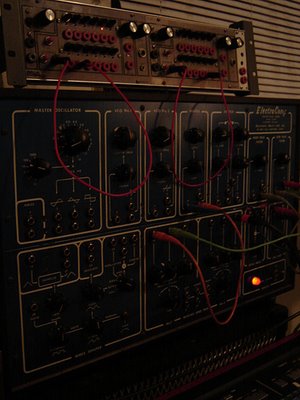
Electrocomp 200 and dual Paia sequencers

Rack mounted circuit bent speak and spell, Roland SH-101 and more

bit strangler

Electrocomp 200 and dual Paia sequencers

Rack mounted circuit bent speak and spell, Roland SH-101 and more

bit strangler
See dealers on the right for pricing and availability on gear.
LABELS/MORE: Circuit Bending, PAiA, Roland, Speak and Spell
LABELS/MORE: Circuit Bending, PAiA, Roland, Speak and Spell
Steiner Parker Synthacon

Image sent my way via vgermuse. I'm uploading another video and will post it shortly. Be sure to check out this post for the previous video.
Roland System 100
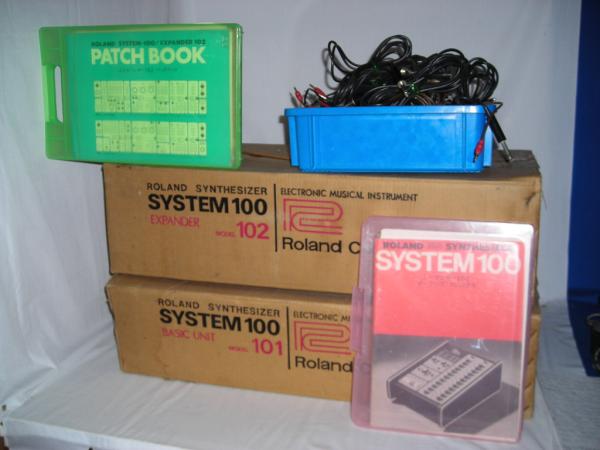 Title link takes you to shots pulled via this auction. For some reason I love seeing the old packaging almost more than the synths. Shots are harder to find and it gives you a sense of what it might have been like receiving the synth new.
Sent my way via alex.
Pearl
 "The Pearl SC-40 is a hybrid drumsynthesizer from 1985 with digital oscillators and analogue filters. It can be controlled by 8 drumpadinputs or Midi.
Instead holding whole drumsamples the oscillators got their sound almost from 1-cycle waveforms, 32 different waveforms are available.
Each voice is made of a strange combination between an oscillator, a noise generator, 3 egs and 2 bandpassfilters, creating a unique sound between early digital synths and analogue Simmons Drums.
SC-40 got a 4 voices at a time, the SC-20 2. The soundstorage is in the drumkits, in which you copy first one of the 128 preset sounds and then you can make your own settings. A drumkit includes 8 pads which means 8 different sounds are available at a time"
Title link takes you to the source with pdf manual on http://block4.com/research/
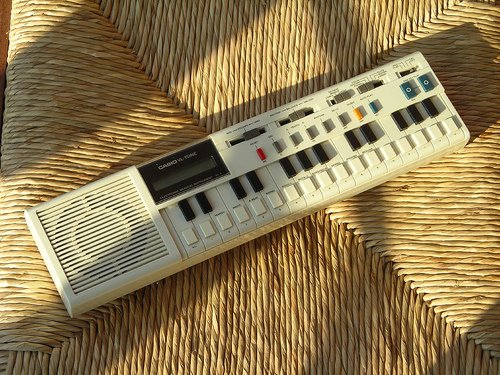

Dialin' up some 'vintage' sounds on the SQ1
 flickr by aaronazz.
Title link takes you to a couple more shots.
Synth Sniglets
The following was sent in via Jon. I've personally experienced Lostore and Loostore and a couple of very difficult yet amazing patches. Just love the feeling.
Two of which are pretty much lost forever. One day I will make them again, well, one of them I'm not so sure due to Fucknob. The Matrix-6 definitely suffers from Fucknob, yet... it has no knobs. Go figure.
Via Jon:
"during the mid-eighties there was a line of humor books called "sniglets". A sniglet being any word that doesn't appear in the dictionary, but should. the books had words, and pronunciation guides and some of them had cute little illustrations. lately i've been thinking about snigletizing our world of synth. i don't have anywhere good to actually post this stuff, but i figured you'd get a kick out of it.
Danqueue: The mysterious 3 second difference between the german and english versions of a kraftwerk song.
Lostore: any act during the process of saving a patch (fumbling with buttons, forgetting to hit "store" a second time, ect.) which causes the edits you just spend 2 hours working on to be lost.
Loostore: one's feeling of self worth immediately following a lostore.
Duplisynthous: any synth you own whose functions are completely subsumed by a more powerful synth you also own.
Fucknob: a parameter that, when altered, causes your patch to change in a way so that it never sounds quite like it did, even though the parameters value has been reverted. also any global parameter change which can neither be remapped nor turned off.
Knihl: an alteration to a parameter that causes the patch to become inaudible.
DODaist: a person who uses his synths internal effects on every patch.
Bypastist: a person who never uses internal effects.
Burchlay: the alternate universe where buchla designs became the dominant synth paradigm.
presetlude: the ditty played while demoing patches
fourier-1-k: planning your retirement on the assumption that by the time you hit 65 softsynths will be good enough that you can sell your hardware."
Feel free to add or modify the list in the comments.
Two of which are pretty much lost forever. One day I will make them again, well, one of them I'm not so sure due to Fucknob. The Matrix-6 definitely suffers from Fucknob, yet... it has no knobs. Go figure.
Via Jon:
"during the mid-eighties there was a line of humor books called "sniglets". A sniglet being any word that doesn't appear in the dictionary, but should. the books had words, and pronunciation guides and some of them had cute little illustrations. lately i've been thinking about snigletizing our world of synth. i don't have anywhere good to actually post this stuff, but i figured you'd get a kick out of it.
Danqueue: The mysterious 3 second difference between the german and english versions of a kraftwerk song.
Lostore: any act during the process of saving a patch (fumbling with buttons, forgetting to hit "store" a second time, ect.) which causes the edits you just spend 2 hours working on to be lost.
Loostore: one's feeling of self worth immediately following a lostore.
Duplisynthous: any synth you own whose functions are completely subsumed by a more powerful synth you also own.
Fucknob: a parameter that, when altered, causes your patch to change in a way so that it never sounds quite like it did, even though the parameters value has been reverted. also any global parameter change which can neither be remapped nor turned off.
Knihl: an alteration to a parameter that causes the patch to become inaudible.
DODaist: a person who uses his synths internal effects on every patch.
Bypastist: a person who never uses internal effects.
Burchlay: the alternate universe where buchla designs became the dominant synth paradigm.
presetlude: the ditty played while demoing patches
fourier-1-k: planning your retirement on the assumption that by the time you hit 65 softsynths will be good enough that you can sell your hardware."
Feel free to add or modify the list in the comments.

Wednesday, November 01, 2006
That was one heck of a party...
 Happy day-after-Halloween via Lenny the Lemur.
Update you might recognize Lenny from the following two posts:
Lenny the Lemur and Dave Smith
Lenny the Lemur Rocking an MS20
Lenny the Lemur - Last Halloween


Steiner Parker Synthacon (with RC-20 Loop Station) live
YouTube via matrixsynth
Sent my way via vgermuse.
OSCar
 I try to keep auction posts limited to either interesting shots, details or the somewhat obscure and rare. This obviously falls into the latter, as the shots aren't the best and the details aren't particularly interesting. Title link takes you to the shots pulled via this auction. The details are from this emusician.com page.
EML Electrocomp 100
Note: links to listings are affiliate links for which the site may be compensated.


via this auction
There's a cat in the bunch. As always, if you are going to bid on this stuff, be careful. This one is Money Order only.

 Update1 via cornutt in the comments:
"Info on the EML 100 is surprisingly hard to find, compared to its better-known cousin, the 101. Here's a link to an email chain that discusses some of the differences. The 100 is actually a lot more rare than the 101."
Update2 via Laurie Spiegel in the comments; "Hi Matrix. The guy running that auction is in error. I've sent him messages saying the 200 was before the 100 but he doesn't believe me and won't change it. I want to correct the choronology before this misinfo spreads any further because once something's all over the net it's forever.
According to the 1st edition of Mark Vaile's book (the edition I happen to have here) the 200 dates from 1969, and the 100 came out in 1971. Mark gives 2 dates for the 200: 1969 on p. 128 and 1972 on p. 129. The p. 129 date was a typo.
I am just about certain from my own experience that the 100, with its black and white keyboard, was released after the 200 purely modular model and its Model 300 Controller. I visited EML in CT a couple of times and their eariler products were meant to be marketed for educational use, not live performance. Also I've owned a 100, a 200 and a 300 since the early 1970s and IMHO the 200 has a just plain older feel and style and concept.
Though my memory for specific dates may be a bit fuzzy 4 decades later, my paper records show I was hired in fall 1970 to teach at a college that had an Electrocomp studio based on the 200 modular synth its 300 controller.
If anyone has any info that differs from what I've written here, please post it. It was a long time ago.
Thanks again for a great site Matrix,
- Laurie Spiegel"
Peter Forrest's A-Z of Analogue Synthesizers confirms the order as well, although he has the 100 starting in 1970 vs. 1971. According to that book, the 200 came out in 1969 (1969 - 1980) and the 100 in 1970 (1970 - 1972). Regardless, the order is 200 followed by 100. Both books are listed in the Synth Books section.
Update3 via Sasha. The verdict is still out:
"I ran across some background info on the Electrocomp 100 from Christopher Landers who was a famous newscaster back in the day. Thought you might be interested as it seems to suggest that the EML100 was the first synth in the line and that the separate modules came later (as opposed to what Laurie Spiegel is saying here: http://matrixsynth.blogspot.com/2006/11/eml-electrocomp-100.html ). He said it would be ok to post this info and quote him.
I got mine directly from Walter Sear when I was in high school (I worked at his studio in NYC and was in the room when Keith Emerson was being taught how to work his new Moog C3). Sear had been working with Moog in a business deal until Moog brought in Musonics and Sear split. At that point, Sear found the EML guys in nearby CT and had them create a box that could take on Mini-Moog ...but with the two note deal. The Electrocomp thus became the first "polyphonic" synth--using the top and bottom notes played on the keyboard so the oscillators knew what command to carry out--and also the first device to use IC's. I believe it was later that EML came up with a "box" without a keyboard. I should mention here that Bob Moog, while being the exceptional engineer that he was ...with the higher invention of "voltage control" that permeated many more electronics systems than simply synths (such as medical devices). It was Sear who suggested using a keyboard controller (Moog was set on a resistance strip, which also showed up sitting on top of keyboards for a while). Controllers, back in those days, were the holy grail. It was Sear who experimenting early with the guitar controller. As he related to me: "We can control an oscillator with almost any instrument because we can determine what frequency the controller is making and send that information to the oscillator; the problem with the guitar and other stringed instruments is multiple strings. A guitar has six strings and you can have six oscillators but, which oscillator plays in reponse to which string?" Is that great or what?
Best, Sasha"
Update4 via mr.scappy in the comments: "I have a 100 and a blue-face 200, and each has a different address for EML screen-printed on the control panel. Both list P.O. Box H, but the 100 has the city address as Talcottville, CT, 06080, and the blue-face 200 has the address at Vernon, CT 06066. (Today the 06080 zip is specific only to MacDougall-Walker Correctional Institution. Interesting.)
All of my literature for EML synths shows the Vernon address, and the EML-100 is not included among the synths shown. Perhaps the 100 was built at the Talcottville location and all others at the Vernon location? This would seem to place the 100 first in line. Just a thought."
Update5: Sasha contacted Jeff Bachiochi who worked for EML. Here is what he had to say:
"If I'm not mistaken the 100 was the first keyboard synthy that EML produced but not the first synthesizer. The first was a studio type that was just oscillators, mixers, filters, sampler, and ring modulator connected by patch cords and manually controlled with knobs. Which blue was the original color of all EML products, the line quickly went into a brush aluminum style with etch black nomenclature. These were originally made for class room use and the blue paint used would chip off, from all the patch cord plugging and unplugging by the students. Ah, those were fun times."
followed by:
"Yes, Sasha, the first was the 200. That's how I got started with EML. My wife (then girl friend) told me that her High School music class had gotten this electronic music box and the address on the front was the local town. I stopped by the factory, which was in basement of one of the three co-owner's house. We began a long time friendship and I started to work for them as their first employee. The 300 came on line soon after using a keypad as the first crude kind of keyboard."
Update (6/29/2011) via Prosper in the comments:
"I now own this synth. It was refurbished and repaired in 2007 with the following mods. A) Filter has been opened up so the Filter Octave Switch goes one higher and one lower than on the synth. Very handy. B) For the Noise pot in the filter mixer, instead of going between white and pink noise it goes from white to OSC 1 output so OSC 1 does not have to patched into the filter mixer. Very handy.
I've pointed out the differences between the 100 and 101 on the VSE page for the 100."


via this auction
There's a cat in the bunch. As always, if you are going to bid on this stuff, be careful. This one is Money Order only.

 Update1 via cornutt in the comments:
"Info on the EML 100 is surprisingly hard to find, compared to its better-known cousin, the 101. Here's a link to an email chain that discusses some of the differences. The 100 is actually a lot more rare than the 101."
Update2 via Laurie Spiegel in the comments; "Hi Matrix. The guy running that auction is in error. I've sent him messages saying the 200 was before the 100 but he doesn't believe me and won't change it. I want to correct the choronology before this misinfo spreads any further because once something's all over the net it's forever.
According to the 1st edition of Mark Vaile's book (the edition I happen to have here) the 200 dates from 1969, and the 100 came out in 1971. Mark gives 2 dates for the 200: 1969 on p. 128 and 1972 on p. 129. The p. 129 date was a typo.
I am just about certain from my own experience that the 100, with its black and white keyboard, was released after the 200 purely modular model and its Model 300 Controller. I visited EML in CT a couple of times and their eariler products were meant to be marketed for educational use, not live performance. Also I've owned a 100, a 200 and a 300 since the early 1970s and IMHO the 200 has a just plain older feel and style and concept.
Though my memory for specific dates may be a bit fuzzy 4 decades later, my paper records show I was hired in fall 1970 to teach at a college that had an Electrocomp studio based on the 200 modular synth its 300 controller.
If anyone has any info that differs from what I've written here, please post it. It was a long time ago.
Thanks again for a great site Matrix,
- Laurie Spiegel"
Peter Forrest's A-Z of Analogue Synthesizers confirms the order as well, although he has the 100 starting in 1970 vs. 1971. According to that book, the 200 came out in 1969 (1969 - 1980) and the 100 in 1970 (1970 - 1972). Regardless, the order is 200 followed by 100. Both books are listed in the Synth Books section.
Update3 via Sasha. The verdict is still out:
"I ran across some background info on the Electrocomp 100 from Christopher Landers who was a famous newscaster back in the day. Thought you might be interested as it seems to suggest that the EML100 was the first synth in the line and that the separate modules came later (as opposed to what Laurie Spiegel is saying here: http://matrixsynth.blogspot.com/2006/11/eml-electrocomp-100.html ). He said it would be ok to post this info and quote him.
I got mine directly from Walter Sear when I was in high school (I worked at his studio in NYC and was in the room when Keith Emerson was being taught how to work his new Moog C3). Sear had been working with Moog in a business deal until Moog brought in Musonics and Sear split. At that point, Sear found the EML guys in nearby CT and had them create a box that could take on Mini-Moog ...but with the two note deal. The Electrocomp thus became the first "polyphonic" synth--using the top and bottom notes played on the keyboard so the oscillators knew what command to carry out--and also the first device to use IC's. I believe it was later that EML came up with a "box" without a keyboard. I should mention here that Bob Moog, while being the exceptional engineer that he was ...with the higher invention of "voltage control" that permeated many more electronics systems than simply synths (such as medical devices). It was Sear who suggested using a keyboard controller (Moog was set on a resistance strip, which also showed up sitting on top of keyboards for a while). Controllers, back in those days, were the holy grail. It was Sear who experimenting early with the guitar controller. As he related to me: "We can control an oscillator with almost any instrument because we can determine what frequency the controller is making and send that information to the oscillator; the problem with the guitar and other stringed instruments is multiple strings. A guitar has six strings and you can have six oscillators but, which oscillator plays in reponse to which string?" Is that great or what?
Best, Sasha"
Update4 via mr.scappy in the comments: "I have a 100 and a blue-face 200, and each has a different address for EML screen-printed on the control panel. Both list P.O. Box H, but the 100 has the city address as Talcottville, CT, 06080, and the blue-face 200 has the address at Vernon, CT 06066. (Today the 06080 zip is specific only to MacDougall-Walker Correctional Institution. Interesting.)
All of my literature for EML synths shows the Vernon address, and the EML-100 is not included among the synths shown. Perhaps the 100 was built at the Talcottville location and all others at the Vernon location? This would seem to place the 100 first in line. Just a thought."
Update5: Sasha contacted Jeff Bachiochi who worked for EML. Here is what he had to say:
"If I'm not mistaken the 100 was the first keyboard synthy that EML produced but not the first synthesizer. The first was a studio type that was just oscillators, mixers, filters, sampler, and ring modulator connected by patch cords and manually controlled with knobs. Which blue was the original color of all EML products, the line quickly went into a brush aluminum style with etch black nomenclature. These were originally made for class room use and the blue paint used would chip off, from all the patch cord plugging and unplugging by the students. Ah, those were fun times."
followed by:
"Yes, Sasha, the first was the 200. That's how I got started with EML. My wife (then girl friend) told me that her High School music class had gotten this electronic music box and the address on the front was the local town. I stopped by the factory, which was in basement of one of the three co-owner's house. We began a long time friendship and I started to work for them as their first employee. The 300 came on line soon after using a keypad as the first crude kind of keyboard."
Update (6/29/2011) via Prosper in the comments:
"I now own this synth. It was refurbished and repaired in 2007 with the following mods. A) Filter has been opened up so the Filter Octave Switch goes one higher and one lower than on the synth. Very handy. B) For the Noise pot in the filter mixer, instead of going between white and pink noise it goes from white to OSC 1 output so OSC 1 does not have to patched into the filter mixer. Very handy.
I've pointed out the differences between the 100 and 101 on the VSE page for the 100."
See dealers on the right for pricing and availability on gear.
LABELS/MORE: Auctions, Audio, EML, Synth Cats, Updates
LABELS/MORE: Auctions, Audio, EML, Synth Cats, Updates
Cibes Bass Synth Pedals
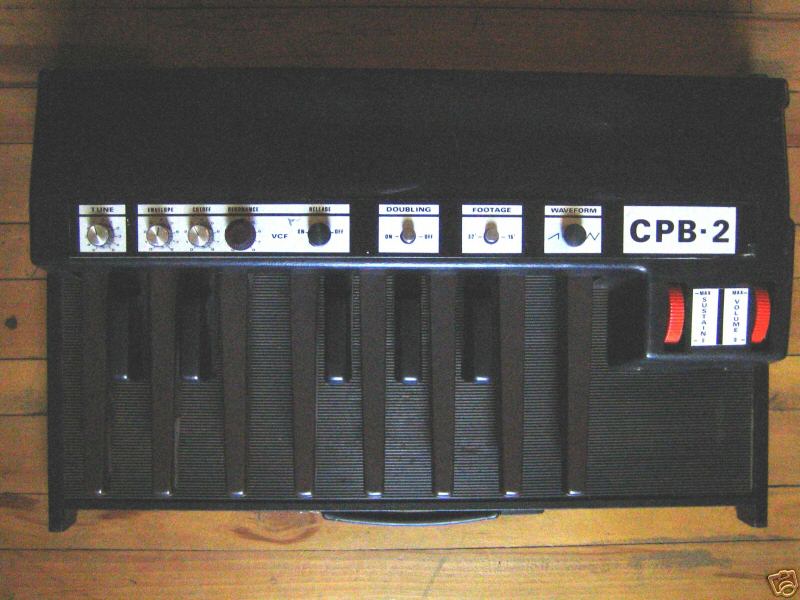 Title link takes you to shots pulled via this auction.
Details:
"This is a rare Italian Analog Bass Synthesizer Pedals made by CIBES. This is obviously a very cool piece of musical history! It is generally played with the feet, but it is also easy to play with your hands. It has a very wide range of unusual synth sounds, from ultra-low Sub-Bass that rattles the windows, to high pitched wobbling "space" sounds. These bass synth pedals make incredible sounds. Everything works extremely well. The body is used, as it should be, but is in excellent shape (1 knob has been replaced). Controls include: tune, envelope, cutoff, resonance, release, doubling, footage (octave), waveform, sustain, volume, with a 1/4-inch guitar input."
Soviet Estradin 230
 Title link takes you to shots pulled via this auction. Check out the red led.
Details:
ESTRADIN-230 is a monophonic 3-osc power synthesizer produced by Elektroizmeritel, millitary radio plant in Zhitomir, USSR.
Synth has 4-oct keyboard (F-C) with velocity (sensitivity assign to vibrato effect). For live performance there is a wheel which provides pitch shift. ESTRADIN 230 is based on 3 VCO (osc. No.3 can work as the modulator), 1 VCF (lowpass 24dB/oct)with ADSR, 1 VCA, 3 LFO, noise generator (white/pink), portamento, memoryloop. It has an EXTERNAL INPUT allowing to use FILTER and GENERATORS with OTHER INSTRUMENTS such as guitars, other synths! ESTRADIN 230 consist of 5 main sections - OSC'S, MIXER, MODULATION, FILTER and AMP...
OSCILLATORS section:
- osc 1,2,3 registers - 2", 4", 8", 16", 32", LF
- osc 1,2,3 waveshape select - triangle, saw, square, pulse, sine
- osc frequency
- freq 1..3, freq 2, freq 3
-linked to keyboard pitch on/off
MIXER:
- osc 1,2,3 on/off, level
- ext input level, on/off
- noise generator level, on/off
- noise mode switch: white/pink MOD section:
- portamento on/off, rate;
- mod mixer knob: balance between modulated by OSC3 and noise, depth amount;
- pitch wheel (glissando)
FILTER:
- mod on/off
- cutoff, resonance, brightness
- attack, decay, sustain
- keytrack on/off
AMPLIFIER:
- attack, decay, sustain
- key hold memory on/off Next
- global section: main volume, phones volume, phones out (5din), A-440Hz tone on/off, power.
Connection (5 din): input, output, pedal input, phones.
Power supply: 220V/50Hz, fuze 0,125A
More info on on ruskeys.
Cynthia Zeroscillator Shots
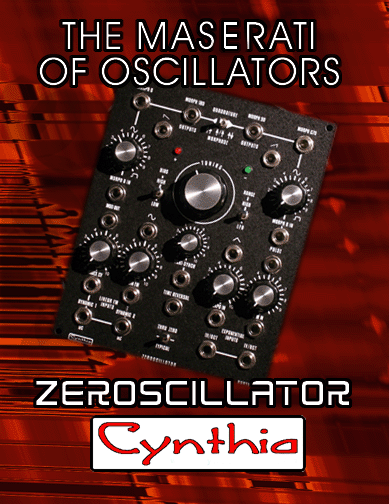 Title link takes you to the set. Each shot has a different tagline. And... Just in case you missed my previous post, Cynthia modules are now available via Analogue Haven.

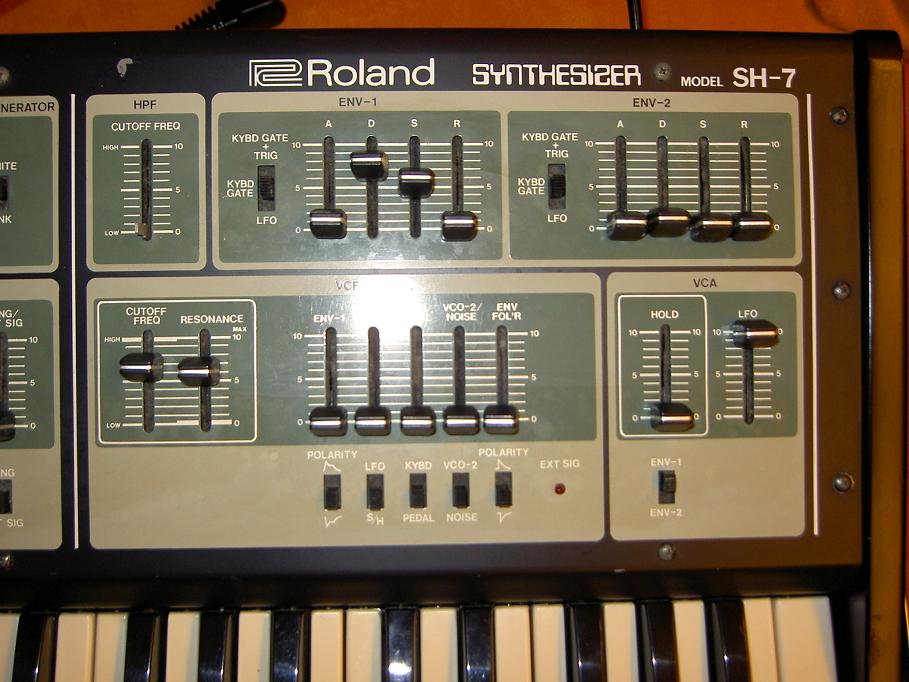
Roland Jupiter 6
YouTube via actionbasic. Sent my way via frederic.
Yamaha SY2
YouTube via actionbasic. Sent my way via frederic.
Joystick Studer Modules
 Title link takes you to shots pulled via this auction. Anyone know what joystick studer modules are? Note the auction is for 6 Moog knobs, the matrix pictured, 8 pin connectors, and the Joystick Studer Modules.
via Luca.
Buchla Lightning II
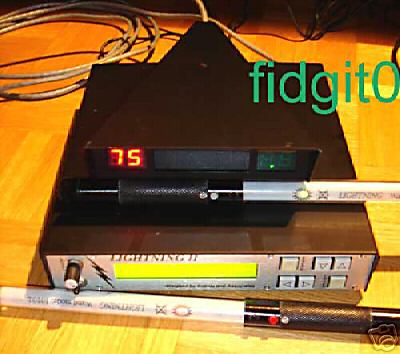 Title link takes you to some shots pulled via this auction. They aren't the greatest, but there you have it.
 Details:
" LIGHTNING II is a specialized MIDI controller with built in tone generator that senses the position and movement of handheld wands and transforms this information to MIDI signals for expressive control of electronic musical instrumentation. In addition to functioning as a powerful MIDI controller, LIGHTNING II, with its self contained 32 voice synthesizer, comprises a complete, ready to play instrument.
The bulk of LIGHTNING II's electronics is housed in a half rack cabinet.
A remote head, designed to be mounted on a standard mike stand in front of a performer, contains optics and numeric displays.
Based on principles of optical triangulation, LIGHTNING gathers its information by tracking tiny infrared transmitters that are built into baton-like wands. Unencumbered by wires, these wands provide complete freedom of movement within a performance space that can be as large as 12 feet high by 20 feet wide.
Basically, LIGHTNING II senses the horizontal and vertical position of each hand, for a total of four independent coordinates. From this information, LIGHTNING's digital signal processor computes instantaneous velocity and acceleration, and performs detailed analysis of gesture. An easily mastered, musically oriented interface language allows the user to define relationships between various gestures and potential musical responses.
In one sort of implementation, LIGHTNING's coordinates might be mapped to various MIDI controllers on multiple channels. Spatial pitch wheels, pan pots, level sliders and modulation wheels are easily defined and great fun to play. Performance gestures can be analyzed for direction and velocity and can be used to generate a variety of notes as well as other musical events. Multi-dimensional zoning capability can be used to create different musical responses in different regions. Everything you need to create the conceptual ensemble (an invisible, acoustic virtual reality).
User definable scale and tuning tables allow one to determine the range and selection of notes occurring along a horizontal or vertical axis. Pitches can be in any order, and the boundaries can be set where ever desired, facilitating the creation of spatial instruments and imaginary orchestras.
LIGHTNING II features a conducting facility that can analyze a conductor's gestures, display deviations from a preset tempo, and signal errors such as missed beats. Simultaneously, LIGHTNING can transmit a synchronous MIDI clock for controlling external sequencers and output programmed note data to accompany specific beats within a measure.
To facilitate its use in conjunction with other controllers, LIGHTNING possesses intelligent MIDI merging capability. A complete system exclusive implementation enables LIGHTNING presets to be stored and edited via external computers and sequencers."
via robert.
Tuesday, October 31, 2006

Virus TI Goldfilter
 Yep....
"What if you had the chance to own the mother of all Viruses, an object of desire, bling bling enough to get you a record deal with Dr. Dre straight away? What if this one-off, special edition Virus TI Polar called Virus TI Goldfilter would make you as powerful as the keeper of the ring in Lord of the Rings? What if your fellow studio friends would circle around it and whisper "my precious"?
You will never know until you own it.
Dig out your video cams and prepare yourself to celebrate the Virus's 10th birthday. Film yourself reading a poem to your Virus by candlelight. Bungee jump from the Golden Gate Bridge wearing your ABBA revival costume, while toasting the 10th anniversary of the Virus. Put on your rocket-powered Rollerblades and shout out "Sniff my gas - I got infected!" as you blast through the keyboard section of your local music shop. OK - you might not want to do that - but we reckon you get the drift.
Send in a Video which shows you congratulating the Virus on its 10th anniversary, and you might be the lucky one who win's the Virus TI Goldfinger - the only one of it's kind. Yes, it's true - scary but true -"
Title link takes you there. Who ever gets this bling, I want pics!

TUMOR REFILLED HALO
 via brian comnes:
"Well here at last are pictures of my homebrew version of a Metasonix TS-21 Hellfire Modulator based on an Eric Barbour circuit (of Matasonix fame). This thing is definitely a twisted and demented sound shaper. The name TUMOR REFILLED HALO is an anagram of the original's HellFire Modulator. The unit has 5 tubes consisting of a rectifier for DC voltage, a VCA distortion tube, an LFO oscillator tube and two tubes for adding more artifacts to the sound. The chassis is an old bench test unit that I salvaged. Eric's power circuit design uses dual transformers to economically generate the proper voltages for the the tubes at 6VAC and 140VDC and is very innovative. The overall sound is similar to the TM-1 Waveshaper . I'll send sound samples later. I'm sure the Noisefest crowd will get a rise out of this."
Title link takes you to the shots.
Mix - Real Time Audio Looping Software Inspired by Audiopad
 "Mix is an experimental graphical real time audio loop mixing app inspired by AudioPad. This is an early prototype and I'd appreciate any feedback on how to improve it."
 Title link takes the download. Mac only. Sent my way via s o n i c b r a t:
"basically u can grab audio files (preferably MP3 because wav samples will cause a bit of a hang due to processing) and drop it like how you would drop the "coin-like" controllers in the Audiopad... the out look of it is almost the same with the path of circular rotating stripe turning... and two blue circles that is L/R output... so you drag any other cirles (sound files) with rotating aura close to either one it will be louder left or right... hard to explain it.
I have used it for live improvisations basically to make my sounds travel more organically with control of the mouse. You remove files by doing a ctrl+x; to add files just drag and drop.."
BTW, check out this post on Audiopad for video that will give you an idea of how this works.
String Thing
 "String Thing is a cello-like electronic instrument played by stroking or beating metal rods with the hands. The use of bodily gestures, infinitely variable and visible to the audience, avoids the ‘robotic’ and visually uncommunicative quality typical of computer music.
Four roughly parallel metal rods are each divided into a long and a short section by a bridge element. The pressure and position of the fingers on the longer rod section are continuously sensed to control pitch and expression; pressure on the shorter sections controls velocity, attack and volume. MIDI software converts this information into sound and, through magnets under each rod, vibrates the rod according to the pressure it senses, thus returning haptic feedback to the player."
Title link takes you to more info, shots, samples and video. String Thing is a project by benjamin dove.
Star Instruments Synare 01 and 03
 James of InnerSpace Recordings & Cherry Sound Studios LLC sent me a link to a MySpace page he set up for the Star Instruments Synare 01 and 03. He has Synare 01 number three. Amazing. You can see the pads at the bottom of the slider box on the 01 in the second shot.
 Title link takes you there. Audio demo of the 01 here.

Gearwire Crosstalk #021 - Little Phatty
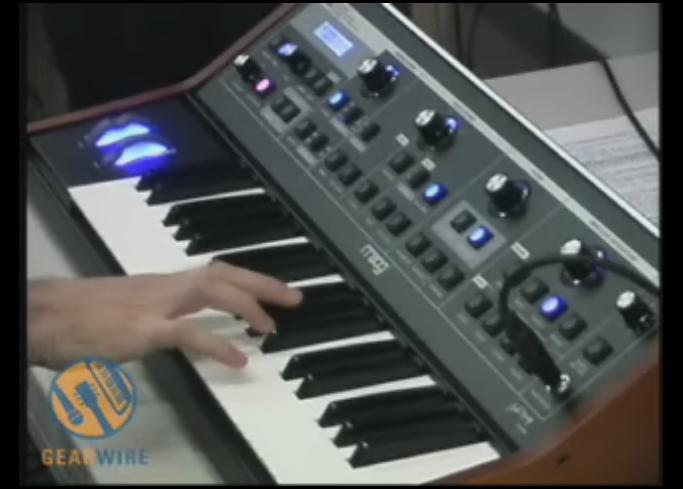
Click here for the latest Crosstalk on Gearwire where you'll find various play options and the playlist. The Moog Little Phatty comes in at 27:33.
Also featured: Maudio's NRV-10, Universal Audio's DCS Remote Preamp, Native Instruments Audio Kontrol 1, and Native Instruments Massive.
See dealers on the right for pricing and availability on gear.
LABELS/MORE: MOOG, Native Instruments
LABELS/MORE: MOOG, Native Instruments
Ensoniq Fizmo
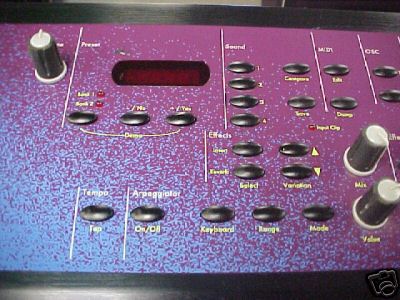 Title link takes you to shots via this auction.
Note, if you are thinking of picking this up, be sure to read this.
via rick.
Untitled Synth by Devowski
 flickr via devowski. Title link takes you to more.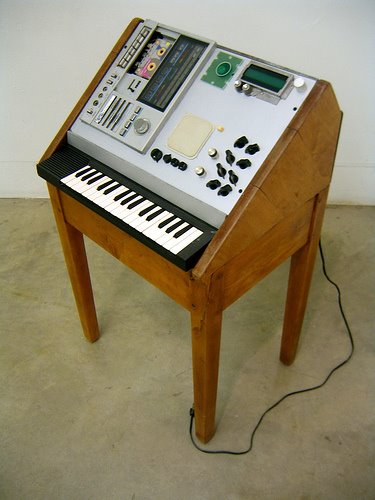
Be sure to check out Devowski's previous creation.
jMusic
 "jMusic is a project designed to provide composers and software developers with a library of compositional and audio processing tools. It provides a solid framework for computer-assisted composition in Java™, and is also used for generative music, instrument building, interactive performance, and music analysis. jMusic supports musicians with its familiar music data structure based upon note/sound events, and provides methods for organising, manipulating and analysing that musical data. jMusic scores can be rendered as MIDI or audio files for storage and later processing or playback in real-time. jMusic can read and write MIDI files, audio files, XML files, and its own .jm files; there is real-time support for JavaSound, QuickTime and MIDIShare. jMusic is designed to be extendible, encouraging you to build upon its functionality by programming in Java to create your own musical compositions, tools, and instruments. In a spirit of mutual collaboration, jMusic is provided free and is an open source project. jMusic is 100% Java and works on Windows, Mac OS, Linux, BSD, Solaris, or any other platform with Java support."
Title link takes you there. Via sequencer.de.
Update via Peter Kirn of CDM in the comments:
"See also jm-Etude, which interfaces this with Processing, a free and cross-platform environment designed to make Java coding accessible to non-programmers and quicker for programmers. link"

Monday, October 30, 2006
Audiopad
In case you missed the update to this post on Reactable, here's a video on Audiopad.
Title link takes you to more. Via freakyfreefrancis.
See dealers on the right for pricing and availability on gear.
LABELS/MORE: multitouch, Reactable, Video
LABELS/MORE: multitouch, Reactable, Video

WEM Nightshade and Dubreq Bass Stylophone


helio display, air video screen
Control your synths and DAW with this. YouTube via yowzerz. Sent my way via FreakyFreeFrancis.
VMM-R
 "VMM-R (pronounced "Vimmer") is a software MIDI sequencer and recorder. It is heavily based upon a hardware sequencer, known as the Alesis MMT-8.
VMM-R provides an affordable (free) alternative to expensive professional MIDI sequencing equipment. It runs on an ordinary home PC, requiring only Windows XP and a standard sound card. It is also intended to be suited to the music professional, able to be used for live performance on stage.
For the professional, VMM-R can communciate with any device that attaches to the MIDI port of the sound card. Such devices include synthesizers, musical keyboards, and even other sequencers (including the original MMT-8)."
Title link takes you there. Via synthesizer-magazin.de.

Airbourne (Airböurne) AVS04 - Updated Info
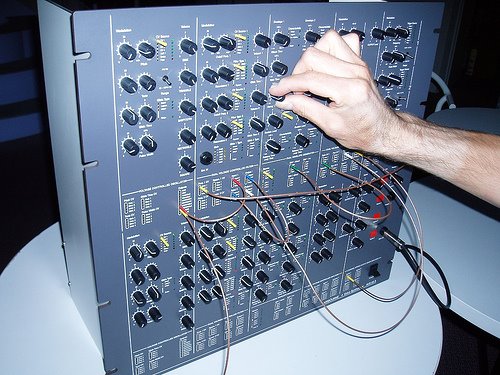
Remember the AVS04? Click here for a post on sequencer.de with more info in German.
The following is the Google translated version:
"The second part of the Synths is now also available. Thus it has thus all 4 Voices and 8 filters as well as 8 envelope generators. Also those Noise generators, random CV and the Mehrphasen LFO is ready.
If it is enough to me, I will still adapt the Midiinterface that it also with two pressed keys correctly functions; -/Default-moderately that stands Interface for the moment on mono mode.
The wildest things are written over my VCF. BPF are and were never intended. At present the LPF with 12, 18 functions and 24 railways. I worked to the HPF for a long time and am not not to the goal come with my technology. I assume that the 80 bits Computational accuracy are not sufficient for a HPF. Around the project not still more to retard, I have at present only times the LPF built in that Hope, by reprogramming the filter modules medium-term also HPF realize to be able. I do not have a schedule in addition however.
The Midiinterface is not in the back and takes away from anybody place. The difference between the two Synthteilen AVS-04A and B is in that the right five columns:
PREVIOUS PAGE
NEXT PAGE
HOME
© Matrixsynth - All posts are presented here for informative, historical and educative purposes as applicable within fair use.
MATRIXSYNTH is supported by affiliate links that use cookies to track clickthroughs and sales. See the privacy policy for details.
MATRIXSYNTH - EVERYTHING SYNTH
© Matrixsynth - All posts are presented here for informative, historical and educative purposes as applicable within fair use.
MATRIXSYNTH is supported by affiliate links that use cookies to track clickthroughs and sales. See the privacy policy for details.
MATRIXSYNTH - EVERYTHING SYNTH