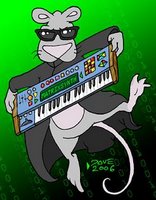
Actually, I’m dissapointed that DS-10 sales in the U.S. and Europe haven’t been as good as in Japan,but this pic is so uplifting ! And if you play DS-10 on your live stage performance, it will be super-uplifting!!!!"
"Cool Therevox ET-3 ET3 tabletop instrument. This is a modern recreation of the tannerin used originally by the Beach Boys to recreate the Theremin part from "Good Vibrations" live. This was built in a limited run of 13 last year by Mike Beauchamp. These are no longer available. This works great and sounds really cool. It has some more complex functions available as well as the basic saw and sine waves tones. Its an excellent stand alone instrument or as a controller for Modular synth stuff or CV inputs. It is similar in form and function to the Eowave Persephone and the French Connection controller, which is a copy of an Ondes Martenot. For more info, see the now retired therevox website: http://therevox.com/index.php" Also see the Therevox label below for prior posts.
Be sure to check out Sonic State's News section for more NAMM coverage. I'm only putting up the synth vids here, so you are missing the other gear and written articles.
Update via Konketsu in the comments: "analogassailant is correct. We had this happen in Vancouver at a community space called "Here on Earth" that was located in the industrial section of East Vancouver, and it was organized by several members of a now defunct electronic music collective called "The Black Hole Club". I found these and other pictures while I was cleaning up one of my hard drives, and I thought that I would upload it so I could share it on http://www.livepa.org/board and I didn't expect it to show up here.
We had somewhere around 30 machines show up and the idea was to get them all synced up to one clock source. Sort of a "hey, can we do this?" exercise more than a musical or recording one. It did work, but as you can imagine the sound was godawful and given the number of machines there obviously was a lot of slop in the timing. The hard part was actually getting a clock that each of the machines could recognize; there were a number of pre-MIDI boxes that had a wide variety of differing clock requirements so it was no small feat getting everything to talk to one another.
Before we did this, we had to define what a "drum machine" was, and we settled on a definition like "a stand alone hardware device that is capable of generating simultaneous and polyphonic sounds that are primarily percussive in nature and is capable of playing back those sounds in a preset or user-defined pattern, and is intended for use as a backing rhythm track source alone", or something to that effect which excluded MPC's, sequenced monosynths/modulars and workstations/grooveboxes.
Like I said before, it was really a try-it-and-see type thing, rather than a musical or recording exercise, as well as a great excuse to get together, geek out on drum machines and drink beer. Good times!
YouTube via ChordicaRevolution "This brief tutorial video introduces you to the Chordica Interface. Learn how to distinguish the various parts of the instrument with their proper names."
Converting Alphabet Chord Sheets
"This tutorial video shows the steps needed to convert a chord sheet written in alphabets into a number sheet. For further assistance, do go to the Chordica Forum at http://www.chordica.com/forum"
Chordica: There Can Be Miracles
"Live demo of the Chordica playing a portion of the song: When You Believe by Stephen Schwartz For more videos and to join a growing number of Chordicans, check out chordica.com"
YouTube via julieshaircut. via AtomoSynth.
"Julie's Haircut perform this improvisation for Rockit Webzine at Bunker Studio, january the 6th 2009. Filmed by Corrado Nuccini, edited by Luca Giovanardi."
Anyone know what the keyboard to the left is? I'm curious what the interface to the left of the keys is.
"The following are quick sound samples of the Plan B Model 30 Triple Digital VCO Subsystem.
There are no sound sources outside of a single Model 30 which is being either frequency, timbre or level controlled by external envelope generators, random voltages and LFOs. There were no filters, delays or any other types of sound processing devices incorporated.
Sample 2: PWM demonstration Patch Mini mode 1. THree VCOs tuned to unison with a single envelope generator controlling PWM on each: http://www.ear-group.net/samepatchPWM.mp3
Sample 3: Patch: Mini Mode 2. Three sine waves with the amplitude of VCO 3 being controlled by a single envelope generator: http://www.ear-group.net/sineFM.mp3
Sample 5: Sloped Random Waveform demo Patch: Mini Mode 1. Three VCOs tuned to unison, their frequency controlled by a single S+H and the output set to the second of two noise-based waveforms: http://www.ear-group.net/smoothrandomwaveform.mp3
Sample 7: VC waveshape demo Patch: Mini Mode 1. Same patch as above, this time with an external envelop generator modulating the wav eshape of all three VCOs form sine to saw: http://www.ear-group.net/samepatchVCwaveshapesine2sa.mp3
Sample 8: Frequency Shifting demo Patch: Frequency Shift 2. A single drone controlled by five independent LFOs. One is altering the waveform of each oscillator, three other LFO set to very low amplitude are sweeping the frequency of the oscillators with one other LFO varying the amplitude of VCO2: http://www.ear-group.net/freqshift2.mp3"
WSG and GS-201 from Jose Franco on Vimeo. via josefranco.org "Here is my version of Ray Wilson's Weird Sound Generator running through Guido Scognamigli's excellent GS-201 Tape Echo.
flickr by sentencesintensenses (click for more) via David Kronemyer "Recently there has been considerable controversy regarding alleged similarities between the Roland SH-1000, the Roland SH-2000 and the Multivox MX-2000. In an effort to investigate the situation further we recently set up all three at a studio where I do a lot of synth programming, electronic composition and re-mixing. The resolution of this vexing problem is they all sound completely different. Some of this of course may be due to drift in component values (we did not examine schematics or undertake a detailed circuitry inspection). Most saliently at Presets-3 the Multivox has the highly desirable "percolate," "space reed," "outer space" and "frogman" voices. Whereas the SH-2000 has the equally desirable "funny cat," "planet," "popcorn" and "singing voice." So in conclusion I would like to put a damper on internet rumors that the Multivox simply is a clone or a knock-off of the SH-2000. While they have superficial cosmetic resemblances due to the groovy-looking tabs the simple fact of the matter is they are different instruments."
YouTube via tarabusch "Here's more from AnalogSuicide.com's at NAMM 2009! Here, Tara Busch gets the latest on all the new Plan B goods from Plan B's founder, Peter Grenader.
YouTube via bigcitymusic http://bigcitymusic.com "Here's our friend Arlan playing the Mellotron through a Moog MF-104z Analog Delay, then into a JMI AC-30 amp.
The Mark VI is currently in production and is available at Big City Music in Los Angeles. All of the original Mellotron sounds are available as tape frames as well as many of the original Chamberlin sounds."
YouTube via wiretotheear "My favorite music application for the iPhone is called synthPond. Above is a video of six compositions I created using synthPond. Using "effector nodes" and "reactor nodes" that can orbit around each other while changing pitch you can create some wonderful sequences. A big thanks to Zach Gage for creating such a terrific app! I can't wait for future versions of synthPond." You can find synthpond here: and synthpond lite here:
YouTube via znshn "Testing Tapstereo iPhone App with the TENORI-ON and analog filters.
IF POSSIBLE USE HEADPHONES OR CONNECT YOUR COMPUTER TO A QUITE DECENT SOUND-SYSTEM.
Material in this video: - TENORI-ON - Korg Kaoss Pad 3 - Benfox Filthy Fuzz - MI Audio Pollyanna Octave - Moog Low Pass Filter (MF-101) - Moog Ring Modulator (MF-102) - Space Echo (Boss RE-20) - Tapstereo iPhone Application - Apple iPhone 3G - Boss FV-500L (as expression pedal for LPF Resonance) - Boss FV-500L (as expression pedal for RM Frequency) - Boss EV-5 for Space Echo volume
Note the Video Interface and it's actually Solton by KETRON lab
You can find some prior KETRON posts here. I also updated all Soton and Ketron posts to have both labels.
Details: "This is a fantastic sounding professional general midi synthesizer, that is an arranger module. It can be played by connecting it to a general midi controller such as a keyboard or midi guitar, or by your feet, using the midi bass pedals and programmable foot switches, or a combination of all of these methods. It is the perfect set up for a guitarist, pianist, accordionist or vocalist, professional or amatuer, for a one man orchestra. It plays styles, which are musical arrangements, which repeat or loop. It has 99 built in styles. Each style has 4 variations, 2 intro’s , 2 endings, and 3 fills and can be edited and saved to disk. It has Ram to accept up to 13 additional user styles. It has 256 voices, in 2 banks of voices plus another bank for user voices. It also plays midi files. The complete features are available on jpg files. [link]"
I noticed Atomo Labs started going by Atomo Synth a while ago. I finally took the time to ask them and their name changed about a year ago. It is now Atomo Synth. I went ahead and updated the labels for prior posts.
YouTube via JingleJoe "First I'd Just like to say thankyou to Hugh, the guy who sold me this fantastic synth! I've been playing it scince it arrived almost non-stop! And I'd also like to say this is the first Video of a Teisco 60f synthesizer on youtube! Horay! Also I filmed it as the sun was setting so that in the begining you can see the synth better but by the end you can see the awesome little lights better!"
YouTube via LouRobinsonFilms. "This is me playing Enter Shikari - Mothership on a vintage Kawai/Teisco 100F synthesizer. Sorry the sound is abit off and the it sounds wierd....just the camera microphone is abit rubbish."
YouTube via rpcurtiss. sent my way via J "Fumio and his many keyboards were the first live music program the Boffomundo Show produced in 1979."
Fumio Miyashta part 2 (1979)- Far East Family Band
Fumio Miyashta Part 3 (1979) - Far East Family Band on the Boffomundo Show
Spot the synths. Anyone ID the little white ones? Found them. Two white Kawai/Teisco 100fs. Update via the comments: the white are most likely patch sheet overlays.
Update via Hawker in the comments: You can find more videos for the contest on DesignCon 2009.
Video Description:
"Contest ID: 1376 My entry for the Designcon® Chiphead® 2009 Video Contest: Rockin' Chiphead®
This project was shot and rendered in HDV 1080i so click "Watch in HD" at the lower right of the video screen. Expand to full-screen, crank up the sound and enjoy!
Lyrics:
I hang out with guys holdin big degrees
Designin boards for the industries
Were usin chips in standard packs
To send out data -- hope we get some back!
Some chips are custom, some chips are plain
Some chips will drive an engineer insane!
We spec em in the design looks sweet,
We buy a half a million before they go obsolete!
Im a Chiphead well, Im a Chiphead yeah, Im a chiphead
I coulda been a doctor or a lawyer instead, but Im a Chiphead
Im a Chiphead -- Im a Chiphead yeah, Im a chiphead
Semiconductors help me earn my bread yeah, Im a Chiphead
I lay out circuits in the day and the night
Always got my headphones adjusted just right
I need three hands, while Im watchin the screen
Two for the mouse and keyboard, one for sippin caffeine
Im a Chiphead -- Im a Chiphead yeah, Im a chiphead
I get turned on watchinschematics get drawn cause Im a Chiphead
Im a Chiphead -- Im a Chiphead yeah, Im a chiphead
I check out the specs on the complex projects, yeah, Im a Chiphead
I go to tradeshows to learn from the pros
I watch the how-to videos
Talkin double-data-rate memory
Data transfer at high at M-H-zs
Integrated circuits come in every shape and size
Gettin smaller and hotter you gotta realize --
If you work with these your gonna need thermal grease,
Fans, clamps and heatpipes so the heatll decrease!
You gotta be a Chiphead! Be a Chiphead be a Chiphead
Be a Chiphead come on be a Chiphead, be a Chiphead..... etc."
"Welcome, this is a site devoted to the ARIES Modular Systems. Here you will find some useful info, pictures, schematics and documentation about the various ARIES systems. If you have any more information about Aries, please contact me.
Aries was a modular synthesizer manufacturer founded by Frank Fink and was located in Salem Massachusetts US. They built high quality modular synths in both factory assembled and kit form. The modules of the ARIES modular system ware at the time manufactured by resident company RIVERA MUSIC (RMS)."
"1999 Yamaha CS-2x. Patches / performances edited by WC Olo Garb. Video editing by WC Olo Garb. ||| Syntezatory.prv.pl Videos: showing you not what a synthesizer can do, but what a man can do with a synthesizer.
Each of these machines has its own distinct sound. The three different characters complement each other very well:
ARP Omni 2: Clear, shining, shimmering
Logan String Melody II: Fat, warm, organic, middy
Weson Symphony: Balanced, restrained, smooth
The goal was to achieve the highest audio quality possible in order to leave the original sound untouched. That's why only highend equipment and a reference wordclock were used to sample every single key of the machines at 24 bit resolution. The 241 samples were then restaurated and cleaned from hum and noise. To preserve the original movements within the sound the loop points were searched manually according to the natural "loops" caused by beats which resulted in loop lenghts up to 4 seconds. With this method the looped sampled tone can't be distinguished from the original and there are no noteiceable loop points. A lot of work, but worthy to capture those really glorious sounding machines with the original character leaving untouched.
There are two engines that allow to layer and split two sounds, tune and pan them, and change the attack and release times. The two engines even can be sent to individual stereo outs on demand for separate external processing.
The samples are completely loaded into the RAM (140mb), no disk streaming needed. This means: Compact and easy on CPU. Available for Receptor too with free crossgrade from the PC version.
Note that there are also a few other string machine emulating plugins containing "Stringer" in their names: - Falkelab Stringer - Numerikart Stringy Stringazoide Stringer - Easytoolz easy-mr.stringer"
"The time has come to announce the release of the world's first published polyphonic tone manipulation software. The dream of musicians to isolate single notes out of chords and so to manipulate most forms of recorded audio has come true on the 20th of January 2009.
Applications: * Change chords or single wrong notes in polyphonic recordings o To fit pieces into your composition that otherwise would not have been accessible due to their key o To creatively play around with recorded audio like with a midi instrument - it will play your musical ideas by a click but it still sounds like the real instrument * Isolate the natural harmonics of instruments, manipulate them, take your instruments under the magnifying glasses to understand their sound * Create real sounding harmonizations, i.e. make chords out of monophonic parts of audio * Correct intonation problems of any instrument or voice while keeping the formants as they are Create artificial vibrato, stretch the formants, rearrange melodies, draw frequency curves with your mouse to access monophonic and polyphonic audio in a way it has never been possible before
This first version of VisualVox polyphonic costs only 25 Euros as being a student and not a big company I still need your suggestions to remove any possible inconveniences. The final version 1.0 will cost 99 Euros but the upgrade from version 0.9 will cost only 50 Euros. (Prices do not incude taxes dependent on your location)"
YouTube via AbletonInc "Max for Live puts the power and potential of Max/MSP inside Live. Create all the instruments, effects and extensions you've ever wanted. Go beyond the common and predictable, and transcend the limits that conventional tools impose. Build completely unique synths and effects, create algorithmic composition tools, or fuse Live and controller hardware into radical, new music machines. Join a society of makers and share ingenuity.
Max for Live was co-developed by Ableton and Cycling '74."
YouTube via AbletonInc "The APC40 (Ableton Performance Controller) is a dedicated controller for Ableton Live, designed by the same engineering team responsible for Akai's iconic MPC range of products. This is a dream come true for the Ableton Live community and an exciting first step into the world of Ableton Live for new users."
YouTube via AbletonInc "Who is Ableton? What is Ableton Live? What's so great about it anyway? Who uses Live? Why? All the answers are here, in this one-minute movie."
What's new in Ableton Live 8
"New in Ableton Live 8 Version 8 enhances the Ableton vision of creative, real-time digital music with a wealth of new techniques, effects and most-wanted workflow improvements."
YouTube via AbletonInc "Operator, Ableton's renowned do-it-all synthesizer, has been given a major overhaul. We opened up the hood, took a long hard look inside and did some serious hot-rod stuff..."
 via the KORG DS10 blog


.jpg)