"SPIKES GOLD. — 15 Years of Error Spikes is one of the earliest Eurorack-inspired instruments, born 15 years ago—back when the modular world was still small, led by pioneers like Doepfer and a handful of boutique makers. While many brands moved toward mainstream retail, Paul Tas of Error Instruments chose a different path: staying underground, raw, and experimental. Rooted in noise, dark techno, and avant-garde traditions inspired by Warp Records and musique concrète, Spikes remains true to its origins—focused on creativity over convention. Now, 15 years later, a new version is here. Spikes (Anniversary Edition) is a standalone analog instrument, expanded with a built-in delay FX processor that can also be used independently. It introduces a unique hybrid interaction: conductive touch, light sensor control, and hands-on manipulation come together to create unpredictable, expressive soundscapes. • Six conductive spikes allow touch-based sound shaping • Central mixing area blends signals into evolving textures • Oscillator controls (potentiometers) generate and manipulate tone • Dual middle controls adjust delay feedback and time—from short to endless • Light sensor adds performative modulation (switchable on/off) This instrument thrives in chaos—perfect for glitchy rhythms, skipping textures, noise explorations, and cinematic sonic journeys. As a fully analog device, it requires a bit of tuning and exploration, rewarding hands-on experimentation. Available in silver and gold, this is a strictly limited edition of 50 units, all handmade in the Netherlands. Release: Superbooth 2026, Berlin Availability: One-time release only For demonstrations and deeper insight, watch the video and explore the user manual. Spikes is not just an instrument—it’s a statement."
"🔥 Experimental Dawless Techno Groovebox Jam | Custom Samples (Jaw Harp & PVC Pipes)
In this video I perform an experimental techno groovebox jam using unique custom samples like jaw harp and PVC pipe sounds, blended into a driving electronic groove.
This track is created using a fully dawless setup with two powerful grooveboxes:
🎛 Novation Circuit Tracks
🥁 Novation Circuit Rhythm
Both grooveboxes handle rhythmic and melodic elements, working together to create a layered and evolving experimental techno sound. The use of jaw harp and PVC pipe samples adds an organic, unusual texture that pushes this jam beyond traditional techno.
Everything is performed live in a DAWLESS workflow, with all sequencing done directly on the Circuit Tracks and Circuit Rhythm.
Final mastering was completed in Ableton Live to enhance clarity, punch, and overall balance.
If you enjoy:
Experimental techno
Dawless groovebox jams
Custom sample sound design
Hardware electronic music
Unique / unconventional instruments in techno"
In this video I perform a dawless techno groovebox jam built around custom samples and organic textures. This track combines electronic grooves with unusual sound sources like didgeridoo and PVC pipe samples, creating a unique and experimental techno atmosphere.
The setup features two powerful grooveboxes:
🎛 Novation Circuit Tracks
🥁 Novation Circuit Rhythm
Both grooveboxes handle rhythmic and melodic elements, working together in a seamless combo setup. The Circuit Rhythm brings character through custom sounds, blending organic tones with electronic beats for a distinctive underground techno vibe.
This is a fully DAWLESS performance — everything is sequenced and performed live on the hardware.
Final mastering is done in Ableton Live to enhance clarity and punch while preserving the raw live energy.
If you enjoy:
Dawless techno jams
Groovebox performances
Custom sample experiments
Hardware electronic music
Underground techno vibes"
"🔥 Conceptual Techno Groovebox Jam | DAWLESS Performance
In this video I perform a conceptual techno groovebox jam built around custom samples and evolving rhythms. The track explores a deeper and more experimental techno atmosphere while staying fully groove-driven.
This setup uses two powerful grooveboxes: the Novation Circuit Tracks and the Novation Circuit Rhythm. Together they create a compact but very capable hardware techno setup.
Both Circuits handle rhythmic and melodic elements, allowing the track to develop organically during the performance. The Circuit Rhythm adds character through custom samples, while the Circuit Tracks provides sequencing, synth layers, and structural control.
This is a fully dawless jam — everything is sequenced and performed directly on the hardware using the Circuit Tracks and Circuit Rhythm. The final sound was mastered in Ableton Live to enhance clarity and punch while preserving the live energy.
If you enjoy dawless techno jams, groovebox performances, custom sample experiments, and live electronic music hardware setups, this video is for you."
YOUR NOVATION CIRCUIT TRACKS — REBORN AS A MODERN ACID MACHINE. FROM TIMELESS ACID HOUSE TO RAVE TECHNO
ACID transforms your Novation Circuit Tracks into a modern Acid machine, designed for genres such as Classic Acid, Acid House, Techno, Detroit Techno, Acid Techno, Hard Techno and Rave genres.
Roland TB-303 behaviour emulated — with a more modern sound, yet fully capable of delivering the classic tone. Modernised and expanded.
The pack includes 128 patches in total: 96 authentic 303-style Acid sounds plus 32 additional sounds, including a strong selection of polyphonic material such as chords and classic genre sounds to expand your productions beyond classic monophonic Acid lines.
All patches respond to velocity where appropriate, allowing expressive control and dynamic performances directly from the Circuit Tracks pads.
The 303-style patches are programmed to recreate the behaviour and response of the original machine — from timeless Acid House to harder Acid Techno and underground rave territories — featuring velocity-based accent behaviour, glide response, LFO modulation for evolving movement, and powerful modern distortion algorithms with delay and reverb send effects.
Completed with 64 drum samples (House, Techno, Hard Techno, 707, 808, 909 and more), ACID becomes a complete production toolkit — effectively turning Circuit Tracks into a purpose-built Acid production machine."
"🔥 Energetic Techno Groovebox Jam | Dawless Performance
In this video I perform an energetic techno groovebox jam using two powerful machines: the Novation Circuit Tracks and the Novation Circuit Rhythm. This dawless techno setup shows how these two grooveboxes perfectly complement each other in a live performance environment.
Both Circuits handle rhythmic and melodic elements, creating a full techno track entirely from hardware sequencing. The Circuit Tracks provides synth parts and sequencing, while the Circuit Rhythm adds powerful drum patterns and sample-based grooves. Everything is performed and sequenced live on the devices, making this a true hardware techno jam .
The final mastering of the track was done in Ableton Live to polish the sound while keeping the raw energy of the live performance.
If you enjoy dawless techno jams, groovebox performances, and electronic music hardware, this setup is a great example of how compact gear can produce a powerful underground techno sound."
In this video I perform a live dawless techno jam using a powerful hardware setup built around Novation Circuit Tracks and Novation Circuit Rhythm.
These two grooveboxes perfectly complement each other in a combo setup. Both Circuits handle rhythmic and melodic elements, allowing for a dynamic and evolving techno arrangement.
🎛 Novation Circuit Tracks – synth parts, basslines, and groove structure
🥁 Novation Circuit Rhythm – drums, textures, and custom samples for unique character
The Circuit Rhythm features custom samples.
This is a true DAWLESS performance — everything is sequenced and performed live directly on the Novation Circuits.
Final mastering was done in Ableton Live to ensure clarity, punch, and balanced dynamics."
In this video I perform a powerful dawless techno jam using a hardware-only setup built around Novation Circuit Tracks and Novation Circuit Rhythm.
This groovebox combo perfectly complements each other in a live performance workflow. Both Circuits handle rhythmic and melodic elements, creating a driving, layered techno sound:
🎛 Novation Circuit Tracks – synth parts, basslines, and groove structure
🥁 Novation Circuit Rhythm – drums, textures, and custom samples for unique character
Everything is sequenced directly on the hardware — no DAW during performance. This is a true live techno hardware jam.
The final master was processed in Ableton Live for clarity, punch, and balance."
"In this video I perform a high-energy techno EDM groovebox jam using the powerful combo of Novation Circuit Tracks and Novation Circuit Rhythm.
This is a fully dawless live jam — all sequencing, rhythm, and melodic elements are created directly on the hardware. Both Circuit units perfectly complement each other in this setup:
Novation Circuit Tracks handles sequencing, synth parts, and groove foundations.
Both grooveboxes contribute to rhythm and melodic layers, creating a dynamic and driving techno performance. The final master was polished in Ableton Live for clean, punchy sound.
If you enjoy hardware techno, dawless jams, groovebox performances, and live electronic music, this one’s for you."
"In this video I perform a groovebox jam, and this time it’s a techno EDM track created entirely with hardware.
The groove is driven by a powerful Novation Circuit combo, blending rhythm, melody, and energy into a tight live performance.
Two grooveboxes are used in this setup:
Novation Circuit Tracks – rhythm and melodic elements
Novation Circuit Rhythm – rhythm, textures, and custom samples
Both Circuit grooveboxes perfectly complement each other, allowing me to build dynamic beats and evolving melodic patterns in a fully dawless workflow. Everything is sequenced live on the Circuit Tracks and Circuit Rhythm, without using a DAW during performance.
Final mastering was done in Ableton Live to polish the track.
Thanks for listening and enjoy the vibe 🎶🚀"
"In this video, I perform a dawless techno groovebox jam using a powerful Novation Circuit combo setup. This track is built entirely on hardware, delivering an energetic and hypnotic techno sound.
The jam features two grooveboxes working together:
🎛 Novation Circuit Tracks – rhythm and melodic elements
🎛 Novation Circuit Rhythm – rhythm, melodic parts, and custom samples
Both Circuit grooveboxes perfectly complement each other, blending digital sequencing, drums, and melodies into a tight live performance. Everything is sequenced dawless on the Circuits, creating a hands-on techno workflow with a raw, live feel. Final mastering is done in Ableton Live to polish the sound."
"In this video I perform a groovebox jam, delivering a driving techno track created in a fully dawless setup.
This live session features a powerful combo of Novation Circuit Tracks and Novation Circuit Rhythm, two grooveboxes that perfectly complement each other in a hybrid performance workflow.
Both Circuit Tracks and Circuit Rhythm handle rhythmic and melodic elements, creating a tight and evolving techno structure. The Circuit Rhythm is loaded with custom samples, adding character, texture, and punch to the groove. Everything you hear is sequenced live on the hardware, keeping the performance hands-on and spontaneous.
No DAW is used during the jam — this is a true dawless techno performance.
Final mastering is done in Ableton Live to enhance clarity, dynamics, and low-end impact."
"Feel the Power of Rhythm with Korg Wavestate! Ignite the dancefloor with "Dance Legends", a powerhouse collection of 40 cutting-edge performance presets for the Korg Wavestate. This essential soundset captures the explosive energy of electronic dance music's most iconic eras, delivering everything from thunderous basslines and razor-sharp leads to hypnotic pads and ready-to-play drum loops.
This collection of 40 exclusive presets are created by well-known sound designer, OttO K. Schwarz, a creator of remarkable soundsets such as “Divina”, “Berlin Era” and others. In this soundset you will find punchy drum loops and percussive sequences, sub-crushing basses and grooving synth basslines, lead weapons (from acidic squelches to soaring supersaws), transparent pads and nasty synth/plucks sounds!
All presets are modulation wheel and X/Y Pad - assigned, which gives you a wide options to rule and customize the sound. This soundset is perfect for electronic music producers, live performers and DJs, sound designers creating dance music, as well as Wavestate owners wanting ready-to-play dance presets. Whether you're crafting mainstage anthems or underground bangers,
'Dance Legends' delivers the authentic sound of dance music history with modern production gloss.
"🎛️ Novation Bass Station II Swifty Limited Edition – The iconic synth with a new look! 🎨
At Superbooth 2025, Novation celebrates the return of a classic – in a brand-new design! The Swifty Limited Edition of the legendary Bass Station II combines analog power with striking retro artwork designed by British graphic designer Ian Swift (aka Swifty)."
Googlish:
"🎛️ Novation Bass Station II Swifty Limited Edition – The iconic synth with a new look! 🎨
At Superbooth 2025, Novation celebrates the return of a classic – in a brand-new design! The Swifty Limited Edition of the legendary Bass Station II combines analog power with striking retro artwork designed by British graphic designer Ian Swift (aka Swifty)."
Together with visionary British graphic designer Ian “Swifty” Swift, we’ve reimagined our iconic paraphonic synthesiser in his inimitable DIY style and packed it with fresh, new artist packs from Bass Station II power users Legowelt, Pecq, and Maria Chiara Argirò.
Key Features
Limited-edition colourway
Includes 60 new artist patches
Two analogue oscillators
Two characterful filters
Incudes AFX and Paraphonic modes
Analogue soul.
Since 2013, Bass Station II’s deep capability, raw character, and unbeatable value have made it a modern classic. Now, together with British designer Ian “Swifty” Swift, we’re reimagining it with a fresh, new look, that brings underground attitude to a synth that's long been a driving force in electronic music.
Powerful analogue oscillators
Bass Station II’s true-analogue signal path begins with two tuneable, syncable oscillators with four waveforms each plus, a sub-oscillator for even more low end and adjustable portamento. The two dedicated LFOs allow for modulation of other parameters via four waveforms of their own.
"Ilse the Eurorack synth voice in one DIY module is making warm but harsh Berlin Techno / Surgeon style stabs.
Ilse is an elegantly minimal, yet fully functional synthesizer voice in a compact 10 HP Eurorack module. The only thing you need to let it meow is a CV source to trigger its 1V/Oct frequency input (or a MIDI to CV converter and a MIDI sequencer) . Because it has a low part count it is ideal for Eurorack beginners or entry-level DIY projects.
Ilse is named after a cat, living in the legendary “Villa” in Weimar, Germany. The “Villa” was a place where a community lived and came together. Many underground concerts and parties took place here before the house got sold, renovated, and the mayor moved in. We created the graphics on the aluminum face-plate in her memory. Ilse (the synth) makes great acid sounds, so it was only logical to illustrate a cat tripping. Turn the knobs to make her look around or roll her eyes.
Ilse is designed to be affordable, easy to build, yet flexible, and feature rich. It is a synthesizer voice for your Eurorack, but can even be driven without a rack using two 9V batteries (not included).
Ilse is fully open source (KiCad schematic and layout is available in a git repository) and inspired by Syntherjack’s single-chip synthesizer Totoro. Check out his website with nice explanations, e.g. on the filter (we use the same filter on Ilse). We extended the design for external voltage control on filter, oscillators and LFO. Unlike Totoro, Ilse is designed around a unique oscillator design, which integrates the exponential conversion directly into the oscillator core. This results in an efficient circuitry saving you build time, parts and costs.
PCB and face-plate are manufactured in the EU. Kitting was done by our friends from Befaco in Barcelona. Complete assembly manual can be found in our forum.
Technical specifications
Functions
Two saw tooth oscillators Bridged-T low pass filter with resonance control Triangle LFO with speed control, and routing to filter and/or oscillators Simple mixer and detune for oscillators Controls
1V/Oct CV for oscillators (0-5V) Gate (0-5V) Filter cutoff (0-5V) External filter input Volume controlled output LFO Speed (linear, via solder pad on back, 0-8V) Oscillator 2 detune (linear, via solder pad on back, 0-8V) Current draw per Eurorack rail
+12 V: 22mA -12 V: 18mA +5 V: NC Dimensions
50mm wide (10HP), 128.5mm high (3U), depth in rack: 23mm, overall thickness: 43mm"
"Based on a true story, GForce Bass Station is an expertly modelled recreation of our first ever synth released in 1993. Its digitally controlled analogue oscillators, filters, and VCAs from the late, great Chris Huggett’s legendary WASP synthesiser, gave it an unruly, lo-fi sound. Cementing its status as an underground icon, the original Bass Station featured on pivotal records from Radiohead, Orbital, Nine Inch Nails, and Wu-Tang Clan.
What's better, is how Launchkey MK4's creative tools and customisable mapping capabilities enable you to perform the digital recreation, not just play. Watch to see what you can do with Launchkey and the GForce Bass Station.
Bass Station fans will feel at home here, with the original hardware’s sound, feature list, and much of the interface faithfully recreated in exacting detail. However, GForce didn’t stop there. This digital descendent comes with modern enhancements and quality-of-life improvements we could only dream of in 1993.
The Bass Station plugin is included with every purchase of Launchkey MK4, SL MkIII, or FLkey and has been specifically designed to integrate seamlessly with each model. It is also available for purchase directly from GForce Software.
Chapters:
00:00 - Introducing GForce Bass Station
00:05 - Using Components to send Custom Modes for GForce Bass Station
00:13 - The GForce Bass Station plugin's voices
00:28 - Combining Polyphonic Mode and Launchkey's User Chord Mode
00:46 - Mapping Launchkey's encoders to on-board effects
00:57 - Programming Launchkey's polyphonic aftertouch pads
01:20 - Expanding your modulation
01:40 - Programming patterns
01:50 - Controlling GForce Bass Station's macro dials
02:18 - Choose the perfect waveform for your track
02:43 - Access expertly crafted presets
03:00 - Mapping parameters to Launchkey's encoders
03:15 - Create and mutate musical sequences using Launchkey's Arp Pattern Mode
03:37 - What Novation products come with the GForce Bass Station plugin?
03:45 - Find out more about the GForce Bass Station plugin"
"Introducing Basilisk from Wirehead Instruments, a new hybrid-analog generative bassline exploration machine! Available soon from Thonk, Tindie & more!
Basilisk is a new bass-line exploration synthesizer from Wirehead Instruments, with dual digital oscillators driven into an aggressive MS20-style analog filter coupled with a powerful generative
sequencer.
Whether you need thumping bass-lines, melodic leads, or percussive tribal beats, the Basilisk is
ready to lead you down the rabbit hole from the moment you power it on.
The dual oscillators include saw and square/pulsewave, with manual & LFO control over PWM,
detune, pitch envelope & glide.
The analog filter has a fat saturated drive stage with resonance that can go from subtle to squelching to screaming, and the external audio input can process instruments from your desktop or Eurorack
All of this can be sequenced and modulated by the attack/decay exponential envelope, multiwaveform/multi-destination LFO and Elektron-style parameter-locks.
The Basilisk is powered by a 1-16-step generative sequencer evolved from the Freaq FM, with multiple algorithms. Explore deep space, underground caverns, deep jungle or 1980s suburbia!"
"Basilisk is a bass-line exploration synthesizer, with dual digital oscillators driving into an aggressive MS20-style analog filter all powered by a built-in generative sequencer.
Dual Digital Oscillators, Saw & Square/Pulse
Analog MS20-style Filter With Overdrive
Generative Sequencer with LFO and Parameter Lock Modulation
External Audio Input"
GForce Software and Oberheim proudly unveil the Oberheim OB-1.
It’s incredible that the 1978 hardware Oberheim® OB-1 has remained under the radar for so long. The GForce Oberheim OB-1 broadens the Oberheim sound palette in ways that we believe will see it become a big favourite among techno and electro producers and underground artists, as well as composers for its character and anyone cherishing vintage analogue tones. Its rich, aggressive sound and expansive feature set make it an essential hustler.
The GForce Oberheim OB-1 delivers a sound as full and robust as the legendary Minimoog® yet as aggressive and snarling as the MS-20®. It strikes the perfect balance between these two icons, making it an incredibly versatile tool in any producer’s arsenal.
Whether you’re conjuring deep bass lines or soaring leads or looking for something a little extra special, the Oberheim OB-1 is your ultimate ally in the studio.
Join the rebellion against mundane sounds and bring balance to your music with the timeless strength of the OB-1. Let the OB-1 guide your sonic journey like a true master.
HOW WAS IT AUGMENTED?
The GForce Oberheim OB-1 emulation has been richly enhanced to bring the best of both worlds—vintage charm aligned with modern possibilities. Here are the key enhancements:
Enhanced Signal Path: The OB-1 retains the authentic, rich tones of the original while benefiting from a new waveform alongside waveshape modulation, discreet level for the oscillators, sub and noise, LFO sync & retrig, Envelope looping, discreet key tracking, cross-mod, pan spread and more.
Polyphony up to 16 Voices and Unison: Unlike the monophonic original, we’ve added polyphony and mono unison.
X-Modifier: Unlocks unparalleled creative possibilities by enabling direct modulation of most parameters, transforming your sonic landscape with ease.
High Pass Filter: This addition allows for more precise control over the frequency spectrum, enabling cleaner mixes and more intricate sound design.
Chorus, Delay, and Reverb Effects: Integrated effects expand the sonic palette, allowing for lush, atmospheric, and dynamic soundscapes.
Four Versatile Macros: These provide real-time control over key parameters, enhancing expressive performance and sound customization. Macro4 can be modulated by the sequencer. This can get very creative.
Built-in Arpeggiator and Sequencer: These tools make it easy to create dynamic rhythmic and melodic patterns, adding depth and complexity to your music. The sequencer features individual step length and probability, as well as a track dedicated to sequencing Macro4.
Advanced Patch Browser: Quickly find and customize the perfect sound from a vast preset library, streamlining the creative process.
These enhancements ensure that our Oberheim OB-1 is not just a nostalgic homage but a powerful and versatile musical instrument.
You can find additional details and demos at GForce Software.
"Imagine an underground spa in mid level hotel in an episode of Miami Vice.
This would be the scene when the New Age cult members slipped Tubbs a Roofie and lured him into the spa at night.
We're using the Solton Project 100 along with the EKO Ritmo 20 - a very nice sounding Italian drum machine with individual volume controls for each sound.
For effects we're using two 80s grade B, rack units - the half rack format LEM FX 22 and the Vermona DEG 50 Echo.
The LEM FX 22 is a multi-effect with a combo mode that lets you engage two effects at the same time.
The Vermona DEG 50 is actually part of our secret weapons arsenal - a pretty crappy and noisy Digital Delay rack unit but the chorus modulation has that magic wonk.
The Solton Project 100 is maybe the coolest name for a synth we've ever heard - prove us wrong in the comment section :)"
This post is developing. Check back for new videos and updates below.
Street price appears to be $999. See dealers on the right for availability. In via Alex Timchak.
"We are delighted to announce the release of Syntakt – the 12 track drum computer and synthesizer that fuses digital and analog synthesis together in one music megabox.
Enter this sonic metropolis and experience epic sounds from the past, while pulling others into existence from the future. Syntakt is a drum specialist, full of percussive possibilities, but its four analog and eight digital tracks can be used for melody, harmony, and bass sounds too, giving you a musical melting pot with dozens of machines at your disposal.
Affect the sound of each machine with the intuitive and playful graphics. Add analog distortion and filtering to your mix or separate tracks, using the FX block. Run wild and free with the four expressive modifiers. Access a variety of different scales via the keyboard mode. And create dynamic soundscapes with its phenomenal sequencer.
The streets of Syntakt are never-ending, the neon lights are never-dimming, its underground is fathomless. Discover worlds within worlds."
"Syntakt is a sonic metropolis of machines, fusing digital and analog synthesis together in one drum and melody megabox. A 12 track drum computer & synthesizer melting pot like Syntakt needs a majestic guide. Let the intrepid Elin Piel show you around the many features at your disposal."
Baseck Plays : Elektron Syntakt : 12 Track Analog & Digital Synthesizer / Drum Computer
"Elektron's newest device is finally here : The Syntakt ! A 12 Track Synthesizer and Drum Computer!
Let's see how far our friend Baseck can push this new machine.
Grab one NOW : https://bit.ly/3EEzgOE
"Our pal Mario from Elektron came down to the Perfect Circuit HQ and walked us through the ins and outs of their newest Synthesizer and Drum Computer : Syntakt
0:00 - Intro & overview
1:30 - Machines & Visual Language
3:27 - Beats To Melt Brains To
3:59 - Modifiers
7:40 - FX Track
11:50 - Outro Jams
"Elektron's new instrument, the Syntakt, is a powerful combination of analog drum sounds, digital synthesis, and new performance features not seen on any other Elektron product. In partnership with Elektron, watch as our host Fess breaks down these features."
"In this video I perform one of my new tracks using the Elektron Syntakt and the Octatrack MK2. All the sounds in this video are from the Syntakt, I am using the Octatrack with my performance template.
"Some patterns I’ve made with Syntakt. No processing.
Things I love: The machines! The flexibility!
It can be so many things.
8 tracks of Model cycles chord machines with deeper control, 2x LFO per track, full envelopes, dual filters, p-lockable FX track. Or half a Rytm , plus new digital drum synth and bass/lead synth machines.
Or a mix between.
All with a tasty chunk of analog Heat drive, filter, and EG, but p-lockable!
There is an inverted envelope shape in the analog fx that I use as a master compressor. The drive is lovely.
I also love using some of the analog kicks with a bandpass filter for textures. Can even get kinda of vinyl pops and clicks out of these.
Can have up to 3 simultaneous analog DVCO machines."
"The brand new Elektron Syntakt is here!
I'm doing a brief overview, followed by a SID emulation rendition of Rob Hubbard's theme music for the C64 game 'The Last V8' from 1985. Then it grows into a live jam, using all the 12 digital and analog tracks of the Syntakt, including the features such as analog distortion.
0:00 Intro
1:50 Song starts
3:57 Live jam!"
Full details:
12 Track Drum Computer & Synthesizer
Enter a sonic metropolis with Syntakt. Analog and Digital synthesis. Drum and melody. In full fusion.
All your sound crafting, sequencing, and performance needs are fulfilled, in an all-round music mega box that fits in your lap. Syntakt is a drum specialist, full of percussive possibilities, but its four analog and eight digital tracks can be used for melody, harmony, and bass sounds too. Experience epic sounds from the past, pulling others into existence from the future.
The streets of Syntakt are never-ending, the neon lights are never-dimming, its underground is fathomless. Discover worlds within worlds. Adore now. Explore forever.
Meet the machines There are 35 sound-generating machines to call on, covering a wide range of drum and melodic sounds. Some machines have been reimagined from Analog Rytm and Model:Cycles, with deeper sound control for the latter, while others are entirely new to the world.
For you to create and personalize your sound, we’ve made sure you’ve got a set of parameter controls tailor-made for each machine. They let you quickly tweak the nature of each type of sound, showing you just the relevant options. Comprehensive without being overwhelming. Let loose with analog or digital overdrive, depending on the tracks you’re playing with.
The graphics more than play their part too, with plenty of animated icons offering visual guidance and extra clarity on how each parameter affects the sound. The joys of tweaking shouldn’t only be for the ears after all.
Special effects Syntakt lets you route any of your synth tracks or external audio sources through the FX block. This gives you analog distortion and filtering, and a couple of LFOs to go to town with. Additionally, you can also call on Delay and Reverb as powerhouse send effects.
And all of the above effects can be sequenced with the FX track. Have them kick in at just the right moment. Add accents and dramatic changes to the selected tracks or external audio. Or use it as a master track for ducking and gating effects.
Modify the moment Wield a little extra trig craft using the four modifiers, offering four varied levels of expression. Configure the first two modifiers to give you the retrig or velocity behavior you desire, and use the other two to access custom intensities of other parameters. They’re ready for action regardless of which synth track you’re using.
And the best bit is that they don’t just give you that extra playability fun in the here and now, you can also capture the moment by recording to the sequencer.
The keys to the city Syntakt’s keyboard mode gives you a whole bunch of different scales to play with.
There are some familiar faces and some maybe a little less familiar for you to try out, helping you discover new places and taking things to another level.
Play across a single octave like on a piano keyboard. Or use fold, and have several octaves laid out in front of you.
Deep sound-shaping Syntakt comes full of filter and envelope goodness. All tracks have a Multimode filter to put to use allowing you to emphasize different parts of your sound, with the digital tracks also able to call on Parametric EQ and a Base-width filter – an additional filter giving you even more sonic control.
Choose from two amplitude envelope types to define the ideal contour of your sound. Try out the ADSR envelope – for your wicked synth lines – or the simpler AHD envelope – perfect for transient percussive sounds.
"Made in cooperation with Swede from 808 Mafia, music producer for biggest stars Lil Wayne, Dj Khaled, Gucci Mane, Nas, Farruko, Dalex...
Made music for soundtracks like Bad Boys for Life with Will Smith, TV Show kidding with Jim Carrey, music for commercials with NBA Star Paul George and more!!"
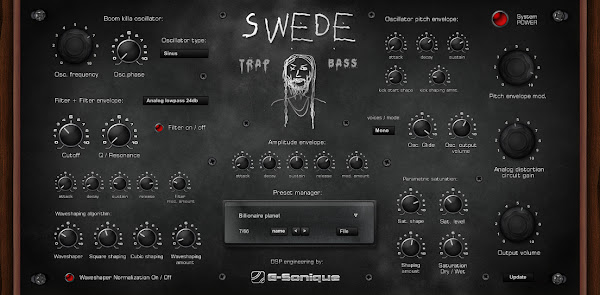
"Swede Trap Bass is a plug-in synthesizer designed for creating heavy Trap / Hip-Hop Kicks and fat Basslines. Cooperation between G-Sonique X Swede, plug-in developer more than 14 years on the market and famous hip-hop RIAA platinum producer Swede.
Swede made music for world-class rappers and singers like Lil Wayne, DJ Khaled, Gucci Mane, Nas, Farruko, Dalex etc. his music was used in Hollywood movies / Soundtracks like Bad Boys for Life with Will Smith, etc.
Trap Bass is instrument designed to create kicks and basslines easy and fast without the need of difficult post-production and fine-tunning with additional effects, everything is included. With trap bass you can create massive kicks and basses in seconds, from classic to progressive new kind of basslines. The synthesizer combines the best of digital and analog/vintage, from warm analog filters and oscillators, to vintage style exponential envelopes coded after real hardware drum boxes. 20 kick oscillators, 8 filters, oscillator waveshaping, analog distortion circuits, parametric saturation and much more. Thanks to emulation of various vintage analog circuits/modules plug-in sounds very smooth, round and fat comparing to basic digital synths.
The synthesizer is designed for heavy Trap and Hip-Hop kick drums and basslines but it can be used in various music styles like Techno, House, Acid, Rave, Underground tekno, Hardcore, Gabber, Psytrance, Deep Drum and Bass, Bigroom, Minimal, Uk garage, Downtempo, Electro and others.