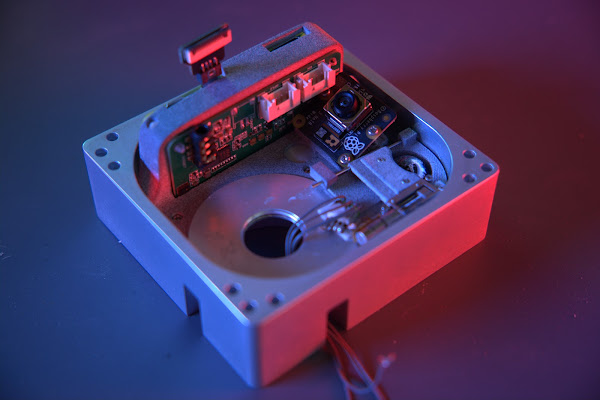
"Not just a synthesizer, but an electronic objet d'art with its own distinct character.
Meet the Blippoo Box, an instrument born from a desire to move beyond conventional synthesis. It is, in the words of its creator Rob Hordijk, "bent by design." This philosophy intentionally contradicts the practice of circuit bending—the creative short-circuiting of existing electronics—by instead building an instrument where complex, unpredictable behaviour is a fundamental feature, not a modification.
At its core, the Blippoo Box is an exploration of chaos theory. It is crucial to distinguish the scientific definition of chaos from the common notion of randomness. A random system has no discernible patterns, while a chaotic system is deterministic: its behaviour is governed by fixed, nonlinear rules. However, these systems are so profoundly sensitive to their initial conditions that their long-term behaviour becomes practically unpredictable. This fascinating duality is the engine that drives the Blippoo Box.
This is what is meant by "well-tempered chaos." The instrument is engineered to constantly seek out "balanced states"—what mathematicians call attractors. Within these states, the machine generates patterns that, while never perfectly repeating, have roughly predictable sonic characteristics. These patterns can persist, creating a stable soundscape, before a tiny change in a knob's position pushes the system across a threshold, causing it to "bifurcate" and settle into a new, entirely different balanced state.
This design fundamentally changes the relationship between performer and instrument. It moves away from total control and toward a dynamic of interaction and improvisation. To play the Blippoo Box is to enter into a dialogue with a system that has its own agency and tendencies. The performer learns to guide, influence, and react to the instrument's chaotic nature rather than dictating its every move.
Plug in, experiment, and let it take your performances to the next level."
Larynx is a monophonic semi-modular analog performance synthesizer with a 37-key aftertouch keyboard, MPE support, and a unique triple-filter architecture inspired by the legendary Synton Syrinx. Designed for expressive sound design, Eurorack integration, and hands-on performance.
Limited First Batch – 50 Units Only
Shipping from September Includes 10% early adopter discount
Inspired by a Rare Voice
Built on the foundation of the SER-2020, Larynx continues the legacy of the Synton Syrinx—an instrument known for its vocal, organic sound.
Reimagined for modern musicians, Larynx combines vintage character with performance-focused control and modular flexibility.
Built to Be Played
37-key keybed with aftertouch Touch’n’Bend performance control Real-time modulation across the entire signal path From subtle pressure to aggressive modulation, Larynx translates touch directly into sound.
Every gesture becomes sound.
Organic. Vocal. Alive.
Oscillators CEM3340-based VCOs delivering warmth and stability
Character From deep bass to expressive, evolving textures
The combination of classic oscillator design and a unique triple-filter structure allows Larynx to move beyond traditional subtractive synthesis—into something more organic, more dynamic, more alive.
Modular Without Limits
CV inputs and outputs Eurorack compatibility Flexible routing Integrate seamlessly with Eurorack or use Larynx as a powerful standalone voice. A performance instrument that expands into your modular world.
More Than a Synth
Designed for expression, not presets Inspired by rare, character-rich instruments Built in limited batches for serious musicians For Those Who Go Deeper
Larynx is built for musicians who want more than presets — for those who shape sound, perform with intent, and seek an instrument with a voice of its own."
"Afternoon exploration session with 3 silver boxes, the Elektron Machinedrum handling the beat and the classic SID Station led by the Lightreft Monolit on the 2.0β firmware.
Machinedrum keeps things tight and mechanical while the SID Station focuses on texture. Bit-grit, noise edges, and shifting timbres.
Just experimenting, seeing how far the monolit can take Midi Automation over an IDM groove. #machinedrum #sidstation #idm"
####
The LightReft Monolit made its first appearance on the site earlier this month in another video by HANJŌ.
The following is a playlist featuring dditional demos, followed by some pics and details further below.
Playlist (in most recent order - video 7 is from one year ago):
1. Monolit Sequencer
2. Machinedrum + Monolit : Simple Setup
3. MONOLIT x DECKARD'S DREAM MK2
4. Monolit: Quick Tips for Hardware Users
In this video, we demonstrate how Monolit connects seamlessly with synths, grooveboxes, and samplers — no computer needed. No deep menus, no distractions — just a clean interface and immediate control.
We explore different scenarios where Monolit shines: real-time MIDI control, clock generation, note and CC mapping, automation, and even gamepad integration. Hand-built in Japan, Monolit is a minimal yet powerful tool for artists seeking intuitive, hands-on control.
5. Monolit Firmware 1.2.0: Unlocking New MIDI Control Features!
In this video, we dive into the new features introduced in Monolit firmware v1.2.0. From advanced MIDI routing to external slider control and dynamic button functions — Monolit just got a serious upgrade. We’re showcasing a dual-Monolit setup, where one unit controls the other, which is connected to an Elektron Monomachine.
6. Monolit × Octatrack — Live Performance Control Demo | LightReft
Welcome to the first tutorial on the MONOLIT device! In this 40+ minute video, you’ll get acquainted with the essential settings, programming, and MIDI control on MONOLIT, while exploring the device’s unique capabilities. This session covers the key aspects of working with MONOLIT, making it an ideal guide for musicians and producers who want to master its full potential.
Main topics covered: Initial setup and connecting MONOLIT Programming and MIDI control Using functions and operational modes
Dive into the world of sound with this introduction to MONOLIT! Tutorial by Tim Shatny.
"MONOLIT by Light Reft
A smart, modular MIDI computer built for live performance and smooth integration with any setup.
Monolit is not a controller you map once to forget.
It is a playable instrument - a physical interface that lets you shape sound through motion, record gestures as automation, and turn parameters into something alive.
Designed for those who don’t just adjust sound, but perform it.
WHY MONOLIT?
A motion driven MIDI instrument for live sound shaping, expressive sequencing, and gestural automation. 8 banks with 64 controls per preset Real-time MIDI automation and parameter morphing Seamless DAW + hardware integration USB, TRS-MIDI, external device support Customizable, minimal, and fast. MEET MONOLIT, YOUR NEW MULTIFUNCTIONAL MIDI COMPANION! MONOLIT by Light Reft is a cutting-edge, multifunctional MIDI-computer that transforms your music production experience. Designed for musicians who seek precision and flexibility, MONOLIT offers seamless integration with all DAWs and hardware devices, customizable presets, and an intuitive interface for effortless control and creativity. Whether you're diving into your DAW or jamming out with external hardware instruments, MONOLIT has you covered. An endless library of presets at your fingertips—each one offering 8 banks, with 8 sliders and 8 buttons per bank. That's a whole lot of control!
For each slider and button, we present a range of versatile options. You can record MIDI automation, set delay times for slider movements, send notes and LFOs, and adjust various parameters directly within the device. This flexibility ensures that you have complete control over every detail of your setup. But it doesn't stop there. MONOLIT is as versatile as you are, allowing you to connect other devices like Gamepads, Keyboards, Monome Grid , or any MIDI device you fancy. This means you can take command of your entire setup, all through one sleek, powerful interface. Whether you're crafting the perfect beat, tweaking synths, or anything in between, MONOLIT is the tool that brings your musical ideas to life with ease and style. Designed and assembled in Japan, MONOLIT is ready to be shipped worldwide.
"So whilst on soak test I came across this crazy bank:
Notes from the .txt
ART SPRINGER STRIKES AGAIN (free)
Reviewed by Mike Metlay
All right, gang, I know what you're expecting in this space, so I'll oblige you
and get it over with. Ready? Here goes: "WAHOOLAZUMA! Everybody's
favorite twisted puppy is back from the audio torture chamber, and he's brewed up
the most brain-slashing package of monstrous elektronoyze EVER! This stuff's
great for warping your brain patterns, killing your cat, etc..."
Okay. Happy now? Good, now let's get serious. I heard from Art recently that
he didn't get a terribly good response to his first mailing, and that few, if any,
XUG members looked him up for his second set of patches
He seemed in a pretty good humor about it, but I couldn't help wondering if my
presentation of his patch set didn't scare a lot of people away just by the wording.
So, with a new patch set from Art (more diverse than the first two) in hand, I'd
like to try again.
One of the most unhealthy trends I see in today's patch-editing software is the
patch randomizer, that cute but overused utility that generates random patches at
the click of a mouse. Literally thousands of these random patches are being sold
by unscrupulous hackers as "original sounds," and a whole new generation of
MIDI morons is springing up (pardon the pun) whose idea of "good programming
chops" is the ability to tweak a randomly generated sound into something that
(almost) works. No program of this type exists yet for the xpander, and I'm glad of
it: the lack of computer-generated garbage on the market forces the user
community to seek one another for new ideas, rather than some electronic I
Ching. We come together in this Group to share ideas and learn from one another
and I believe that studying another human being's work beats watching a
computer coughing up random numbers. Which brings us to the music of Art
Springer.
In my opinion, these patches are important. VERY important. I get so enthused
about Art's work because I see in him a reflection of my college days, when I
puttered about with ARP and Buchla modular monsters creating sounds for the
sheer joy of it, putting together tonalities never before heard on Earth rather than
trying to make a realistic shakuhachi. This was, and often still is, the meat and
potatoes of electronic music to me. And when I hear Art telling me that people-
Xpander users!-are returning his work because it's "too weird," I know
something's wrong. The Xpander isn't a sampler or a digital piano. It's not an
imitative instrument by nature. It's a powerful, multiply interfaceable modular
synthesizer with a great deal of flexibility. Art Springer takes a stance on its use
that no other Group member has had the courage to try: using its Power as a CV
percussion device to enhance the sounds of his more traditionally oriented synths.
(By the way, Lionel and I are big fans of his music ... it's not as inaccessible as
you might think, and the odd tonalities make his dance pieces a lot of fun.) This is
a new idea to a lot of you, and I don't blame you for being frightened. But it's
better to learn from someone whose ideas differ from yours than to convince a
computer to feed you something safe. I'd like to suggest something simple to start
with: get one of Art's sound sets, trigger your Xpander with your drumbox, and
try writing music with these sounds as part of the atmosphere rather than
conventional drum noises. Or do something completely different. The important
thing is to try to expand (hm) your horizons to something new. These sounds of
Art's do take getting used to, but I think you'll learn a lot from them. Trust me."
A Technology Preview Exploring AI, DIY Culture, and the Future of Music Creation
Los Angeles, November 11, 2025 — Roland Future Design Lab, the advanced technologies research group of Roland Corporation, announces Project LYDIA, an audio processing platform preview created in collaboration with Neutone, developers of next-generation AI tools for musicians and artists. Project LYDIA merges Neutone’s trainable AI software with Roland’s hardware expertise, using a Raspberry Pi 5 single-board computer to deliver a compact, stage-ready prototype that reimagines DIY innovation for a new generation.
Bridging AI and DIY Creativity
Roland’s legacy in DIY music creation began in 1981 with AMDEK (Analog Music Digital Electronic Kits), a line of build-it-yourself kits that encouraged musicians to experiment with technology. Today, Roland Future Design Lab revisits that spirit, asking how modern creators can explore sound through emerging AI tools.
AI for Sound Discovery and Exploration
Powered by Neutone’s Morpho technology, Project LYDIA, named after DIY and AI, uses “neural sampling” to learn the tonal qualities of any sound and apply it to another in real time, with the sonic results ranging from highly musical to exotic and surprising. The current Project LYDIA mockup houses a Raspberry Pi 5 computer running Neutone’s special version of Morpho alongside Roland’s latest ideas for a simple, tactile control panel. Audio I/O is currently managed via a USB-connected Roland Rubix interface, with future iterations aiming to fully integrate I/O for a completely self-contained device.
AI Innovation at Roland
Project LYDIA builds on Roland’s growing exploration of AI as a creative partner for musicians. In 2024, Roland and Universal Music Group (UMG) jointly introduced the Principles for Music Creation with AI, a framework outlining shared commitments to ethical and artist-centered innovation.
“Roland has taken a leadership role globally in practicing responsible development with AI for music creation,” said Paul McCabe, Senior Vice President of Research and Innovation at Roland. “Part of being responsible is getting input from creators on what they find useful, helpful, or inspiring, and what ideas may not be welcome in their workflows. Releasing Project LYDIA as a technology preview allows us to demonstrate possibilities, seek community input, optimize, and improve.”
Shaping the Future Together
Project LYDIA debuted at the Audio Developer Conference taking place November 10 through November 12 in Bristol, UK, inviting feedback from the creative community to guide future research in AI-driven music tools. Musicians and makers can share their thoughts and ideas via a short survey here.
To learn more about the inspiration and technology behind Project LYDIA, visit Roland’s feature story on Roland Future Design Lab.
We are proud to present a detailed demo and tutorial of the new Trident MkIII, a recreation and evolution of the rare but powerful Korg Trident. Both the original and this version are really three synths in one: an analog subtractive synth, brass synthesizer, and a string machine. We go through all three sections individually and together, along with the new Motion features and effects. Along the way, we enjoy the instrument's lush and cinematic sound shining through.
3. MOMENTUM PACK For Cherry Audio Trident - James Dyson
MOMENTUM is a collection of 100 additional presets for Cherry Audio's Trident Mk III synthesizer. Created by James Dyson, this Preset Pack highlights the multi-timbral combination of Trident's Synth, Brass, and Strings sections. It takes full advantage of features like layers and splits, the sequencer, and dual arpeggiators, resulting in a stunning showcase of dynamic sounds and motion for the Trident Mk III.
Cherry Audio is pleased to announce the Trident Mk III synthesizer, a stunning virtual instrument that meticulously revives the sonic capabilities of the original Trident hardware synth. Priced at just $69, the Trident Mk III offers an authentic recreation of the classic synthesizer, significantly enhanced with new capabilities designed for today’s music producers.
I first learned about Roger a few years ago while making a film called “The History of Sampling in Music” [below]. While I didn’t know anything about Roger at the time, I was astounded to learn that he had created both the LinnDrum and the MPC, which shaped the punchy robotic drums of 80s pop music and the grungy experimental grooves of 90s hip-hop respectively. I did a quick bit of research about him for my video, but didn’t really dig much deeper than that… However, a few months ago I decided to rewatch my old project, which reignited my interest in Roger’s story and gave me the idea for this video.
Like my previous project, I’d initially planned to write a script and do a voice-over, but after discovering the assortment of recorded interviews that Roger has already appeared in, I realised that I could just chop them up and have Roger tell his own story. I thought 'hey that sounds pretty cool, how hard could it be?'
Well, let’s just say I’m probably never going to do something like this again. I did enjoy making this and I am proud of it, but if I had just done a voice-over not only would it have been easier to make, but I also could’ve included a lot information without it feeling incredibly clunky. The initial cut was about 26 minutes, but I cut out loads of stuff for the sake of pacing and trying to stick to narrative beats. Roger is a fascinating guy with a lot of great anecdotes though, so if you enjoyed this video then I highly recommend you seek out some of the podcasts/interviews he’s done over the years.
I planned on making all the music for this film myself, but decided it would be better to use music that relates to Roger in some way (for example, he co-wrote 'Promises' by Eric Clapton and 'Quittin’ Time' by Mary Chapin Carpenter, and first used the LM-1 Drum Computer on the Leon Russell album 'Life & Love' which featured the track 'One More Love Song'.) I salvaged one of these demo tracks for the credits, but you can listen it and a few more scrapped tracks here:
Since you’ve read this far, here’s a few bonus Roger facts that got cut out of the video:
The LM-1 was featured on the best selling album of all time - 'Thriller' by Micheal Jackson, as well as other early 80s hits like 'Maneater' by Hall & Oates, 'Valerie' by Steve Winwood, and for some reason - the original 1983 Thomas the Tank Engine theme song.
Roger hired his friend, a professional session drummer called Art Wood, to record most of the sounds on the LM-1. They set up the kit in Roger’s closet, recording each of the drums one at a time… then called it a day. Given the popularity of the songs featuring these recordings - Art Wood is technically one of most prominently featured drummers of all time.
And here's two bonus facts about this video:
The title 'The King of Drum Machines' is a quote from the father of MIDI - Dave Smith, when he spoke about Roger and the Tempest drum machine (which they built together) on a Sweetwater panel in 2015. [below]
This video was released on Roger’s 70th birthday.
I hope you enjoy it!"
The History of Sampling in Music (2022)
"Join Mitch Gallagher as he moderates 'The Inventors of Synth' panel discussion at Gearfest '15. Featuring industry icons Dave Smith, Tom Oberheim, and Roger Linn discussing their thoughts on the past, present, and future of analog synthesizers and controllers.
Legendary synth designer and Grammy-winner Dave Smith was the founder of Sequential Circuits in the mid-'70s. His Prophet-5, the world's first fully programmable polyphonic synth, was the first musical instrument with an embedded microprocessor. Dave is also known as the driving force behind the development of the MIDI specification. He has continued to innovate, and recently unveiled his latest synth creation, the Sequential Prophet-6.
A pioneer of the synth and MIDI world, Tom Oberheim co-designed the Synthesizer Expansion Module (SEM), a device that allowed musicians to simultaneously combine live playing and sequenced playback - a concept that pre-dated the MIDI revolution. In 1981, he, along with Roland's Ikutaro Kakehashi and Sequential's Dave Smith, developed the MIDI spec, which changed the course of modern music. Tom recently re-released his famed Two Voice synth.
Technical Grammy award-winner Roger Linn invented the LM-1 Drum Computer (the first sample-based drum machine) in 1979. He later designed the Akai MPC60, which combined a sampling drum machine with a real-time MIDI sequencer. His guitar effects unit, AdrenaLinn, has been used on hit recordings by John Mayer and Red Hot Chili Peppers. In 2014 he released the LinnStrument, an expressive MIDI performance controller."
"Quray is a touchless AIR controller for those who seek freedom and expressiveness. With a single hand movement, you control sound, light, and visual projections. Quray connects via MIDI and CV, integrating with synthesizers, modular systems, and multimedia setups. The magic of movement draws all attention to the artist and creates unforgettable impressions."
"Tone Explorer is a technology preview from Roland Future Design Lab, made available for music creators to try as a GALAXIAS Labs Experiment."
Press release follows:
Roland Future Design Lab Introduces AI-powered Tone Explorer Technology Preview
Group seeks feedback from progressive music creators on workflow-enhancing AI application.
Los Angeles, CA, November 12, 2024 — Roland Future Design Lab, the horizon-scanning R&D group of Roland Corporation, has introduced their first-ever technology preview called Tone Explorer. Focused on the challenge of finding the perfect sound for a musical part, Tone Explorer uses neural networks to analyze the characteristics of a recorded MIDI phrase and presents an array of matching options ranging from safe to surprising. Offered as a functional but unfinished “technology preview,” Tone Explorer is a unique opportunity for early adopter music technology fans to directly influence future Roland development.
The Tone Explorer Technology Preview is being offered through Roland Cloud as a “GALAXIAS Labs Experiment.” Existing Roland Cloud Ultimate members have immediate access to the preview, while newcomers can sign up for a 3-month trial by visiting the Tone Explorer information page and completing a brief onboarding questionnaire. While participating in the preview, newcomers will enjoy the full range of benefits a Roland Cloud Ultimate membership has to offer.
Paul McCabe, leader of Roland Future Design Lab, said, 'When Roland and Universal Music Group established The Principles for Music Creation with AI, hearing from musicians as we consider and develop AI applications was made fundamental. With the Tone Explorer technology preview, we are honoring this as we seek input from innovative music creators on everything from initial concept to execution. If we move forward with Tone Explorer development in the future, it will be based directly on the feedback we receive over the coming weeks.'
For more information on the Tone Explorer Technology Preview from Roland Future Design Lab, visit here.
Product Name: SyntGazos Synthesizer Designer: George Tsomokos by TSL Studio Equipment Type: Digital Multi Complex Synthesizer Unit
Overview
The SyntGazos is a versatile and powerful synthesizer designed for musicians and sound designers who seek a unique and customizable instrument. With its rich set of features and high-quality sound generation capabilities, SyntGazos provides endless possibilities for creating and exploring new sounds.
"We had lots of fun recording and filming our cover of Harold Faltermeyer's Axel F. Does it show? There is a video online somewhere, where Harold shows the Jupiter 8 he played during his original recording. That video triggered us to seek out how he did it and approach the original sound. These are inspiring and learnful experiments for us.
Credits to MaWey for providing the video footage :
https://www.mawey.be/"
"In November 2023, I joined the team at Het Concreet in Tilburg, The Netherlands for a week long residency.
Het Concreet is a Dutch sound collective dedicated to finding new sounds by experimenting with analog electronic devices, magnetic tape and acoustics. Their analogue ambitions are rooted in their studio space, where they seek to find new meanings of sound by working with techniques that have become largely obsolete in today’s world. Their main instrument is magnetic tape, so I collaborated with my own analogue gear.
Radio Concrète was a a 12-hour broadcasting marathon that explored radio as a compositional tool and included contributions from Margherita Brillada, Veerle Pennock, Clara Byom, Bas van Druten, Nele Möller, Marieke van de Ven, Sharon Stewart, and was hosted by Steph Byrne.
During my stay, I fell in love with the Elektor Formant, a vintage Dutch synth handmade by Jos van Ras. In addition I used my SOMA Ether, Lore Mill Keyed Mosstone and Make Noise Strega synth. At the end of the broadcast, I made an intimate performance for a live and dedicated audience in collaboration with Het Concreet. This is an excerpt from that show."
"Even if you don't know his name, you know Mike Dean's sound. The super-producer and "Synth God" solo artist is a pillar of modern music production. The Weeknd, Beyoncé, Kanye West, Travis Scott, Madonna, Jay-Z, Christine and the Queens—these artists and more have made classics with Dean, and that's just his recent work.
Before that, he helped craft a whole era of Southern hip-hop with the likes of Scarface, Geto Boys, UGK, and Devin the Dude, after getting his start as Selena's keyboardist and musical director.
Ahead of an upcoming solo performance at Los Angeles' Wiltern Theatre on March 1, we got the chance to see the genius at work, learning first-hand exactly why so many artists seek him out.
TCHC announces availability of SMALL STRING GESTURES as toolkit to dial up musical personality with intimate interpretative band behind each key
EDINBURGH, UK: having ‘softly’ set out its software stall late last year with a low-key launch of STRING MURMURATIONS that saw decades of award-winning experience in the music tech sector and at the composing coalface distilled into an easy- to-use, intuitive, and comprehensive sample-based virtual instrument plug-in and GUI (Graphical User Interface) introducing the cutting-edge concept of Gestures (whereby an orchestra interpreting its user’s composition and making it into music and art lies behind every key played), music-making community tools-maker The Crow Hill Company is proud to announce availability of SMALL STRING GESTURES as the latest incarnation of that concept — creating a set of tools where individual instruments and the playing style, strengths, and frailties of the intimate interpretative (3, 3, 3, 3) band behind each key are available for the user to dial up the personality of their composition, created from a collection of master recordings that have been mixed and edited into a sample-based virtual instrument plug-in with a GUI and preset browser that are as easy on the eye as they are in use — as of January 26…
An armada of strings can create awe — an epic tidal wave of human emotion, of scale, of wonder. While STRING MURMURATIONS makes it easy and intuitive to make music that sounds human thanks to three distinct palettes of expressions, each designed to feel like the user is collaborating with an orchestra of real musicians, creating endless harmonic possibilities that inspire from the moment a key is touched, sometimes music-makers need it to be intimate, truthful, personal, human — hence The Crow Hill Company creating SMALL STRING GESTURES as a set of tools where individual instruments and the playing style, strengths, and frailties of the instrumentalists involved are available for the user to dial up the personality of their composition. Cue humanity, in other words.
With this in mind, The Crow Hill Company specifically selected a 3, 3, 3, 3 — three Violin 1, three Violin 2, three Violas, and three Cellos — band size that ensured its sampling style brought every individual within that ensemble into beautifully detailed and intimate focus for SMALL STRING GESTURES. This toolset is provided with a different lens and aperture to play through.
The Crow Hill Company collectively likes to keep things moving, so while this latest incarnation of its Gestures concept is very much related to one of those distinct palettes of expression available in STRING MURMURATIONS, it is worth highlighting hysteresis — dictionary-defined as the phenomenon in which the value of a physical property lags behind changes in the effect causing it, such as when magnetic induction lags behind the magnetising force, for instance — in relation to SMALL STRING GESTURES. Getting in on the act of creating sample libraries involves always asking the instrumentalists involved to perform musical material that is incredibly easy to play in order for the end result to always be ‘together’. That is fine for programming or composing simple stuff since that would sound true to real life, but it becomes harder, however, for players to remain totally locked to each other’s tuning or timekeeping when playing more difficult passages. Pure sound becomes more problematic as a result — reduced fundamental meaning more character, which is why a lot of sample-based music used in films, games, and TV sounds ‘characterless’. Clearly the samples involved therein lack hysteresis as they were easy to play, yet playing something difficult with them does not sound natural, real, or human. Indeed, it is fair to say that what makes musicians ‘hysterical’ is speed — faster playing means looser playing that is less in time and also less in tune; reach — the wider the gap between the notes, the further they have to reach, resulting in less perfectly in tune playing; and pitch — the higher a player plays, the harder it becomes as it involves more intense accuracy from string players performing on fretless instruments.
It is for this reason that The Crow Hill Company decided to get its players to perform the hard stuff — not compositions, but mere fragments, which is why anyone working with SMALL STRING GESTURES will not feel like they are playing phrases; instead it is rather like having a string band under their fingertips. For Gestures are the very real sound of reach and performance. But by not giving the musicians behind SMALL STRING GESTURES simple stuff to play prevented them from getting bored. Better still, SMALL STRING GESTURES users are accessing the sound that musicians make when they are smiling... hysterically!
It is also fair to say, therefore, that the effect of hysteresis on a large string section — including that which was involved in the creation of STRING MURMURATIONS, for instance — is a silky, blurry sound. An audible example of this might be the fast string runs in John Williams’ ‘Hedwig’s Theme’ from Harry Potter and the Philosopher’s Stone — ditto the closing bars of ‘Mars, the Bringer of War’ from Holst’s The Planets suite. Saying that, though, there are times when music-makers do not need awe, epic, and huge scale in pursuit of their compositional craft, but instead seek something more intimate, more personal, more human. The theory that led to SMALL STRING GESTURES revolved around if The Crow Hill Company could get a string band small enough then the impact of hysteresis would not be a musical blurring, but rather an exposure of each player involved in its creation — their own style of bowing and vibrato, their own fragilities to help the user’s audience connect more with the human nature of their music.
Making that happen meant designing SMALL STRING GESTURES to make its users approach composing and making music from a totally new angle, one where it feels like there are musicians at their fingertips — not samples. SMALL STRING GESTURES is a collection of master recordings — made by world-class producers and engineers at Glasgow’s Clockwork Studios, a new custom-designed scoring stage for the UK comprising of a large hall for full orchestra (up to 80 players) with a balanced and focused sound ideal for modern orchestral recording, as well as a smaller dry space in Studio B (up to 15 players), with the world-class Scottish Session Orchestra playing some of the finest instruments through the finest microphones and mic pre-amps — that have been mixed and edited into a sample-based virtual instrument plug-in with a GUI and a preset browser that are as easy on the eye as they are in use. Ultimately, it works within anyone’s favourite DAW (Digital Audio Workstation) with 25 presets — presented as six Gestures, four Longs, 10 Presets, and five Bonus — and additional hand-crafted Selects designed by The Crow Hill Company team. There are three mix-ready stereo signals — namely, CLOSE, WIDE, and AMBIENT, as well as unique REVERB controls and a granular effects processor.
Duly designed by professional composers with the sonic connoisseur in mind, The Crow Hill Company’s collective conclusion certainly rings true, stating, “We’re a small team and have worked hard to make everything as intuitive as possible.” Put it this way: with SMALL STRING GESTURES it is perfectly possible to make music that sounds intimate, truthful, personal, human! Hysteresis, of course, comes into play here, albeit with the desired effect — exposure of each player involved in its creation.
Clearly, then, big messages come in small packages when it comes to working with the diminutive-sized SMALL STRING GESTURES as another easy-to-use and intuitive virtual instrument plug-in from The Crow Hill Company, one which is also easy on the wallet for those wishing to step into this new world of gesture-based sampling.
SMALL STRING GESTURES is available to purchase — as an AAX-, AU-, VST-, and VST3-format-compatible sample-based virtual instrument plug-in comprising 8 GB of uncompressed material (compressed losslessly to 4.4 GB) that loads directly into a DAW — for £49.00 GBP (including VAT) directly from The Crow Hill Company here: https://thecrowhillcompany.com/small-string-gestures
SMALL STRING GESTURES is available for free until February 29, 2024 when purchasing STRING MURMURATIONS for £199.00 GBP (including VAT) directly from The Crow Hill Company here: https://thecrowhillcompany.com/string-murmurations/ (Note that SMALL STRING GESTURES is also available for free to existing owners of STRING MURMURATIONS until February 29, 2024.)
Watch The Crow Hill Company founder and composer Christian Henson’s must-see SMALL STRING GESTURES walkthrough video here: [video up top]
I asked them what the platform would be based on. They replied:
"The web-based interface will be an adapted version of Patatap to which we’ll add a video feed and other interactions that will be possible to trigger inside the space capsule (i,e agitate the marble by turning on a fan, LED array, microphone, speaker, etc).
The space capsule has a set of different elements that allows to change the position of the physical marble floating inside the zero-gravity chamber (a set of sensors that calculates the position, a fan that agitates the position of the marble, a microphone that records those interactions, etc). All that data is then being sent back to us on earth (or in reverse sent to the capsule from earth using the Live mode). In other words, the web-interface receives data/interactions from the capsule and the Live mode allows to send data/interactions directly to the capsule. Lastly we’re building a VST plug-in allowing to receive MIDI and hook up data directly into your DAW or other synth."
In short the interactive hardware controller w/ microphone to capture audio is in space, while the synth engine and processing is done on earth.
Addtional details from the Kickstarter/Press Release follows.
The Blue Marble Synthesizer is the first-ever music synthesizer that can only work in space and that is playable from here on earth. It’s a synthesizer for making music and experimenting with sound. The system consists of a pressurized capsule in a low earth orbit satellite, a network of sensors, and a web-based interface for people to play with here on earth.
1. The Blue Marble Synthesizer Capsule consists of a pressurized CubeSat module configured with a control computer, camera, sensor array, fan, LED array, a microphone, and a speaker. It measures the behavior of a marble floating in a zero gravity synth capsule and sends sensor data, audio feed, and video feed back to us on earth.
2. The Web-Based Interface is an interactive and self-contained web audio synthesizer designed for everyone. Through a collaboration with the creator of Patatap, this application blends interactions from the Blue marble Synthesizer Capsule data with a traditional interactive music synthesizer. This web-based interface is a way to explore the interactions between the Blue Marble Synthesizer Capsule and people’s own musical creativity.
● When does the space mission start? The Kickstarter campaign is set to start on Wednesday, October 4 for 30 days until the rocket launch which is set for Wednesday November 1 aboard the SpaceX Falcon 9 Rocket. Once in orbit, the Blue Marble Synthesizer Space Capsule will be rotating around earth every 90 minutes.
● Why does this project matter? The Blue Marble Synth Project is intended for all those who share a passion for space, music, and the intersection of science and art. Music has always been a universal language that transcends cultural barriers, connecting people on a deeply emotional level. By introducing a music synthesizer to space, we expand the horizons of artistic expression and create a new dimension for human creative endeavors off-planet.
● What is the experience like for supporters?
1. Two primary ways: people will have the chance to make music with the audio and the data captured by the Blue Marble Synthesizer in two primary ways: through an interactive web-interface or via a VST-plug-in. Some supporters may also have the chance to play and interact with the system directly in space.
2. The Blue Marble Web-Interface: is a self-contained web based application that works from here on Earth. Inspired by Patatap, this application blends interactions from the Blue Marble Synth Capsule Data with a traditional interactive music synthesizer.
3. The Blue Marble VST Plug in: this feature allows to receive MIDI and control data from the Blue Marble Synth Capsule to use with other digital synthesizers and digital audio workstations such as Ableton LIVE, FL Studio, Presonus Studio 1, etc.
● Who are the artists involved? Andrew Huang, Benn Jordan, Trovarsi, and MAYSUN, are invited artists who will compose original music with the Blue Marble Synthesizer during this orbital mission. They each possess the adventurer's spirit that we believe is at the heart of this project.
Andrew Huang We are thrilled to have Andrew Huang, the YouTube phenom and Toronto-based artist join the Blue Marble Synth Project. As a highly acclaimed music and video producer, Andrew's unique ability to seamlessly blend diverse musical styles with captivating visuals aligns perfectly with the innovative vision we seek to bring to life. His creativity, coupled with his commitment to pushing artistic boundaries, makes him an invaluable addition to this project
These 4 artists will compose original music using the Blue Marble Synthesizer and the resulting tracks will be released for project supporters on an exclusive LP post-mission.
● What else can supporters get by supporting? Beyond accessing the Web-Based interface and Artist Album, supporters also get access to a range of branded Blue Marble Synthesizer merchandise designed by Physical Synthesis. The collection features a sticker and mission patch, hoodie, t-shirt, cap, tote bag, and more.
● What goes inside the Blue Marble Synthesizer? Technical Breakdown The Blue Marble Synthesizer Capsule consists of a pressurized CubeSat module configured with a control computer, camera, sensor array, fan, LED array, a microphone, and a speaker. The module allows supporters to receive data so they can control other synths and interfaces as well as initiate actions that affect what happens inside the capsule
1. Zero Gravity Dynamics: to make the Blue Marble Synthesizer an instrument that can truly work in space, it requires harnessing the power of zero-gravity. To do this, the synthesizer relies on interactions between a spherical piece of glass – the blue marble – and an array of accurate laser sensors that measure the distance and location of the marble as it floats around a small pressurized chamber.
"EN// The Residence - The Tale of Silence - in Auvergne, France is a collaboration between photographer Joséphine Leroux and artist/musician Tom Leclerc. Capturing suspended moments of life, composition, exploration, and optimism lie at the heart of this journey of writing and documenting Tom's upcoming album. This album is the creation of a genuine natural park that can be listened to, where details, microcosms, and sonic curiosities blend in a unique acoustic ballad.
The challenge today is to offer a new, friendly, inspiring, and curiosity-inducing imagination for the delicate and bucolic nature. With this collaboration, it is also a genuine artistic exploration of the narrative of tomorrow and tranquility.
Armed with his experience with the Moss Explorer collective, Tom Leclerc is accustomed to the mountains and their inspiring secrets, which lead him to discover new forms of art production and dissemination in nature. Composing with nature is not an easy task; one must learn to let go.
In the age of capitalist anxiety, the search for tranquility becomes a difficult endeavor. And when we finally find it, we are already thinking of finding it again. In these places, the natural and ephemeral orchestra is alive; it can invite us to compose with it. I seek to bear witness to these moments to offer the world these new imaginaries.
And there are those moments, at the turn of a mountain's contour, where sound comes to life and offers us a true tale of silence.
"From Classic to Brand-new Sounds Inside UNO Synth PRO X, users will discover a unique analog sound engine that they can sculpt to be anything they desire. With a fresh layout, the new UNO Synth PRO X gives players immediate control over its dual-filter, 3-oscillator paraphonic design, 256 presets, 64-step sequencer and much more.
To add more color to the sound, there’s a warm and organic true-analog overdrive, plus 10 studio-quality effects (including a new shimmer reverb and uni-vibe-like modulations) in three simultaneous slots: modulation, delay and reverb. External signals can be routed through the filters and the effects in addition to UNO’s original thru-put for daisy-chaining multiple units together without using a mixer.
More Ways to Play and Perform UNO Synth PRO X offers a 64-step paraphonic sequencer with parameter automation including CV and Gate. It has step and real-time recording with a sequence randomizer (following the scale selected) to create intricate and evolving soundscapes. UNO Synth PRO X also features a 10- mode arpeggiator with pattern designer.
In addition to legato, mono and paraphonic modes, users will find a new Bassline mode which modifies the behavior and interaction between core parts of the synth like the filter and envelopes in exciting and inspiring ways.
Comprehensive, Easy-to-use Controls UNO Synth PRO X offers the simplicity and familiarity of classic synths with added modern control elements. It provides over 30 hands-on controls plus a 16-slot modulation matrix. Users can easily design the most sophisticated modulation scheme with both internal and external sources including MIDI controllers.
UNO Synth PRO X stores 256 user-editable presets, each capturing the full state of the sound en- gine from oscillators to effects. Presets can be further managed with the included Editor/Librarian. The Editor works as both a standalone application and as a plug-in inside a DAW allowing users to program and play the UNO Synth PRO X just like a virtual instrument.
Connectivity includes USB-C and 5-pin DIN MIDI In and Out making it easy to integrate with other synths and Mac/PC, while assignable CV/Gate connections let UNO Synth PRO X interact effortlessly with Eurorack or other modular systems.
The Sonic Sidekick Compact and weighing less than a kilo, UNO Synth PRO X is the ideal traveling companion. It can be powered via USB-C and includes a standard power supply unit with barrel for the power-in jack. It has a dedicated 1/8′′ stereo headphone out as well as balanced stereo outputs for superior audio quality in any situation, whether on a plane or on stage.
No other synth in such a portable format places this amount of sound design tools at one’s fingertips. UNO Synth PRO X truly frees users to create the sounds they seek, whether emulating classic analog synths or shaping new unique sounds all their own."
Click here for additional posts on the UNO Synth Pro X.
"Italo Disco Machines?
Not false - but these two offer so much more.
In the next videos we'll be exploring the sound capabilities of the Solton Programmer 24 and Solton Project 100.
These were both launched around the same time in 1984 and didn't cause many ripples in the synthesizer sea.
Overrun by sleeker Japanese machines they seemed painfully dated already at the moment of their release.
But adjusting the rearview mirror to seek a more timeless, or rather the slightly more dated, vibe of a few years prior, we think they stand the test of time well and sound pretty awesome.
The Solton Programmer 24 is the obvious song writing tool while the Project 100 adds the depth and richness in sound that the former machine lacks.
In our opinion these two form a dream team ;)"
На базе распространенного мк ардуино
кому интересно, скетч: https://drive.google.com/file/d/1wnSW...
В качестве подопытного пациента в кадре выступает Эстрадин-314 "Солярис", с которым интегрирован демонстрируемый образец, выполняя функцию тембрового вибрато
Googlish:
Title: Development of a digital programmable control voltage generator for analog synthesizers
Based on the popular micro arduino
for anyone interested, sketch: https://drive.google.com/file/d/1wnSW...
Estradin-314 "Solaris" acts as an experimental patient in the frame, with which the demonstrated sample is integrated, performing the function of timbre vibrato
Kick, snare, and hi hat from a Vermona DRM1 Mark III. One of the DRM1's 'Drum' voices also created the 'woo-woo-woo' sound that comes in at about the 3-minute mark.
The stern, crunchy stabs are from an Arturia Minibrute running through a Boss XT-2 Xtortion pedal.
The warm pad that kicks off the track and then begins to pulse rhythmically comes from a Prophet 600 going through Arturia's 'Filter Mini' plugin, with the step sequencer modulating the cutoff frequency.
The house-y vamp, bassline, sine wave synth, and various other stabs and bleats are all from Korg's Minilogue.
Delays: Moogerfooger MF-104Z Analog Delay, Boss RE-20 Space Echo pedal, Electro-Harmonix Deluxe Memory Man, Boss PS-3 Pitch Shifter/Delay pedal
Reverbs: Vermona Retroverb and Tech 21 Boost R.V.B. pedal.
I also used Audio Thing's 'Speakers' plug-in to send the whole mix through a 60s telephone for a couple of measures.