"today I found a very nice and rare synthesizer LP at a local flea market: Rick van der Linden - GX1. As the name suggest, the whole record is done with the Yamaha GX1 synthesizer.
Here is 3 synthesizers I Finally got round to putting together in the last 3 months. I put them in my fine art degree show so I got to get some good snaps of them.
left to right [top to bottom here]
Dual MFOS Soundlab and Keyboard
with S+H and Drum trigger
the mixers can take all 4 of the available oscillators
ASM-2 semi-modular
without patching the left side is 2 saws to state variable then vca
right 2 squares to LP moog then VCA
CLONE MODULAR
Built to act like a traditional subtractive modular. stupidly dense ( it needs to be due to lack of bedroom space ) trying to fit a sort of bank of well know filters thats , polivoks, steiner, arp, moog, korg ms20, korg resonator, ems, wasp etc - 6 YU vco's and some unusual modules like fritz chaos , tube vca, S+H/T+H, attenuverter, Noise cornicopia . with a little vca bank, it should be possible to get about 5 voices going at once. the mixers are not yet on it ( they go in the 1 u strips ) . 2xfritz AR 2xMFOS AR 1xYUADSR 1xMFOS ADSR - the mfos AR has repeat so it should double up as a sort of trapezoid LFO. It should be possible when its complete to do some FM experiments too
at the moment they only just work, but in a few months they should be all operating and then eventually in years! I should have them finished!
Sonicstate TV via TheCircuitSymphony "# This is the official promo video used for the Jupiter 8v.
The Circuit Symphony were asked to produce the soundtrack for the video.
TCS have also programmed a bank of patches and two tracks all available from Arturias website. # Link www.TheCircuitSymphony.com # Tags Arturia Jupiter 8v Oliver Davis Roland The Circuit Symphony"
Sonicstate TV by TheCircuitSymphony "# A quickie around the studio of The Circuit Symphony # Link www.TheCircuitSymphony.com # Tags Alesis ION, Alesis Micron Roland Juno 6 Godwin String Concert Analog Synthesizer Moog Little Phatty "
Sonicstate TV via ianweb123 "A cheap and cheerful rendition of an old favourite, created using all Freeware plugins. Interestingly because I am so familiar with the original I can almost hear the vocals even though there is no phrasing in the vocal parts at all."
YouTube via icez1969. via synthzoom. "Here is Tony's theme from Scarface , written by Giorgio Moroder. Im using a Roland Juno 106 which recreate quite well the warmness of the sound used on the original theme."
YouTube via lesingemonotone "rehearsing tonights liveshow with Le Singe Monotone at Klubb Rotor, Orange, Uppsala, Sweden. Kitlist: abelton, tr-606, moog prodigy, boss re-20."
"The Rougue is good for minor modifications. There is two VCOs, but the control is quite limited. The modification over here adds following features: Two dials at right side controls the PW of oscillator 1 and 2. Dial at left controls the PWM from the LFO. Switch at the middle selects the waveform for osc1 and the original switch at right is for osc 2."
"The P6 was enhanced with the improved mod-section. Three switches at left selects the MOD target, VCO, VCF or VCA. Next three selects different waveforms (saw, sqr, s/h) and sources (LFO, PWM-LFO of arpeggio clock)." Inside a KORG Polysix
"Hi folks! I've decided to offer a VERY limited number (15) of Bananalogue VCS PCB sets to the synth DIY community. The set is four boards, three for components and pcb mount hardware with a fourth optional bridge board (you could opt to use fly wires if you want to play with different panel designs). Please note the following caveats BEFORE ordering from me:
1. these are an early revision of the Bananalogue VCS and the PCBs don't have any spare room vertically to squeeze into a frac/euro rack. we redesigned after this revision to allow more room between the rack rails - so please consider that.
2. i will not be offering ANY support or documentation for these PCBs, we simply don't have the time, so not a good project for beginners!
3. the PCBs have all the component values and placement silkscreened on them. if you have successfully built one of Ken Stone's CGS boards you should be familiar with this system. if you have NOT built a CGS board i would STRONGLY discourage you from starting here.
so, if you are still bold enough - email me with your shipping address and i will send you my paypal account. sets are $40 each, and shipping should be about $3 USA, $6 overseas
"From the guy that brought you the first music album on a NES cartridge, Alex Mauer's "9999" features 42 songs using 9 different game system's soundchips. The list includes: NES, Commodore 64, Gameboy, Atari XL computer, MSX computer, IBM PC/DOS, Commodore Amiga, Game Gear, and Sega Genesis. CD available for purchase starting June 1st 2008 at http://headlessbarbie.com ; Released on the II (pause) label. *: The first music album on NES cartridge is titled "Vegavox" and has been covered by many blogs and magazines."
I actually put up a couple of posts on Vegavox here.
YouTube via janvanvolt. This is up for auction here. Shots here. "This is a demo of my malfunctionator LFO Device i have built. Unfortunately i have way too many open projects going on, so i part this module."
YouTube via ripe909 "A mellow acid track, obviously plastikman inspired. Mostly machinedrum and revolution, with a little virus for the bass. Sequenced up on six tracks of the octopus."
"Film Composer / Synthesist Amin Bhatia announces the release of 'Virtuality', the long-awaited sequel to his synth orchestral epic 'The Interstellar Suite', on the anniversary of synthesizer pioneer Bob Moog's birthday, May 23 2008.
The album is dedicated to Moog, who was a friend of the composer and is endorsed by the Bob Moog Foundation. Michelle Moog-Koussa, Executive Director and daughter of the late Bob Moog says:
'My father's genius and passion was taking the synthesizer out of the laboratory and making synthesis accessible to musicians, and through them, to the world. Amin Bhatia’s 'Virtuality' is another fine example of that accessibility.'
True to Bhatia’s obsession with orchestral music and science fiction, the first half of the album explores the micro-universe that exists inside the computer. Titles like 'World Wide Web', 'Virus' and 'Second Life' portray aspects of our modern virtual world through music and sound design. Artwork was provided by the award winning digital artist Alexander Preuss.
The second half of the album features 'Bolero Electronica', a one-of-a-kind journey through 75 years of synthesizers through an innovative realization of Maurice Ravel’s 'Bolero'. In Bhatia’s version, instruments as early as the Ondes Martenot and Theremin begin the work, and the piece progresses through generations of synthesizers from Moog, Roland, Yamaha and others chronologically. The work builds in size and power decade by decade ending in present day virtual instruments and technologies. Guest artists include veteran keyboardists Steve Porcaro and Patrick Moraz. Many of the instruments used were from the Cantos Music Foundation. The album was recorded and mixed by award winning producers David Greene and Jeff Wolpert.
Bob Moog had been scheduled to provide a special feature narration track for “Bolero Electronica” but sadly that recording never happened. True to Bob’s mission to document, celebrate and teach innovative thinking, Amin instead employed noted synthesizer historian Mark Vail to create additional liner notes. The result is an illustrated guide which allows the listener to follow along stanza by stanza through Bhatia’s elaborate rendition, complete with a timeline chart of every synthesizer used.
'The Timeline of synthesizers in Bolero Electronica looks like the Moog Legacy to me and I only wish Dad were around to hear this project come to fruition', says Michelle. 'I think he would be delighted in the artistry Amin used to employ so many different instruments.'
Says Amin 'Electronic music to me is like animation. It’s a portrayal of reality through an innovative use of non-reality. When done right it creates beautifully animated images in the mind of the listener. And Bob was the greatest animator of them all.'
'Virtuality' will be released via CD and download on the anniversary of Bob Moog's birthday, May 23rd 2008. A portion of each sale will be donated to the Bob Moog Foundation."
My Notes:
I have been fortunate enough to listen to the CD in full. I have to say the experience of listening to "Bolero Electronica" while viewing the "Timeline of Synthesizers" is an extremely rare and satisfying treat. I literally could not stop smiling throughout the piece. I do not want to spoil this track for anyone, but let's just say there is nothing I have experienced quite like it. The intro delivers in a way that is simply beyond cool and it just keeps on giving. It is an absolutely brilliant composition for the synth enthusiast. Trust me, you will be able to appreciate this one like no one else. Be sure to click on the timeline image in this post.
If you know "Bolero," it is a piece that starts with just a few instruments and then builds with layered instruments into a triumphant finish. When you listen to "Bolero Electronica" and watch the timeline, you instantly make the connection and realize that this isn't just Bolero done with synths, but literally a redefinition of Bolero as the triumph of synthesizers over time. "Commercial synths" essentially began with MOOG, Buchla, EMS and eventually grew into the myriad of synths we have today. Click on the image in this post that looks like a track listing. That is the actual progression of the piece. When you listen to it, you can literally listen to the evolution of synthesizers over time. Utterly amazing. There are very few tracks that will go down as pivotal in the history of synths. I honestly believe this will be one of them considering what it conveys, the history it speaks. You simply have to hear it to experience it in full. You will find yourself going back to focus on different synths and sound evolution through time via synthesis. It is simply just brilliant.
The Making of The Interstellar Suite
Directed and produced by Byron Kent Wong
Additional Interviews directed by Saul Pincus
This 18-minute featurette of Amin Bhatia's epic album The Interstellar Suite features interviews with noted artists and engineers:
Steve Porcaro, Patrick Moraz
Frank Morrone, James Porteous, David Greene and Mark Vail
Roland’s esteemed president, the late Ikutaro Kakehashi
The Carolina Crowns Drum Corps!
and many others…
This video is a bonus feature from the The Interstellar Suite Anniversary Limited Edition
Remixed by Frank Morrone from the original multi-tracks.
Under exclusive license from Capitol Records, Inc.
Publishing Bhatia Music Inc.
DVD & Blu-ray Dual Pack and Companion Guide Book available only until May 7, 2017 at http://aminbhatia.com/is25mayday/
via Amos on the MOOG Music Forum where you can find the download.
"Happy Birthday, Dr. Robert Moog!
Moog Music is pleased to present the latest operating system for the LP Stage Edition; version 2.00!
As many of you are excruciatingly aware by now, this update includes new features such as an arpeggiator with MIDI sync (and MIDI note output from the arp), MIDI sync-able LFO, Tap Tempo, and a whole new bank of tasty presets ranging from pure vintage tones to the ultra-modern..." click here for more info including the download links.
YouTube via SantaElena. via synthzoom. "This is a quick demonstration of user programing on a Roland CR-8000 Analog Drum Machine.
First I show how to clear a pattern by holding the note and rest buttons at the same time until the LED for the selected user program blinks, it takes about 3 seconds. Then I select the Bass drum and program a pattern. Each sequence uses 32 steps, on step 1 and 17 you have both red and green LEDs lit over by the start stop button. On steps 5,9,13,21,25,29 you have just the green LED lit, indicating quarter notes of the 2 bar pattern.
Then I program a hihat pattern, and while paying that I use the Preset instrument pattern buttons to add a clap and some cymbal variations. Each of the top most buttons only adds one instrument in a preset pattern and overrides what you have progamed as long as it is engaged. Very easy to have pattern variations on this machine.
You can erase any individual instrument pattern by just selecting that instrument and pressing rests through the pattern, but you can also just program another pattern over it the notes / rests you punch in will be saved.
There are some other cool tricks in this machine, like selecting two patterns to play at the same time, the programmable and preset Intro/fill in patterns (4 user patterns, 32 steps each) with the auto fill in being able to set the to play every 2, 4, 8, 12, or 16 measures, or off to trigger it manually, if you hit the manual button with the machine stopped, it will play the intro pattern then go into the selected pattern. The rest button becomes a crash button when in play mode, so when switching patterns or coming out of a fill in a crash will sound on the first beat.
The Register button becomes a A/B pattern kind of thing where you select a Preset or user pattern, or any pair of patterns to play simultaneously, then press the Register button and it flashes, and you pick one or two other patterns, then during playback, you hit the register key and it will switch between the two sets.
The register button has a foot switch jack in the rear, and the unit also has a trigger out which is selectable between 8 note, 16 note, or accent pattern (programmable trigger!) the manual has a really cool trick where you connect the triger out to the register footswitch and select two different patterns to get toggled by the trigger.
Really nuts machine. Makes me think twice about auctioning it.
be sure to check out the videos showing the controls on the top. coming soon."
ne sequnda ke kasa - abre ojos from abre ojos on Vimeo. "and suddenly everything fails... it's not because of who you are, draw a line between life and society - together we can make it!
third in an ongoing series of live sound & visual improvisations using a modular synthesizer, dave smith evolver, nord micro modular and quartz composer on a macbook pro."
YouTube via Beatprisoner "This video is a demonstration of the Flame Clockwork module. The only parameters which are being changed during the session on the clockwork are the quantization of the three channels. The module is triggering a Cwejman VM-1 and a Doepfer A-112 Sampler via CV/Gate as well a a Rob Papen Blue synthesizer and an Waldorf Attack Drumsynth via Midi."
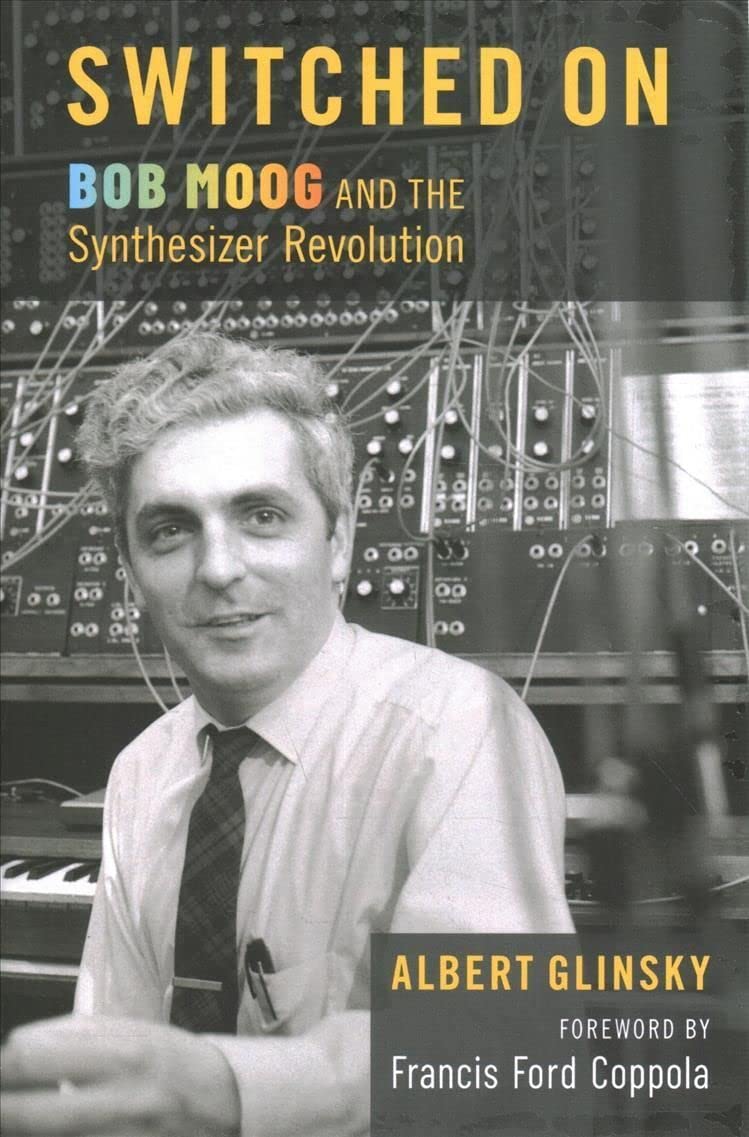
via this auction "Switched On Synthesizer book by Dr. Philip Springer. Published by Almo in 1977, with 127 pages, and 9 X 12 inches in size. This books includes musical arrangements, with program diagrams for the Arp Odyssey and Minimoog, basic glossary of electronic terms, and a demo LP in the back. The book is used however in good condition and the demo LP is un-used also in good condition. This is an interesting book however it is written at a basic level. Not for an advanced user except for a synth book collection."
"The Casio DH-100 is a monophonic MIDI instrument with 6 tone’s : Saxophone, Trumpet, Synth, Reed, Oboe, Clarinet and Flute.
All of the tone's timbre changes depending on the breath control from the mouth piece. The Horn is especially useful as a MIDI controller - as the breath control message is produced from the MIDI out allowing expression to be added to keyboard performances. With the use of MIDI-ox [downloadable from the web] it is possible to filter out the note message and use the horn as a breath controller which produces only the breath control necessary to alter the timbre of other instruments which respond to breath control.
The horn also has a portamento control - and produces this MIDI message - to produce glide between notes and a rear key which alters the octave.
It is possible to produce alternative fingering for the DH-100 by holding down the portamento control upon switching on. Then the instrument can cover a wider range of octaves.
These instruments can suffer from a failure, causing it to "squeak" - but this is repairable for about 50p by adding a capacitor. This has been replaced. The details are at [homepage.ntlworld.com/paul.fox4/casiofixes.htm].
Fingering The fingering method supports 2 modes - one of which is a conventional wind instrument mode with the octave being changed from a key on the rear of the instrument. The other is brought about by holding down portamento whilst switching on and allows a wider range of notes and uses a CASIO fingering mode to create the notes and some of the keys to change octave
Voices The 5 voices respond to the breath control from the mouthpiece whilst the breath control is switched to the ON position but the mouthpiece can be switched OFF and breath control is no longer active in creating any sound. The voices are all monophonic and respond dynamically to breath, varying the timbre and loudness in response to the mouthpiece. Portamento can be added creating a glide effect between notes.
MIDI The MIDI OUT terminal supplies control information for linking to other synthesizers and supports the breath control, though this is sent out as after pressure information. In order to get breath control on instruments such as Yamaha DX series it is necessary to alter the after pressure to a breath control signal - this can be done with a PC and MIDI-ox which is obtainable from MIDI-ox.com."