Showing posts sorted by date for query Polarity Music Only and Polarity Music. Sort by relevance Show all posts
Showing posts sorted by date for query Polarity Music Only and Polarity Music. Sort by relevance Show all posts
Friday, January 30, 2026
I Let My Modular Synth Design Its Own Utopia
video upload by Polarity Music Only and Polarity Music
"I just built a cool drone in the Grid again, with a ton of pads and a lead sound that randomly plays every now and then. There are also some random FX sounds, plus a little wind and rain machine. I tweaked the resonance on the wind filter a bit too. It kind of sounds like that low hum you hear in Deckard's apartment in Blade Runner. I thought it was pretty nice to add that in. You can download the patch for free, as always, and it's made in Bitwig 6, so you'll need that to use it. Have fun, and don’t forget to give me a like! Download: https://polarity.productions/dispenser/"

Friday, September 06, 2024
Tre Modular - Yamaha CS80 Inspired Eurorack Modules & More
video uploads by Tre Modular
The above is a playlist of demo videos from Tre Modular. You can use the player controls to skip around. You will find demos for individual modules with system jams dispersed througout. Note the videos are in newest to oldest order dating back to 1 year ago. This is the first post to feature Tre Modular.
You can find their modules at https://tremodular.com
Playlist:
1. Tre Modular - Replicant ADSR Demo
Tre Modular - Replicant ADSR is an envelope generator inspired by Yamaha CS80 synthesizers filter envelope section. It has Initial lvl, Attack lvl controls and multi stage decay and release, same as the CS80. In addition to those things Replicant ADSR has sustain control, retrigger function and inverted output that was not present on the CS80 filter envelope, making this a truly unique ADSR.2. Replicant ADSR first look
Replicant ADSR is a CS80 inspired envelope generator. It has Initial lvl, Attack lvl controls and multi stage decay and release, same as the CS80.
But that's not all, we have expanded on capabilities of this envelope generator by adding sustain control, retrigger function and inverted output making this a truly unique ADSR.
See dealers on the right for pricing and availability on gear.
LABELS/MORE: eurorack, New Makers, New Modules, News, synth tutorials, Tre Modular
LABELS/MORE: eurorack, New Makers, New Modules, News, synth tutorials, Tre Modular
Thursday, September 05, 2024
Boredbrain Optx v2 brief introduction (ADAT converter for eurorack)
video upload by Boredbrain Music
"Optx v2 - ADAT Optical Converter
Boredbrain is incredibly excited to finally announce that our next generation ADAT module Optx v2 is complete, and is on its way into production. As of today, you can pre-order the module, and the first batch will begin shipping very soon in mid October.
Next generation ADAT conversion
Optx v2 is a pro-quality ADAT lightpipe converter for eurorack modular synthesizers. The DC-coupled module can encode and decode audio signals with extremely low noise, and CV signals with near-zero offset. Additionally, on-board sample clock allows for one-way ADAT output and the ability to be used standalone to interconnect eurorack systems.
Features:
• Bi-directional ADAT lightpipe encoding/decoding of 8 analog inputs/outputs
• Switchable input mode (in pairs) powered by high-performance Cirrus Logic converters
• AUDIO input mode ensures the highest fidelity possible with ultra-low noise
• Self-calibrating CV input mode provides exceptional accuracy and near-zero offset (DC-coupled)
• Precision DC-coupled outputs support both audio and CV signals
• Internal sample clock permits one-way operation without ADAT input and standalone interconnection of two Optx modules
• Dual LEDs on each output indicate signal strength and polarity"
Update: press release follows:
See dealers on the right for pricing and availability on gear.
LABELS/MORE: Bored Brain Music, eurorack, New Modules, News
LABELS/MORE: Bored Brain Music, eurorack, New Modules, News
Wednesday, July 03, 2024
Introducing SONICWARE LIVEN Ambient - Immersive Ambient Generator Synthesizer
video uploads by SONICWARE
https://sonicware.jp/pages/liven-ambient
Playlist:
1. LIVEN Ambient Ø (Official PV)
2. How to make ambient music with LIVEN Ambient Ø
3. Layering tones with LIVEN Ambient Ø


Press release follows:
Soundscape Synthesizer LIVEN Ambient Ø Immersive Ambient Generator
4 layers of tone and texture̶Drone, Pad, Atmos, and Noise̶merge to generate resonance and transformation.
Blendwave Modulation Synthesis
Newly developed synth-engine with 6 structures, designed to create undulating and fluctuating tones.
Noise and Space
The Noise layer processes 8-second stereo sampling loops with noise blending and pitch modulation.
Extensive Effects Section
9 types of lush Reverb with shimmer, plus 6 types of effects including Tape Delay and Master Chorus.
Sequencer on Each Layer
Records performances, notes probabilities, and evolving tonal changes.
Immersive Ambient Generator
Ambient Ø (zero) is incredibly easy to use. Start by playing a tone from one layer using the note hold function. While listening closely, simply tweak the knobs to modify the tone and add other layers to shape a pleasing sound.
Blendwave Modulation Synthesis
We conducted extensive research into creating undulating and fluctuating tones for Ambient Ø, resulting in the development of a new wavetable-based synthesis.
Blendwave Modulation Synthesis combines 6 unique structures with 32 WAVEs featuring complex harmonic transitions, making it easy to create powerful low drones, lush pads, and transparent pizzicatos, perfect for ambient music.
4 knobs / 8 parameters offer a wide range of tone creation.
A WAVE contains 128 harmonic tables, allowing for diverse tonal changes such as moving from basic waveforms to complex harmonics. The WAVE is
represented by a yin-yang icon, with the yin representing moves in the reverse direction through the tables during modulation.
6 Structures
Each structure has a different number of oscillators and modulation circuits. ATMOS 1 applies ring modulation, while ATMOS 2 applies FM modulation.
Noise and Space
The Noise layer includes 8 specially selected nature sounds, offering noise blending, pitch adjustment and modulation to infuse unique spatial characteristics.
Additionally, it allows for up to 8 seconds of stereo sampling from the line input, letting you create personalized textures.
Extensive Effects Section
Ambient Ø is equipped with 9 types of lush reverb, each offering unique spatial dimensions and brightness settings. You can individually adjust the reverb send and shimmer send (for layering octaves) for each layer.
In addition to the reverb, the Ambient Ø offers
an effect unit with Tape Delay, Reverse Delay, and 4 master effects; Overdrive, Bit/Rate Crush, Tilt EQ, and Stereo Chorus.
Sequencer on Each Layer
You can not only layer the four tones, but each layer also includes a sequencer that allows you to record keyboard performances.
Furthermore, you can record changes in numerous parameters, including level, pan, and filter movement over time.
16 Ambient Sound Pattern Palettes, crafted by expert sound designers
No need to start from scratch. Choose a palette that fits your mood, start playing tones, tweak the knobs, and layer them following your heart. Thus, your inner thoughts and emotions will be crafted into sound.
Play On The Go: Portable, Built-in speaker, and Battery-powered
Leave your usual workspace and try using Ambient Ø in your living room or outdoors. As its evolving sounds mixes with the surrounding environmental noises, you are likely to experience genuine Ambient Music.
https://sonicware.jp/pages/liven-ambient
See dealers on the right for pricing and availability on gear.
LABELS/MORE: New Synths, News, SONICWARE
LABELS/MORE: New Synths, News, SONICWARE
Thursday, January 04, 2024
SONICWARE Introduces LIVEN "MEGA SYNTHESIS"
video upload by SONICWARE
Yuzo Koshiro Preset Patterns on LIVEN "MEGA SYNTHESIS"
video upload by SONICWARE

via SONICWARE
Fully Recreate the Legendary Sound of the World's First 16-bit Video Game Console from the Late '80s
You too must have fallen under the spell of the extraordinary visuals and sounds of the groundbreaking 16-bit video game console that once dominated the world! It was powered by the iconic YM2612 sound chip, a legacy that endures even today.
The MEGA SYNTHESIS has resurrected the sound engine of this chip. We've faithfully recreated the 4-operator & 8-algorithm FM sound module, the 8-bit PCM sound module, and the "SN76489" PSG (Programmable Sound Generator) sound module used by the original console.
See dealers on the right for pricing and availability on gear.
LABELS/MORE: Chiptune, MATRIXSYNTH Members, New Synths, News, SONICWARE
LABELS/MORE: Chiptune, MATRIXSYNTH Members, New Synths, News, SONICWARE
Sunday, November 26, 2023
Never Released Korg MU-5000 (Japan, 1985) Vintage Music Synthesizer PC Prototype
Note: links to listings are affiliate links for which the site may be compensated.

via this auction
SN ES 850111
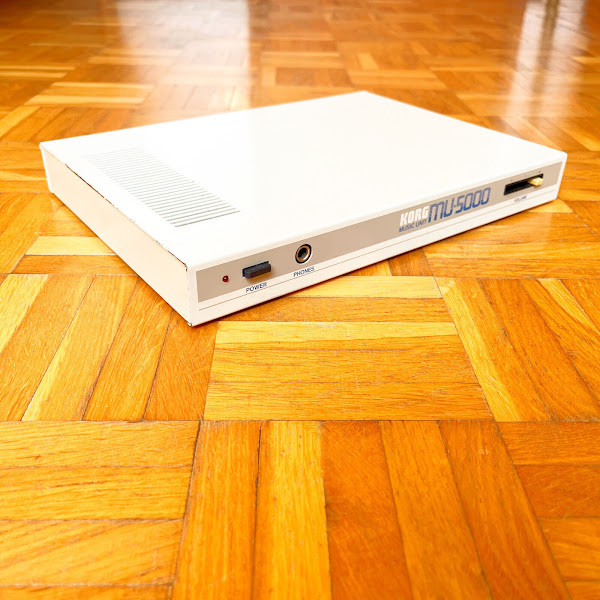
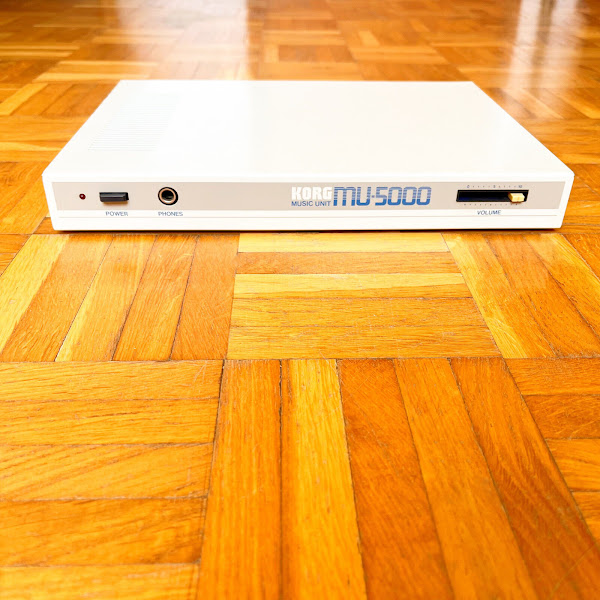 "In 1985 Korg decided to challenge the personal computer market creating a competitor for the legendary Commodore 64 (which was born three years earlier, in 1982).
Rumors then began to circulate about a new musical personal computer signed by Korg, called KORG MC-4000.
Along with the Korg MC-4000, Korg had designed 2 units which were extra and integral parts of the personal computer: a music synth expander called Korg MU-5000 and a microdisk unit called Korg MF-1000.
The incredible fact is that the personal computer project signed by Korg (the first “musical” personal computer in history) has remained for many years as a fake, since none of these products has ever been marketed in the western world.
The only historical artifact related to this project is a Japanese advertisement, a printed ad by Ishibashi Gakki released in the April 1985 issue of “Keyboard Magazine”.
In this ad (please, see the original photos), there were showed 3 products: KORG MC-4000, KORG MU-5000 and KORG MF-1000. The KORG MC-4000 music computer was then presented as a "compact computer containing its own music system".
Korg MC-4000, Korg MU-5000 and Korg MF-1000, according to historical information, have never been marketed because then Korg decided not to challenge the personal computer market. We don't know why!
Today, after years of research, we at Re Seller are pleased to present you the only survivor in the world of that super cool project: the original KORG MU-5000 expander synth!
This find of ours is of fundamental importance as it demonstrates that the Korg music personal computer project would have been really close to being commercialized!
This impossible to find Korg MU-5000 has been tested and is still in working order! Cosmetically there are minor signs of wear due to age, but nothing serious. The power supply is compatible and is included in the sale (this unit works with any 9V power supply and center negative polarity).
This small desktop synth contains beautiful sounds at its core! It is a 16-channel midi expander capable of generating some mighty impressive sounds courtesy of the same Digital Waveform Generator System used in the DW6000 and in the best Korg sounds of the 80s!
What we were able to test is very easy: we connected a midi keyboard to the Korg MU-5000 and listened to 128 sounds preset via program change (we changed the program change directly on the MIDI keyboard).
There are probably many more features to discover, but we don't have the capabilities to test it 100%!
An incredible piece of history, for the most demanding collectors in the world. Impossible to find another in all of history!"

via this auction
SN ES 850111

 "In 1985 Korg decided to challenge the personal computer market creating a competitor for the legendary Commodore 64 (which was born three years earlier, in 1982).
Rumors then began to circulate about a new musical personal computer signed by Korg, called KORG MC-4000.
Along with the Korg MC-4000, Korg had designed 2 units which were extra and integral parts of the personal computer: a music synth expander called Korg MU-5000 and a microdisk unit called Korg MF-1000.
The incredible fact is that the personal computer project signed by Korg (the first “musical” personal computer in history) has remained for many years as a fake, since none of these products has ever been marketed in the western world.
The only historical artifact related to this project is a Japanese advertisement, a printed ad by Ishibashi Gakki released in the April 1985 issue of “Keyboard Magazine”.
In this ad (please, see the original photos), there were showed 3 products: KORG MC-4000, KORG MU-5000 and KORG MF-1000. The KORG MC-4000 music computer was then presented as a "compact computer containing its own music system".
Korg MC-4000, Korg MU-5000 and Korg MF-1000, according to historical information, have never been marketed because then Korg decided not to challenge the personal computer market. We don't know why!
Today, after years of research, we at Re Seller are pleased to present you the only survivor in the world of that super cool project: the original KORG MU-5000 expander synth!
This find of ours is of fundamental importance as it demonstrates that the Korg music personal computer project would have been really close to being commercialized!
This impossible to find Korg MU-5000 has been tested and is still in working order! Cosmetically there are minor signs of wear due to age, but nothing serious. The power supply is compatible and is included in the sale (this unit works with any 9V power supply and center negative polarity).
This small desktop synth contains beautiful sounds at its core! It is a 16-channel midi expander capable of generating some mighty impressive sounds courtesy of the same Digital Waveform Generator System used in the DW6000 and in the best Korg sounds of the 80s!
What we were able to test is very easy: we connected a midi keyboard to the Korg MU-5000 and listened to 128 sounds preset via program change (we changed the program change directly on the MIDI keyboard).
There are probably many more features to discover, but we don't have the capabilities to test it 100%!
An incredible piece of history, for the most demanding collectors in the world. Impossible to find another in all of history!"
See dealers on the right for pricing and availability on gear.
LABELS/MORE: Auctions, exclusive, exclusive2023, Korg, New Old
LABELS/MORE: Auctions, exclusive, exclusive2023, Korg, New Old
Friday, April 21, 2023
New Systems Instruments Introduces Triphase Oscillator Eurorack Module
video upload by New Systems Instruments
"A quick overview of the Triphase Oscillator. For more information, check out our website: https://nsinstruments.com/modules/tri... Patch notes below.
The Triphase Oscillator is a Eurorack Module from New Systems Instruments that lets you explore the space of phase interference. It is an oscillator with three independent phases, with modulation, and a bipolar mixer to combine them.
The first / last patch uses two Triphase oscillators. The lower Triphase is taking two outputs panned left and right and one panned center, with different LFOs modulating the left and right phase. This gives it a stereo chorus type of effect. The higher/melody Triphase has an envelope controlling one of the phases, and an LFO controlling the other two. This makes a square notch that is large at the beginning and then becomes smaller, with both the width of the notch and its position relative to the saw changing. End of chain reverb is added. There are no filters, VCAs, or other modules making or modifying sounds.
Most of the other patches should be pretty self-explanatory. They are recorded dry.
The melodic patch is sequenced from a keystep.
The FM patch is doing audio rate FM from the Inertia, which is configured as an oscillator here.
The hard sync patch is synced with an offscreen oscillator, and uses the Inertia as an envelope to control the pitch of the Triphase."

"New Systems Instruments announced today that the Triphase Oscillator is now shipping and available. The Triphase Oscillator gives you three sawtooth waves with independent control over the phase of each wave, combined with a bipolar mixer. This creates a comb filter pattern in the harmonics, emphasizing some harmonics and canceling others.
The Triphase Oscillator works with phase cancellation, combining three waves at different phases and polarities to remove or reinforce regularly spaced harmonics, such as odd harmonics or every third harmonic. With the bipolar mixer, you can control how the waves interact, canceling or reinforcing parts of the spectrum either fully or partially. Applying CV to the phases creates variable-width pulses, subtle detuning effects, and a continuously moving soundscape. Phase cancellation is related to pulse width modulation, but pulse width modulation only has one dimension of control instead of the multiple phases and polarities of the Triphase Oscillator. A closer relative is a chorus effect, which creates frequency-dependent phase differences by delaying a signal.
One way to use the Triphase Oscillator is to mix all three saws at the same polarity, modulating their phases to create a supersaw, similar to mixing multiple detuned sawtooth oscillators. This creates a classic thick analog sound, further enhanced by the internal CP3 type mixer—a discrete transistor mixer that reportedly gave the Moog IIIp modular system a good part of its sound. With the individual outputs, you can also use a full featured stereo mixer and pan the saw waves left, right, and center, giving a stereo supersaw or stereo chorus type of effect.
Apart from its unique phase modulation capabilities, the Triphase Oscillator is a very capable analog oscillator in its own right, giving a tuning accuracy of around 8 octaves and ranging from 1.5Hz–60kHz, well into the sub and supersonic ranges. In addition to volt per octave and CV over phase, it has a hard sync input, and a linear FM input. All the CV runs at audio rate as well, meaning the Triphase Oscillator can produce some interesting FM + phase modulation sounds.
New Systems Instruments is a modular manufacturer located in the San Francisco Bay Area, focusing on creating new analog designs based on different ways of thinking about music and synthesis.
The Triphase Oscillator retails at $385 USD."
See dealers on the right for pricing and availability on gear.
LABELS/MORE: eurorack, New Modules, New Systems Instruments, News
LABELS/MORE: eurorack, New Modules, New Systems Instruments, News
Wednesday, February 15, 2023
United Plugins Introduces JMG Sound Retronaut - LoFi Nostalgia Machine Multi-effect Plug-in
video upload by United Plugins
Press release follows:

United Plugins puts past into present with JMG Sound Retronaut, realised as LoFi Nostalgia Machine multi-effect plug-in
“I hate to overuse superlatives, but, it has to be said, within a minute of trying out the amazing features of the Retronaut plug-in, I was astounded. Its versatility will work across all manner of instruments, from guitars to drums; I even tried some of the effects on a piano piece, and the results were extraordinary. This is going to be a great asset for film and media compositions, as well as my commercial recordings.”
- Chris Payne, orchestral composer for film and television/synthpop pioneer (co-writer of Visage's 1981 hit single ‘Fade to Grey’/former Gary Numan backing band member), 2023
PRAGUE, CZECH REPUBLIC: independent development teams federation United Plugins is proud to announce availability of Retronaut from founding partner JMG Sound — swinging back into action and putting the (analogue) past into the (DAW-driven) present as a so-called LoFi Nostalgia Machine multi-effect plug-in, perfectly capturing the vibe of old analogue gear by mixing bucket brigade chips, cassette tapes, VCFs (Voltage-Controlled Filters), vintage choruses, vinyl records, and more to transport its users back in time to explore their magical (musical) memories — as of February 15...
Explore the past
History has it that mankind has not only travelled the world and the ‘Seven Seas’ but beyond that to take one giant leap to touch down on the Moon, meaning the sky is not the limit. Steps still need to be taken to literally leave future footprints further away from the natural satellite of Earth, yet reality reasons that humanity cannot physically step back in time to explore the past in person, however, rather relying on history to tell its story. Saying that, Retronaut, JMG Sound’s so-called LoFi Nostalgia Machine, musically transports those interested in exploring their magical (musical) memories from where they originated; after all, music has a miraculous ability to transport anyone back in time. Therefore, seatbelts should be securely fastened in readiness for an ‘analogue’ expedition through history!
LoFi Nostalgia Machine
Make sure, then, that those seatbelts are securely fastened, for an ‘analogue’ expedition through history awaits as Retronaut is assuredly announced as a multi-voice vibrato and chorus plug-in, pulsating with lo-fi effects. Indeed, it is inspired by old analogue gear with which wisened ears welcoming warmth will already be familiar — think bucket brigade chips, cassette tapes, VCFs, vintage choruses, and vinyl records... Retronaut revisits that nostalgic musical magic of the past, putting it into the (DAW-driven) present with multiple ways to age and DEGRADE the signal being processed, thanks to controls for FLUTTER (adds random fluctuations to the modulation shape, simulating tape flutter); DUST (adds noise to the modulation shape); FAIL (adds random glitches of pitch and level drops to simulate old failing gear); WARP (adds pitch drift and a little tremolo at half-rate to all the VOICES globally); DIRT (controls the amount of tape-style saturation); FEED (controls the amount of cross-feedback by taking the outputs of the VOICES and feeding them into each other); and MONO (switches the signal to mono, simulating old gear with only one speaker, such as radios).
DIVERGE, MOD, MIX, and more
Meanwhile, it is possible to offset the multi-voice engine — enabling users to MIX from a single vibrato voice up to 4 VOICES, resulting in a rich chorus — in various ways to create organic and evolving movements via the DIVERGE section: SPREAD (offsets the LFO phase in the left and right channels); LAG (introduces a time delay for each voice); PHASE (offsets the LFO phase for each voice); V2 SCALE (offsets the voice 2 modulation rate from the main modulation rate); V3 SCALE (offsets the voice 3 modulation rate from the main modulation rate); V4 SCALE (offsets the voice 4 modulation rate from the main modulation rate); and RESYNC (resets the LFO phases). But beating at the musical heart of Retronaut is its MOD (modulation) section with HP MOD (controls the modulation depth of the virtual analogue high-pass filter in both positive and negative polarity) and LP MOD (controls the modulation depth of the virtual analogue low-pass filter in both positive and negative polarity); dialling down the modulation depth for the vibrato effect with the associated VIBE control and then using other effects encourages that warm, woolly, and compressed tape sound. Shape the tone with the VCF section — anchored around those virtual analogue high-pass and low-pass filters, switchable between 2 (12dB per octave) and 4 (24dB per octave) POLE slopes, with RESO (resonance) control — and MIX to perfection. Possibilities are endless, almost: add lo-fi to drums, rich chorus to synths, and lush reverb to anything... ask orchestral composer for film and television/synthpop pioneer Chris Payne (Visage, Gary Numan), who was well versed in working with original analogue gear — of the kind that inspired Retronaut — on a number of historic hit records. “I particularly love the DEGRADE section, which can add a huge amount of expression to any sound you use,” he enthuses, ending on an equally high note: “I’ll certainly be building up a huge library of sounds using Retronaut over the coming months, and cannot wait to get started with it on my forthcoming projects.”
Key features:
Captures the vibe of old analogue gear, mixing bucket brigade chips, cassette tapes, vintage choruses, and more in one powerful multi- effect plug-in
Smoothly mix from a single vibrato voice up to four, resulting in a rich chorus
Add that nostalgic lo-fi (musical) magic with the DEGRADE section — age sound from gentle dust and warmth to old, broken gear
Control each voice independently with the DIVERGE section — offset them in various ways to create organic and evolving movements
JMG Sound’s Retronaut is available to purchase for a time-limited introductory promo price of only €24.00 EUR until March 19, 2023 — rising thereafter to its regular price of €89.00 EUR — as an AAX-, AU-, VST-, and VST3-compatible plug-in (using internal 64-bit audio processing capable of handling any sample rate) directly from its dedicated webpage (https://unitedplugins.com/Retronaut/), where a 15-day, fully-functional trial version for macOS 10.10 and newer and Windows 8/10/11 can also be downloaded for free.
Note that no iLok, dongle, or internet access is required for Retronaut activation. (All United Plugins software uses license files for activation and owners can freely use purchased software — with free-for-life updates — on all their computers, as long as they are the user.)
See dealers on the right for pricing and availability on gear.
LABELS/MORE: New Soft Synths, New Synth Effects, News, Soft Synths, United Plugins
LABELS/MORE: New Soft Synths, New Synth Effects, News, Soft Synths, United Plugins
Tuesday, November 17, 2020
KORG Introduces the SQ-64 Polyphonic Sequencer
Korg
Playlist:
1. “Step Up” with the SQ-64 Polyphonic Sequencer
2. Korg’s SQ-64 Polyphonic Sequencer: A Brief Overview
3. KORG SQ-64 Review and full tutorial - leploop
"There's nothing that offers the combination of CV control, MIDI & Audio sync, and polyphonic multitrack sequencing that Korg’s SQ-64 does. Compact as it may be, it gives you three tracks, each with dedicated Pitch, Mod, and Gate output, plus a fourth Drum-Sub track with a total of 16 triggers; eight gates and eight over MIDI. Each of the 64 step buttons uses graduated LEDs to show you exactly what's going on in your track, and a crisp OLED screen gives you an at-a-glance look at details. It's all packed into a rugged aluminum case roughly an inch thick for durability and portability - every step of the way"

via KORG:


 "The SQ-64 is an incredibly powerful and compact Polyphonic Step
Sequencer with amazing hands-on intuitive controls and deep editing options to
give you all the flexibility and sequencing power needed for all your musical
projects. With its 64 step pad Matrix, Crystal clear OLED display, sturdy and
elegant aluminium body, a wealth of connections and a variety of modes and
features, the SQ-64 will become the central piece of your music studio providing
total and seamless control over all your instruments so you can focus on what
matters most; your music!
"The SQ-64 is an incredibly powerful and compact Polyphonic Step
Sequencer with amazing hands-on intuitive controls and deep editing options to
give you all the flexibility and sequencing power needed for all your musical
projects. With its 64 step pad Matrix, Crystal clear OLED display, sturdy and
elegant aluminium body, a wealth of connections and a variety of modes and
features, the SQ-64 will become the central piece of your music studio providing
total and seamless control over all your instruments so you can focus on what
matters most; your music!
Despite its compact size, the SQ-64 has unparalleled connectivity and will allow you to easily control, connect and make the most of all your analog and digital gear. MIDI IN (x1) and OUT (x2), micro USB type B, Sync IN & OUT, 3 Melody tracks each with MODULATION, PITCH and GATE outputs and a DRUM track with 8 individual trigger outputs for controlling analog synths, Eurorack, and drum machines.
Each of the Melody tracks (x3) has 16 Patterns of up to 64 steps each, and the Drum track (x1) has 16 Sub-tracks also with up to 64 steps each, that can be played, chained and edited in a variety of ways.
Melody tracks and patterns can be edited in several modes (GATE, PITCH and MODULATION) so you can alter the information sent by your sequencer on each of these steps in many interesting ways.
The DRUM track outputs can be fine-tuned to match the polarity and voltage of your connected device(s). Its audio Sync In & Out connections will allow you to seamlessly control all your other Korg gear such as the volca synthesizer series, minilogue, monologue, minilogue xd, prologue and many others!
Whether you are into Analog synths, Eurorack semi-modular synths, Digital drum machines, or do everything on your DAW with digital plugins, the SQ-64 will give you instant and precise hands-on control of each and all of these.
The SQ-64 has 64 beautifully LED-lit Step button pads that not only let you see the whole picture at once, but also allow for super-fast and satisfactory editing with its encoder knobs and dedicated mode buttons that will simplify and speed up your workflow. Each step has graduated lighting; the higher the modulation value, the stronger the button lights up to give you a clear visual on what’s going on in the sequence.
The OLED Display is crystal clear, bright and visible from any angle, so you can have access to all the information you need no matter whether you are making music at home, in the studio or playing live!
The 3 melody tracks include a MODULATION output, so every step on your sequence can be creating complex modulations on your gear of choice, greatly expanding your options and possibilities for sound creation. It has never been easier to create polyphonic chords patterns, melodies, complex poly-rhythms and modulations on the fly and record them as data on each of the 64 project slots available.
REAL-TIME CONTROL
The SQ-64 won’t just allow you to create incredible sequences; it packs several features and modes that will let you edit on the fly and play any of your gear real-time.
The 64 pad Matrix can be also be used as a Keyboard, allowing for several layouts to be used for maximum flexibility (several scales can be assigned to any of these and a number of other parameters can be easily changed)
See dealers on the right for pricing and availability on gear.
LABELS/MORE: Korg, New, New in 2020, New Tools, New Tools in 2020, News
LABELS/MORE: Korg, New, New in 2020, New Tools, New Tools in 2020, News
Thursday, October 22, 2020
Introducing Crazy Chain! New approach to daisy chaining
Gaz Williams
New Crazy Chain from myVolts. They are running a promo for the day: "Buy any Ripcord and get one free Crazy Chain, add code CRAZYVOLTS at checkout, code's good to midnight 22nd October." Link: https://myvolts.co.uk

"What is myVolts Crazy Chain?
Did you ever want to power a number of synths and pedals, but find that your existing daisy chain cable just didn't cut it? Wrong size connectors, wrong size polarity, unused connectors, unsuitable cable lengths can all be a hassle you don't need when you just want to make music.
Crazy Chain is a flexible, mix and match cable solution to let you power your gear just the way you want to. Choose tip: You choose which DC power tip size each Crazy Chain connector has, so you can plug, for example, a Korg Volca (1.7mm inner diameter / 4.7mm outer diameter) in the same chain as a Boss guitar pedal (2.1mm inner diameter / 5.5mm outer diameter). Mix and match tips to suit exactly your devices.
Change polarity: You can change polarity from positive to negative as you go along the chain, you can even change it back! Polarity change is identified by an orange DC input, so whenever power passes through this connection, it will change polarity. Make sure to check your instrument specification to ensure it receives the correct polarity. Chain devices: Crazy Chain lets you power only the devices you want to power, whether that's 3 devices or 12 devices. This means no more looking for extra connectors to suit your specific setup, and no more hanging dog-leg connectors adding noise into your audio.
The right lengths: Choose from 3 different cable lengths to suit your setups."
See dealers on the right for pricing and availability on gear.
LABELS/MORE: myVolts, New Tools, New Tools in 2020, News
LABELS/MORE: myVolts, New Tools, New Tools in 2020, News
Thursday, January 09, 2020
KORG Officially Introduces the New ARP 2600
ARP 2600 FS | Welcome Back Published on Jan 9, 2020 ARP
Follow-up to this post.
KORG ARP 2600 FS posts
User & Dealer videos:
Playlist:
The ARP 2600: The Story of a Legendary Synthesizer | Reverb Feature
Korg ARP 2600 FS Synthesizer - All Playing, No Talking! - Kraft Music
Korg ARP 2600 FS Synthesizer - Overview with Nick Kwas - - Kraft Music
Korg Arp 2600 - 1st Look - sonicstate
ARP 2600 Semi-modular Analog Synthesizer System Demo - Sweetwater
ARP 2600 Synthesizer | Overview and Demo - Guitar Center
NEW Korg ARP 2600! | Namm 2020 - GAK - previously posted

"The Total Package
More than a synthesizer, the ARP 2600 is a complete sound design studio. Even today, the ARP 2600 stands as a bridge between the individual elements of modular synthesis and the immediacy of a production / performance instrument. Included are an ample supply of oscillators, envelopes, a filter and amplifier – all of the building blocks of analog synthesis. But the ARP 2600 goes even further, with a spring reverb tank and even a pair of built in monitor speakers. Also present is much of the versatility of a vintage modular system, including a ring modulation, lag and voltage processors, an envelope follower, audio preamp, a clock-able switch, noise source, a sample & hold module, signal inverters, an auxiliary mixer, and even a set of parallel-wired/multi jacks.
The ARP 2600 FS reproduces the sounds of these components at the circuit level. Under the supervision of David Friend, the co-founder of ARP Instruments, parts were carefully selected and every detail was adjusted to replicate the original unit's distinctive synthesis.

Profile of David Friend:
Co-founder of ARP Instruments, Inc. together with the founder Alan Robert Pearlman. In addition to designing the ARP 2600 and Odyssey, he was involved with the development of numerous products, and subsequently entered management, eventually becoming president of the company. His achievements as an entrepreneur have also been acclaimed, and in 2010 he received the "Entrepreneur of the Year" (Emerging Technology category) award from Ernst & Young. After serving as the President and CEO of Blue Archive, Inc., currently he serves as the President, CEO and Co-founder of Wasabi, as well as being a lecturer at MIT's Sloan School of Management. He is also an emeritus of the New England Conservatory and Berklee College of Music.

 Nearly every slider and switch on the ARP 2600 front panels is hard wired to specific control source. For example, the front panel controls allow the pitch of Oscillator 1 to be controlled by the keyboard (On/Off switch), the output of the Sample & Hold module (slider), the shape of the ADSR envelope generator (slider), and/or by the sine wave output of Oscillator 2 (slider), and each in varying amounts. These hardwired pathways provide massive amounts of immediate control that make excellent use of all the ARP 2600 has to offer, allowing the ARP 2600 to be played as is – no patching needed. In true modular fashion, inserting a patch cord into the jack associated with any hardwired control overrides that internal connection, letting you create a new signal path of your choosing. As a programming aid, the detailed panel graphics clearly show the available signal routings.
 Patch Bay Precision
Unlike earlier modular synthesizers that relied on bulky 6.3mm (1/4") jacks and patch cords, the ARP 2600 uses a more streamlined 3.5mm (1/8”) jack that allows for more patch points to occupy the same amount of panel space, delivering more options and more versatility. Most of the patch points are arranged in a single row below the controls of the individual sound modules. This arrangement keeps the main panel clear and unobstructed for tweaking the controls during performance. Needless to say, these patchable connections and the onboard processors can be used to interact with nearly any modular or Eurorack synthesizer system.
3620 Keyboard
While faithful to the original design, the functionality of the 3620 Keyboard has been greatly enhanced for this limited ARP 2600 release. The 3620 Keyboard contains 49 full-size keys, aftertouch, portamento, and is also duophonic, allowing two keys to be played at once – Single or Multiple Triggering is available. In addition, the duophonic keyboard can use an optional foot switch to lock the interval between any two notes, without retuning the oscillators during performance. Vibrato can be added via a dedicated circuit controlled by aftertouch, or by the onboard LFO (Low Frequency Oscillator), using any of three available waveforms. Most noticeable is the addition of a flexible Arpeggiator that allows a user-defined pattern to be manually sequenced and played back. Still present are the original Pitch Bend knob and the Two Octave Up / Two Octave Down Transpose switch. Connecting the keyboard to the main unit now uses a secure eight-pin din cable.
See dealers on the right for pricing and availability on gear.
LABELS/MORE: Korg, New, New in 2020, New Synths, new synths in 2020, News
LABELS/MORE: Korg, New, New in 2020, New Synths, new synths in 2020, News
Saturday, February 09, 2019
Fort Processor - experimental noise synthesiser circuit by Isn'tses
Published on Feb 3, 2019 Isn'tses music
"The Fort Processor is an experimental synth and noise effects circuit created by Isn'tses as part of Fort Process sound art festival 2018.
Available now as a DIY PCB or full kit."

via Thonk
"The Fort Processor is an experimental noise synthesiser and audio effect circuit designed by harsh fun noise duo ISN’TSES (Tim Drage & Lisa McKendrick) for Fort Process sound art festival. This event takes place in the tunnels and bunkers of Newhaven Fort on the Sussex coast, and the electronics and artwork of the synth are based on the layout of the site, with inspiration from the surrounding landscape and ocean.
The synth is controlled by light, touch pads, 3 knobs, and a trimmer. Audio is created and manipulated by four sections which have been combined using a circuit-bent approach:
1. The audio input, (3.5mm) used to connect devices such as a radio, walkman, phone, tablet, mp3, instrument etc. This signal is distorted using high gain then run through a frequency divider to add two noisy sub-octaves. When no input jack is connected, the circuit feeds back and self-oscillates.
See dealers on the right for pricing and availability on gear.
LABELS/MORE: DIY, Isn'tses, New, New DIY, New DIY in 2019, New in 2019, New Makers, New Makers in 2019, New Sound Machines, New Sound Machines in 2019
LABELS/MORE: DIY, Isn'tses, New, New DIY, New DIY in 2019, New in 2019, New Makers, New Makers in 2019, New Sound Machines, New Sound Machines in 2019
Tuesday, October 16, 2018
Rosen Sound Synth Demos & Restorations
Published on Jul 28, 2018 Rosen Sound
This one in via Soviet Space Child.
www.rosensound.com/rentals
Playlist:
1. Oberheim OB-X - Rosen Sound Demo
The OBX was the first major "answer" to the Prophet 5 synthesizer, and at least in our opinion, was the best answer anyone could've given.2. Moog Minimoog - Rosen Sound Demo
The OB-X is based on the basic design of the (S)ynthesizer (E)xpander (M)odule also from Oberheim. Like the SEM, it features two discreet VCO's with saw and pulse, two envelopes, and the low pass section of the SEM filter. It also added noise, a release control, and cross modulation (similar to the Prophet's cross mod). The prophet's cross mod was a bit more dynamic, though. A flexible LFO section is also featured.
None the less, the OBX is in a species all of it's own in many ways. It's one of the very few mostly discreet programmable polyphonic synthesizers, and more than that spec, it sounds unique and absolutely marvelous.
Our unit features encore midi
Book your rental package with Rosen Sound and see the rest of our synth catalog at www.rosensound.com/rentals
3.SCI Prophet 5 - Rosen Sound Demo
In a lot of ways this needs no introduction. One of the most iconic poly synths ever made, and the first synth to offer true programmability with polyphonic architecture.4. Oberheim Four Voice - Rosen Sound Demo
The Prophet 5 offers your basic amenities in a poly synth with 5 voices each with 2 VCO's, a low pass VCF, a VCA, two EG's, one LFO with multiple wave shapes available, with POLY MOD as the icing on the cake. This lets you make FM type sounds and is part of what makes the prophet 5 unique.
Our unit features factory midi
This in our opinion is one of the finest synthesizers ever made in terms of overall sound. The features are of course many and the synth as a whole is very flexible and powerful, but the sound it outputs is nothing short of mesmerizing.5. Moog Memorymoog - Rosen Sound Demo
The FVS features 4 Synthesizer Expander Modules (SEM) each representing a polyphonic voice. This means for one patch, each SEM must be setup identically. This may seem like too much, but it's actually a very enjoyable process that causes you to think different about the patch your making, the polarity of your modulation per voice, and subtle differences you can set.
The synth can also be used in a powerful unison mode, allowing each SEM to be adjusted separately for a crazy 4x dual oscillator synthesizer each with a multi mode filter to be fired at once.
Each SEM is as or more powerful than your standard mono synth, featuring 2 oscillators with saw and pulse each, PWM, FM, 1 LFO, two EG's, a bi-polar filter modulation control, and the sweetest Oberheim filter ever made featuring a bandpass filter and a sweepable LP-HP filter. These filters are special in the way that when the resonance is turned up, there is no loss of volume or low end.
Additionally, our FVS is an early model with no programmer (a feature loathed by many anyway). Instead, it features 2 dual mini sequencers with a common clock available. This means you can do 8-step 4 note poly sequencing between the four SEM's, or split the keyboard with one sequencer playing 1 SEM and 3 note chords on the other side of the keyboard.
Functionally, our FVS is very much in tune and has been stabilized to survive travel and tuning consistency. It is in tune as soon as it's turned on, and we provide a quick start guide for our rental customers to learn how to easily program and tune the machine.
Our FVS also features MIDI in via a modified YARN's module installed inside. This allows through basic midi and if desired (more complicated) midi scripts to play it polyphonically (default on boot), sequence each SEM assigned to a separate channel (enabling MPE), or played in Unison. All of these features can be harnessed by utilizing SYSEX or the Yarns editor, all which is provided on a thumb drive for rentals.
To start, let's forget the internet-lore or an "unreliable" and "impossible to tune" machine. Our service shop is known worldwide for our work on Memorymoogs and stabilizing them for real production use.6. Oberheim OB8 - Rosen Sound Demo
Now, let's introduce you to (what we consider) the pinnacle of Moog synthesizers. With 3 oscillators + ladder filter per voice, flexible and intuitive modulation, and a knob per function, the Memorymoog is not a force to be reckoned with, and is in what we consider to be the top 3 best sounding synthesizers ever made.
From lush pads, 18 oscillator unison leads, heavy bass, and even gentle timbres, the memorymoog is sure to be a staple piece for your session in any genre on music. Plus it has everyones favorite feature: an arpeggiator!
Our rental memorymoog will arrive with an expression pedal and 12 custom patches (87-99) made by our resident in house programmer, Eli Goss. These 12 patches are the juice that will fuel modern productions to achieve sounds unobtainable by any other synth, with plugins not even worth a mention.
One of our staple synths in the collection. The lore of the OB8 is that it's a less-exciting OBXa, however, with some choice mod's which we've done to ours, they are sonically identical.7. Sequential Circuits Prophet 10 - Rosen Sound Demo
The OB8 is one of the most flexible synthesizers available, which includes deep LFO routing from the front panel, and a PAGE 2 function that transforms every knob and button on the synth to do even deeper modulation, including quantized LFO's, musical "OBXA" style detuning, envelope routing, and more.
Additionally, our OB8 has been fitted with a Pratt & Read keybed, which brings the true feel of American poly synths to the experience, while also having the amenities provided by the B5 EPROM including factory midi.
The Prophet 10 is more than just 2 Prophet 5's in one box; featuring an active EQ per voice, deeper modulation, and more performance capabilities with it's dual manuals and CV pedal inputs. This prophet 10 also features midi in and out.8. Oberheim Four Voice Sequence
You could do an entire score with this #oberheimfourvoice. With quad poly sequencing and split modes the sky is the limit. Available for rent through us! Contact us for rates and availability. And yes, it has midi!9. Prophet 5 Rev 3 Restoration
10. Juno 106 Multiboard removal
11. Juno 106 80017A Chip Failure - What To Check
In this video I go over a couple things to check not only to see if your 80017A chips are failing, but also other potential failures of the juno, including failure of one of the MC5534A dual DCO chip.
This video also applies to other models, such as the MKS 30, HS 60, GR 700 and some others.
If you would like Rosen Sound to service your Juno, please contact us at contact@rosensound.com
See dealers on the right for pricing and availability on gear.
LABELS/MORE: DIY, Featured, MOOG, Oberheim, Roland, Sequential Circuits, synth guts, Synth Techs
LABELS/MORE: DIY, Featured, MOOG, Oberheim, Roland, Sequential Circuits, synth guts, Synth Techs
Tuesday, August 07, 2018
::vtol:: modulator
::vtol:: modulator from ::vtol:: on Vimeo.
Another fascinating creation by ::vtol::. The sound that you hear is software. The hardware controls the sound.
"I have always perceived the concept of modulation in music as a complex cyclical visual system: the ricochets of the crest of a wave constricted in its own amplitude, rotations within rotations (in particular, if the shape of the wave is aspiring for a sinus), compound pendulums and centrifugal spirals. Meanwhile, I actually experienced the frequency modulation as synesthesia a long time ago – I had such an experience when playing a guitar, with the oscillatory movements of my fingers accurately and demonstrably accompanying the palpable vibrations of the string.
The modulator is a system consisting of electric motors and a composite hand, with a passive magnet installed at the end. The Hall effect sensors register the movements of the magnet. This only occurs if the rotation phases coincide in such a way that both composite parts of the hand with the magnet at the end and the senor are on one line. After registration of the magnet’s movements, the status of the entire system shifts -– there is a change of pace, the direction of the rotation of one or both motors changes, and most importantly - the parameters of the sound synthesis. The more frequently the system mutates, the more complex the sound becomes and vice-versa, the more infrequently, the tone becomes more diffuse. As the Hall effect sensors register not only the existence of a magnetic field, but also its strength and polarity, another three additional magnets have been installed on the object on the rotating axes which modulate the position of the main magnet when it is all of a sudden in close proximity to them. Taken all together, they form a composite dynamic system in a closed loop and in a constant state of mutation and modulation of its state rotating in an endless sound composition.
soft:
- axoloti
hard:
- axoloti
- 3 custom made Hall-sensors
- 5 dc motors
- custom electronics
- 1 channel sound system
Moscow, 2018."
Be sure to see the vtol label for more.

See dealers on the right for pricing and availability on gear.
LABELS/MORE: Art Installations, Axoloti, DIY, mechanical, New, New DIY, New DIY in 2018, New in 2018, vtol
LABELS/MORE: Art Installations, Axoloti, DIY, mechanical, New, New DIY, New DIY in 2018, New in 2018, vtol
Saturday, February 11, 2017
FEEDBACK Modules Introduces New Juno 106 Chorus Module & More in Eurorack Format & DIY
You'll find them here: https://www.feedbackmodules.com
They offer both completed and DIY versions of their modules, including a recreation of the classic Roland Juno-106 filter. You'll find a list of their current modules with demos captured below for the MATRIXSYNTH archives. Be sure to see their site for pricing and additional details.
FEEDBACK Modules is brought to us by strat-1.

106 CHORUS
"The 106CHORUS is an accurate recreation in EURORACK format of one of the most sought after choruses, the one from a famous analog polysynth from the eighties."
They offer both completed and DIY versions of their modules, including a recreation of the classic Roland Juno-106 filter. You'll find a list of their current modules with demos captured below for the MATRIXSYNTH archives. Be sure to see their site for pricing and additional details.
FEEDBACK Modules is brought to us by strat-1.

106 CHORUS
"The 106CHORUS is an accurate recreation in EURORACK format of one of the most sought after choruses, the one from a famous analog polysynth from the eighties."
See dealers on the right for pricing and availability on gear.
LABELS/MORE: DIY, eurorack, FEEDBACK Modules, New, New DIY, New DIY in 2017, New in 2017, New Makers, New Makers in 2017, New Modules, New Modules in 2017, strat-1
LABELS/MORE: DIY, eurorack, FEEDBACK Modules, New, New DIY, New DIY in 2017, New in 2017, New Makers, New Makers in 2017, New Modules, New Modules in 2017, strat-1
Thursday, June 02, 2016
Future Retro Introduces the 512 Touch Keyboard Playing the Arp 2600 & Buchla Music Easel
Future Retro 512 Touch Keyboard Playing the Arp 2600
Published on Jun 2, 2016 FutureRetroSynths
"Simple test to show the Future Retro 512 keyboard controlling the Arp 2600 modular synthesizer."
Update: New video with the Buchla Music Easel added:
Future Retro 512 touch keyboard playing Buchla Music Easel:
Published on Jun 2, 2016
"Simple demo of the Future Retro 512 keyboard controlling the Buchla Easel. The 512 has an adjustable CV output so you can achieve .469V to 1.34V per octave control voltages to control a wide variety of synths including the common 1V/Oct synthesizers, and this 1.2V/Oct Buchla. Works with EML and EMS synthesizers too!"
New demos here: Future Retro 512 touch keyboard plays the EMS Putney, Minimoog Model D, EML 101, & Eurorack
Previous posts featured the assembly of the new 512 Touch Keyboard from Future Retro. We now have details and what it looks like completed.

Details via Future Retro
"The 512 is a capacitive touch keyboard, packed with a unique blend of truly musical features to enhance your creative experience. The 512 is available with or without the optional rack ears that allow it to fit in a standard 19" rack enclosure, taking up only 4u spaces.
Why is capacitive touch better? Quite simply, eliminating mechanical moving parts found in traditional keyboards makes a product that will never wear out, as mechanical keyboards do. No more intermittent key contacts, or failed aftertouch circuits to worry about! In addition, capacitive touch provides a much faster response time for playing notes, and allows multiple forms of expression to be executed by the performer.
There are five main functions of the 512. It can act as a keyboard, arpeggiator, sequencer, MIDI to CV converter, and MIDI to MIDI converter. The 512 can control both MIDI and CV/Gate synthesizers simultaneously. Pitch, Pitch Bend, Mod Wheel, Gate, Velocity, Aftertouch, and Clock are all available in both their MIDI and CV form. CV's follow the 1V/Oct standard with positive polarity Gate signals, allowing the 512 to control the majority of analog synthesizers both past and present.
KEYBOARD
The 512 provides 9 octave ranges for the 29 full-sized keys (although shorter in length than typical keys) with response to Velocity and Aftertouch. Users can define one of five different Velocity and Aftertouch curves to apply to the keyboard, and dial in the range for each curve to customize the response. The Pitch Bend provides positive and negative pitch bends, and the bend range can be adjusted for full or half range. Mod Wheel is also provided as a modulation source.
ARPEGGIATOR
Published on Jun 2, 2016 FutureRetroSynths
"Simple test to show the Future Retro 512 keyboard controlling the Arp 2600 modular synthesizer."
Update: New video with the Buchla Music Easel added:
Future Retro 512 touch keyboard playing Buchla Music Easel:
Published on Jun 2, 2016
"Simple demo of the Future Retro 512 keyboard controlling the Buchla Easel. The 512 has an adjustable CV output so you can achieve .469V to 1.34V per octave control voltages to control a wide variety of synths including the common 1V/Oct synthesizers, and this 1.2V/Oct Buchla. Works with EML and EMS synthesizers too!"
New demos here: Future Retro 512 touch keyboard plays the EMS Putney, Minimoog Model D, EML 101, & Eurorack
Previous posts featured the assembly of the new 512 Touch Keyboard from Future Retro. We now have details and what it looks like completed.

Details via Future Retro
"The 512 is a capacitive touch keyboard, packed with a unique blend of truly musical features to enhance your creative experience. The 512 is available with or without the optional rack ears that allow it to fit in a standard 19" rack enclosure, taking up only 4u spaces.
Why is capacitive touch better? Quite simply, eliminating mechanical moving parts found in traditional keyboards makes a product that will never wear out, as mechanical keyboards do. No more intermittent key contacts, or failed aftertouch circuits to worry about! In addition, capacitive touch provides a much faster response time for playing notes, and allows multiple forms of expression to be executed by the performer.
There are five main functions of the 512. It can act as a keyboard, arpeggiator, sequencer, MIDI to CV converter, and MIDI to MIDI converter. The 512 can control both MIDI and CV/Gate synthesizers simultaneously. Pitch, Pitch Bend, Mod Wheel, Gate, Velocity, Aftertouch, and Clock are all available in both their MIDI and CV form. CV's follow the 1V/Oct standard with positive polarity Gate signals, allowing the 512 to control the majority of analog synthesizers both past and present.
KEYBOARD
The 512 provides 9 octave ranges for the 29 full-sized keys (although shorter in length than typical keys) with response to Velocity and Aftertouch. Users can define one of five different Velocity and Aftertouch curves to apply to the keyboard, and dial in the range for each curve to customize the response. The Pitch Bend provides positive and negative pitch bends, and the bend range can be adjusted for full or half range. Mod Wheel is also provided as a modulation source.
ARPEGGIATOR
See dealers on the right for pricing and availability on gear.
LABELS/MORE: ARP, Future Retro, New, New Controllers, New Controllers in 2016, New in 2016, Updates
LABELS/MORE: ARP, Future Retro, New, New Controllers, New Controllers in 2016, New in 2016, Updates
Thursday, January 14, 2016
Pittsburg Modular Officially Introduces Lifeforms Eurorack Systems

"Introducing Lifeforms Eurorack Systems
Our best sounding synthesizer yet, Lifeforms systems are available in three configurations. System 101, System 201, and System 301 are the perfect gateway to the eurorack modular synthesizer world.
 Interactive inspiration machines. The next generation of our System line of eurorack synthesizers harnesses the power of the new Lifeforms modules and Structure enclosures. Designed around the Lifeforms SV-1 modular analog synthesizer voice and anchored by the classic Pittsburgh Modular filter and two full range analog oscillators packed with harmonically rich waveforms, the Lifeforms Systems offer a rich sound palette with the flexibility of an open, fully patchable analog voice architecture.
 The System 201 and System 301 also include the Lifeforms KB-1 pressure sensitive keyboard controller. The pressure sensitive keyboard maximizes the creative process with arpeggios, sequences, triggers, voltage memory, and more. More information on the entire Lifeforms line is available at lifeformsmodular.com.
 Evolution of the Synthesizer Voice
The Lifeforms SV-1 is a fully patchable synthesizer module, destined to be the heart and soul of any eurorack modular system. It features two independent, full-range analog oscillators, and the unmistakeable sound of the Pittsburgh Modular filter paired with a highly curated set of modular tools designed to fuel the creative fire. More information on the Lifeforms SV-1 is available at lifeformsmodular.com/sv-1.
Control At Your Fingertips
Shape music like never before with the Pittsburgh Modular Lifeforms KB-1 pressure sensitive controller. The Lifeforms KB-1 eurorack module provides a multi-function, expressive, capacitive touch keyboard designed for performance. It contains a powerful one octave pressure sensitive keyboard complete with arpeggiator, step sequencer, preset voltage memory array, and a pair of multi-mode trigger pads. Eleven patchable outputs and a deep feature set enable an unprecedented level of control over any eurorack system. More information on the Lifeforms KB-1 is available a lifeformsmodular.com/kb-1."

Analog Modular Synthesizer
Suggested Retail Price $699
"The Heart and Soul of Modular Synthesis
The Pittsburgh Modular Synthesizers Lifeforms SV-1 is a complete dual oscillator synthesizer, designed to be the core of your eurorack modular system. Building on the sound and legacy of our celebrated Waveforms oscillator, the SV-1 module features two full-range independent analog oscillators; sound sources that are perfect for dynamic and inspired performances. In addition to these two high-performance oscillators, we stuffed the SV-1 with a perfectly curated set of modular synthesis tools including dual, chained mixers, a plucky, four stage envelope generator, and of course, our legendary analog state-variable filter.
The Lifeforms SV-1 is a synthesizer powerhouse, providing absolutely everything you need to create gigantic and iconic synth sounds: roaring bass, shimmering leads, lush pads and warm drones are only a few knob turns away. Instantly, out of the box, a rich feature set with a fluid, easy to understand interface empowers you to create vibrant, thick tones. Modulation and Tools sections fill out the analog SV-1 modulation capabilities with a triangle and square LFO, two sub-octave oscillators chained to the main oscillator, and noise with sample & hold.
Your Sound, Your Way
Pre-patched under the hood, patch cables are not necessary to get started. But as soon as you begin patching, you will feel the power provided by the 53 patch points and 21 knobs. By breaking each feature of the synthesizer out with patch cables, a tremendous amount of flexibility and control emerges to patch up any sound your imagination can dream up. All the tried and true analog classics are there at your disposal: sine, sawtooth, triangle and square. In addition, our exclusive and powerful blade wave on Oscillator 1 adds a unique weapon to your sonic arsenal. Deep modulation options award you complex control of nearly every function of the SV-1.
A Team Player
We’ve designed the Lifeforms SV-1 to be the perfect centerpiece of any eurorack synthesizer regardless of size. In a smaller system, the SV-1 provides a wide variety of synthesis options through a hefty set of synthesis tools. Combined with a larger collection of modules, you can unlock never-before-heard expressiveness and unparalleled control over the rich feature set of the SV-1. The ability to patch and integrate the SV-1 with other existing eurorack compatible gear gives you truly infinite modulation and expansion options.
Integrated Synthesizer Components
MIDI
We started with the core of our rock solid MIDI 3 module then modified the source code to create a feature set specifically designed for the SV-1. This MIDI to CV converter enables you to connect all your MIDI-compatible gear and convert it to control voltage right inside the SV-1. Volt per octave and gate outputs allow you to connect to your MIDI keyboard or DAW and take control of the SV-1 your way.
Extensive patch options give you access to glide, CC, and velocity. A digital clock-syncable LFO with triangle and quantized random voltage waveforms provides even more modulation options. A clock input allows you to override the internal or MIDI clock and sync to external CV and gate clock signals. A built-in arpeggiator provides all of the deep arpeggio responses from the MIDI 3, including as played, double triggered, random, and random with random gate. This unlocks another level of playability and the capacity to create complex and fresh musical patterns out of just a few notes.
Oscillator 1 and Oscillator 2
Our next-generation dual analog oscillator provides the sonic framework for massive synth sounds or deep exploration of west coast style frequency modulation. Sine, triangle, saw, and square waves are at your control, all available to modulate via FM and hard sync. As a bonus, Oscillator 1 also contains our unique blade wave. The shape of the blade wave can be controlled using the width CV input, creating a sweeping or chorusing effect. Oscillator 2 is normalled to the FM of Oscillator 1, providing jaw-dropping analog FM bass, deep percussive hits, searing leads, and thick, warm analog pads which all come to life from these two modern, organic sounding oscillators. Both analog oscillators dip well below audio rate, allowing them to function as voltage controllable LFOs.
Modulation and Tools
A wide-range utility LFO with triangle and square wave outputs is ideal for VCA or Filter frequency sweeps. Or, turn it up and release the dynamic FM capabilities of either oscillator. A Tools section provides access to two sub-octave oscillators, derived from Oscillator 1’s core frequency. Analog noise and sample & hold finish out the Tools section — the hold function is initially pre-wired to MIDI clock, and equips you to create perfectly timed, random voltage steps.
Mixer
This versatile four channel mixer comes pre-wired for fast access to Oscillator 1’s sine, saw, pulse and sub. However, you are just a patch cable away from instantly making your own unique blend of waveforms from the SV-1. The mixer can be split into two independent two channel mixers simply by patching into the top output.
State Variable Filter
Rich and thick, the sound of the revered Pittsburgh Modular Filter is unmistakable. Absolutely stunning harmonic character with voltage control over the entire frequency range. A provided attenuverter lets you dial in exactly how much CV to feed the frequency input, even inverting the input for dramatic changes in modulation. Separate highpass, lowpass, and bandpass outputs are provided as breakout options, each with their own powerful sonic timbres. Turn up the resonance for an added growl, giving your tones an aggressive edge that no softsynth can match.
Four Stage Envelope Generator
Designed specifically for the Lifeforms SV-1 with a plucky, organic feel, our four-stage analog ADSR allows you to generate envelopes with remarkable, precise control over each stage. Pre-patched to receive gate signals directly from MIDI, the gate input may be overridden by any available clock, trigger, or square wave source.
Voltage Controlled Amplifier
The amplifier section not only controls the overall level of the output, but is voltage controllable. A clean, responsive VCA, capable of everything from transparent control to mild overdrive contours audio or CV signals. The ADSR is pre-patched to the level CV providing shape to the synthesizer audio.
Splitters
Two unbuffered audio or CV splitter sections allow you duplicate your signal in creative ways, routing a single audio or CV source to multiple destinations.
Line Level and Headphone Outputs
High quality stereo headphone amplifier and monophonic line level outputs controlled by a master volume knob.
User Manual
Coming soon...
Module Specifications
Panel size 48hp | Depth 35mm | Power consumption 230mA with reversed power polarity protection"

Pressure Sensitive Keyboard Controller
Suggested Retail Price $499
"Take Control
Shape your music like never before with the new Lifeforms KB-1; a unique and intuitive set of tools designed for controlling your eurorack modular system. The Lifeforms KB-1 provides a multi-function, expressive, capacitive touch keyboard designed for performance. The KB-1 contains a powerful one octave adjustable, pressure sensitive keyboard complete with arpeggiator, step sequencer, four voltage memory pads and two trigger pads. Eleven outputs and a deep feature set enable you to explore new sonic territory with an unprecedented level of control.
Monophonic and Duophonic response modes with user-selectable note priority and retrigger options let you customize the KB-1 specifically to your needs. Octave buttons provide quick selection of one of seven available octaves for a wide sonic range. Monophonic mode allows you to perform soaring leads, buttery basslines with legato, or classic arpeggios. Or, take control of two separate oscillators in Duophonic mode to create rich soundscapes, complex drones and arps, lush pads, and thundering bass.
Easily program melodic sequences with maximum flexibility. Along with immersive keyboard features, there is also a powerful ten note arpeggiator and sixty-four note sequencer, each focused around playability, empowering you to craft inspiring melodies, or utilize the stepped voltage as control for other parameters, such as filter frequency or VCA control.
The Next Step
The Lifeforms KB-1 features a playable, ten note arpeggiator. This robust arpeggiator can cycle through one to three octaves. The arpeggiator in the Lifeforms KB-1 contains three different arpeggiator modes, including single or double note trigger, and random monophonic or duophonic note cycling with random gates . Probability gate burst mode can trigger additional random gates to add complexity to arpeggios. This feature, unique to the Lifeforms KB-1, enables you to have rolling pulses divided by the clock source, allowing for dramatic rhythmic variations of your sequence.
A feature-packed sixty-four step sequencer with multiple play modes gives you precise control over the cycling of your sequence. Sequences can be played forward, reverse, or random. Sequences are quickly created by step programming and each step can have one of six step modifiers: pitch bend, tie, single trigger, double trigger, quad trigger, and whole note. Once the sequence is complete, the first note of a sequence can be shifted back or forward, resulting in generating new sequences out of your initial performance. Probability gate burst mode is also available to sequences adding realtime complexity to a performance.
Express Yourself
The two assignable trigger buttons enable you to unleash your creative potential in new ways. Trigger 1 and trigger 2 can be independently assigned to one of six different trigger button modes including pressure sensitive pitch bend, gate, latch enable/disable, trigger, pressure sensitive trigger burst generator, and a pressure sensitive clock divider.
Preset Voltage Memories
The programmable voltage memory section can function as a four channel sequencer, cycling forward, reverse, or randomly; or the active channel can be selected manually allowing the section to function as a 4 channel voltage memory. Voltages are unquantized analog voltages between 0 and 5 volts. Multiple clocking options are available to drive the preset voltage memory sequencer.
On the Beat
The Lifeforms KB-1 can be clocked internally via tap tempo or from an external clock source such as a sequencer, square wave, trigger, or clock divider. This allows you to either play on your own, or perform locked in time with external devices.
User Manual
Coming soon...
Module Specifications
Panel size 42hp | Depth 38mm | Power consumption 160mA with reversed power polarity protection"
See dealers on the right for pricing and availability on gear.
LABELS/MORE: Audio, NAMM, NAMM2016, New, New in 2016, New Modules, New Modules in 2016, Pittsburgh Modular Confluence
LABELS/MORE: Audio, NAMM, NAMM2016, New, New in 2016, New Modules, New Modules in 2016, Pittsburgh Modular Confluence
Tuesday, January 13, 2015
Buchla Music Easel Suitcase Modular Synthesizer
Note: links to listings are affiliate links for which the site may be compensated.

via this auction
"Manufacturer Description:
This legendary and sought-after Buchla synthesizer from the 200 series will be produced again after 40 years. There are some minor changes here and there but in general it´s pretty much the same as the original. No MIDI inside but you get a really well-thought out semi-modular instrument with great sound and lots of possibilities due to well-arranged patch points. The small sequencer and the touch keyboard with integrated arpeggiatior invite to play the instrument directly and to interact with it.
Technical Details
At the first glance the Easel looks confusing because of the too many switches, faders and many sockests without legending but in the end everything makes sense and it's laid out very logically. The colors of sockets mostly match the function blocks of the Easel (purple = keyboard pressure, yellow = pulser, white = random, orange = envelope, blue = sequencer). The black sockets are CV inputs that are located always left of the according parameter. The sockets at the top of the unit have legending and are self-explaining. The position of most banana sockets below the faders has been chosen for the use of shorting bridges instead of patch cords which enhances clarity of your patch.

via this auction
"Manufacturer Description:
This legendary and sought-after Buchla synthesizer from the 200 series will be produced again after 40 years. There are some minor changes here and there but in general it´s pretty much the same as the original. No MIDI inside but you get a really well-thought out semi-modular instrument with great sound and lots of possibilities due to well-arranged patch points. The small sequencer and the touch keyboard with integrated arpeggiatior invite to play the instrument directly and to interact with it.
Technical Details
At the first glance the Easel looks confusing because of the too many switches, faders and many sockests without legending but in the end everything makes sense and it's laid out very logically. The colors of sockets mostly match the function blocks of the Easel (purple = keyboard pressure, yellow = pulser, white = random, orange = envelope, blue = sequencer). The black sockets are CV inputs that are located always left of the according parameter. The sockets at the top of the unit have legending and are self-explaining. The position of most banana sockets below the faders has been chosen for the use of shorting bridges instead of patch cords which enhances clarity of your patch.
Monday, June 09, 2014
Moog Releases the Werkstatt-01
Introducing Werkstatt-01 Published on Jun 9, 2014 Moog Music Inc ·267 videos
"The Moog Werkstatt-Ø1 is an analog synthesizer kit. Once assembled, you will have the satisfaction of owning a Moog synthesizer that you've built yourself. The Werkstatt-Ø1 is also an excellent platform for exploring the world of analog synthesizer circuits.
In this video, Moog Engineering Technician, Rosser Douglas, gives you an overview of the build process and functionality of the Werkstatt-Ø1 synthesizer.
Learn more at www.moogmusic.com/werkstatt"
Moog Werkstatt Analog Synthesizer Demo by Daniel Fisher
See the banners on the right (top and dealers section below) for shops that carry the Werkstatt-01. Support shops that support MATRIXSYNTH! They help make the site possible.

 OSCILLATOR SECTION
• Single VCO w/ frequency control (8Hz to 16KHz)
• Saw and square waveshapes w/ control for square pulse width
• Envelope or LFO selectable Mod Source that can be assigned to PWM or Pitch w/ Amount control
• Ability to PWM the square wave
 FILTER SECTION
• Classic 4-Pole Moog Ladder Filter w/ Resonance control (20Hz-20KHz)
• Select between the Envelope generator and LFO as Mod Source.
• Polarity switch (+/-) and amount knob for control of filter cutoff modulation
LFO SECTION
• Selectable Square or Triangle waveshape w/ rate control (2Hz-600Hz)
VCA/AMP SECTION
• Select between the Envelope Generator or ON (Drone)
ENVELOPES SECTION
• Controls for Attack & Decay time w/ Sustain On/Off switch
KB SECTION
• One octave low-note priority legato keyboard w/ glide control
 PATCHBAY
• VCA Input0V to +5V in VCA EG Mode, +/-2.5V in VCA ON Mode
• VCF Input-5V to +5
• VCO LINEAR FM Input +/-2.5V - NOTE: this is an inverting control input
• VCO EXPONENTIAL FM Input -5V to +5V, 1V/Octave trimmable
• LFO CV Input 5V to +5V – NOTE: Negative CV slows LFO more than the panel
• VCF AUDIO InputUnbuffered/Unmixed AC coupled input to VCF
• 2x KB CV Output3V/semitone from 1 keyboard - NOTE: Attenuate for 1V/Octave
• 2x TRIG Output 5 msec pulse, 0 to +5 V signal generated from low-note priority
• 2x GATE Output0 to +5V signal generated from low-note priority
• 2x EG Output0 to +5V signal, Simple ASD or AD type Envelope Generator
• 2x LFO Output -2.5 to +2.5V Triangle or Square wave, selected via LFO Switch
• 2x VCF Output-2V to +2 V signal for audio or CV uses
• 2x VCO Output0V to +5V VCO signal, wave selected by VCO Wave Switch
Rear Panel
• AUDIO Output Nominal +/-1.5V Signal
• POWER+12VDC Center Positive w/ 1.2A Wall transformer
• POWER CONSUMPTION 1.8 Watt AVG"
Monday, September 02, 2013
Wersi Bass Synth and Korg Microkorg
Published on Sep 2, 2013 se7ense7·148 videos
"Sounds. Footage. Recording. Music. Self-explanatory.
The Wersi Bass Synth is a mono VCO machine built in 1977 - it's not really a 'preset synth' but it doesn't have standard vco/vcf/lfo controls either. It features a bassguitar sound with adjustable release, a pulse and saw wave which can be filtered with a formant filter with adjustable envelope and lfo (only the depth, speed and polarity) and a sine wave. There also is a pitch envelope (called glide) and a tremolo (adjustable depth and speed)."
"Sounds. Footage. Recording. Music. Self-explanatory.
The Wersi Bass Synth is a mono VCO machine built in 1977 - it's not really a 'preset synth' but it doesn't have standard vco/vcf/lfo controls either. It features a bassguitar sound with adjustable release, a pulse and saw wave which can be filtered with a formant filter with adjustable envelope and lfo (only the depth, speed and polarity) and a sine wave. There also is a pitch envelope (called glide) and a tremolo (adjustable depth and speed)."
NEXT PAGE
HOME
© Matrixsynth - All posts are presented here for informative, historical and educative purposes as applicable within fair use.
MATRIXSYNTH is supported by affiliate links that use cookies to track clickthroughs and sales. See the privacy policy for details.
MATRIXSYNTH - EVERYTHING SYNTH
© Matrixsynth - All posts are presented here for informative, historical and educative purposes as applicable within fair use.
MATRIXSYNTH is supported by affiliate links that use cookies to track clickthroughs and sales. See the privacy policy for details.
MATRIXSYNTH - EVERYTHING SYNTH