MATRIXSYNTH


Thursday, July 20, 2006

Coagula - Industrial Strength Color-Note Organ

"Coagula is an image synth. This means that it is both a program for creating and manipulating images, and a program for generating sound from those images. You can use Coagula to generate rich and complex synth sounds. There are special drawing tools to help you create the pictures." Title link takes you there. Via Doktor Future in the comments of this post:

"I have solved the Buchla problem. Get Coagula, which can make music from a JPEG. Load the Buchla JPEG into Coagula, and hear the Buchla MP3. Finally we can hear MP3's of even retro synths too precious to record and share, or imaginary synths that don't even exist.

Thanks Coagula!"

Update via Brian Comnes in the comments:
"Well FruityLoops softare has had a picture to sound conversion tool for several years....stick in a shot of Pamela Anderson and you hear Kid Rock howling at the moon ....whether or not that is Buchla-like is another matter"

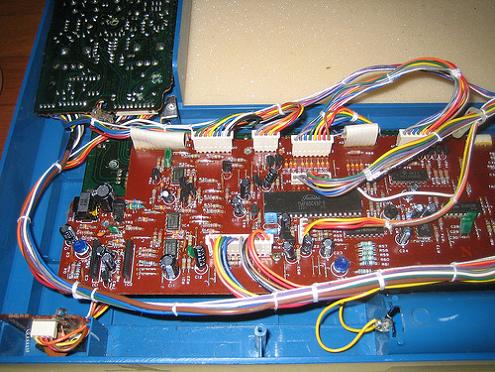
blue science - New Flickr Shot

flicker by arrika. Inside a Blue Roland SH-101. Title link takes you to grey science.

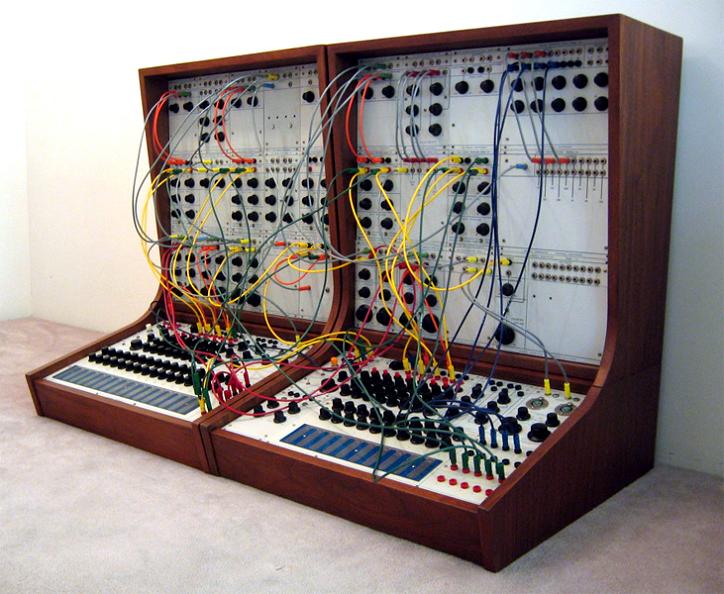
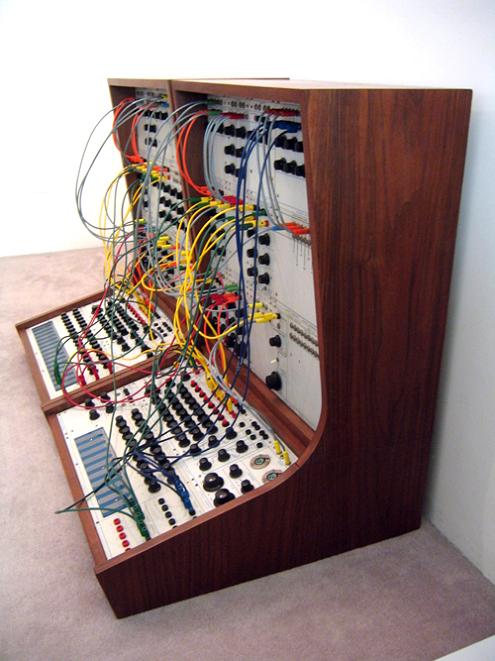
Buchla 100

Two shots in via Rick of electricmusicbox.

"This is a Large 38 module CBS era Buchla 100 assembled around 1969/70. The System has undergone complete repair/restoration including refinishing of the cabinetry and cleaning of all the front panels and hardware. It looks sureal in person, the pictures don't do it justice."

micro composer - New Flickr Shot

flickr by arrrika. Synths and cats, synths in nature...

Prophet VS Rack for $175

Title link takes you to the closed auction with a Buy it Now of $175. Just wanted to shar the pain...

"This is a rare but very cool find. It's in excellent working condition and in very good shape aesthetically considereing its age! It was used by a world class film composer. You probably would hear sounds from this unit in some of his earlier film scores. Power cord is included but no manual. Vector Synthesis is a type of audio synthesis introduced by Sequential Circuits in the Prophet VS synthesizer during 1986. The concept was subsequently used by Yamaha in the SY22/TG33 and similar instruments and by Korg in the Wavestation. Controlling the mix of four sound waves by defining a point on a vector plane using a joystick The Prophet VS vector synthesizer, which was Sequential's only digital synthesizer, came out in early 1986. Boasting a synthesis scheme known as vector synthesis, it combined the revolutionary digital waveform generator and vector joystick to the tried and proven analog Curtis filter, and resulted in a unique instrument with a very distinct sound. It still sees heavy use today despite its reliance on rare custom components with a high failure rate. Vector synthesis provides movement in a sound by providing dynamic cross-fading between (usually) four sound sources. The four sound sources are conceptually arranged as the extreme points of X and Y axes, and typically labelled A, B, C and D. A given mix of the four sound sources can be represented by a single point in this 'vector plane'. Movement of the point provides sonic interest and is the power of this technique. Mixing is frequently done using a joystick, although the point can be controlled using envelope generators or LFOs. "

Matrixsynth Flickr Badge and Set

You might notice a new flickr box in the right nav. It's not an ad. It's a random image player of all the shots in the Matrixsynth flickr set. Title link takes you to the set. I created it because I thought it would be a cool alternative to digging through the archives. Each image is a shot from a post in the archives. Click on one and it will bring you to the shot on flickr. The description of the shot on flickr is a link to the post on Matrixsynth. The idea is if you see an image that strikes you, click on it and check out the post. So far I have July 2005 through September 2005 for a total of 440 shots. I will add to the set as I have time. The goal is obviously to get every single shot in a post in the set. I promised myself I would put this up on my one year anniversary finished or not. The Matrixsynth flickr set of all posts also just went public today. If the images in the right nav are too small, try it instead. Please enjoy. This was an excruciatingly tedious and time consuming thing to do. : )

One Year Of Matrixsynth

The short version:

Today marks the one year anniversary of Matrixsynth. It's exactly one year and 3148 posts since I started this site to track everything synth. Thanks to everyone who makes this site great by either sending stuff in, posting in the comments or spreading the word.

The long version:
I started this blog because my old site Matrixsynth.com/old simply wasn't cutting it anymore. I created the original site in October 1997 as my portal into the world of synths. I'd see an interesting site and add a link (BTW, the alias matrix and the green on black color scheme came well before The Matrix movies. My first and favorite synth was an Oberheim Matrix-6, hence matrix. I'm a synth geek not a Matrix movie geek).

As time when on I found it difficult to find stuff I previously came across. So... I figured what better way to store and make all of this available to others than via a blog. The idea is very simple. I sub to a bunch of lists, feeds and forums; people send me stuff, I interact with people and I see things I want to save for posterity. When I see something I think I might want to see again, I post it. No discrimination. BTW, if you haven't noticed, this site is not meant to be a journal or publication. It's just a bunch of stuff about synths. If you enjoy synths, I hope you enjoy what you see here. It's a heartbeat on what others also into synths are doing, or rather what I happen to come across on a daily basis. Nothing more, nothing less.

When I first started the blog I never would have guessed so much stuff was out there. People asked me if I thought I would ever run out of things to post. I actually wondered myself. The answer turned out to be only if others out there run out of things to share themselves. Which leads me to...

THANK YOU

I want to say thank you to everyone out there who supports this blog. Anyone that has sent me something worth posting. Anyone that takes the time out to engage in the comments and of course everyone that reads this site and spreads the word. Thank you. It's actually crazy. I started the blog to track stuff only I came across. It's turned out to be a whole lot more. I never would have thought people would be enriching the site via the comments and letting me know when there was something else worthwhile posting. Thank you. BTW, you should notice that I frequently update my posts with comments and I always give credit when credit is due.

As a side note, at one point I offered to open up Matrixsynth for others to post but I got a resounding NO, so I created SYNTHWIRE for others to sign up and start posting. You can also promote your own stuff there, so use it!

Back on point. So, what next? Another year of posting. Thanks all, it has been one heck of a year.

Special thanks to moogulator of sequencer.de, Tom Whitwell of MusicThing, Peter Kirn of Create Digital Music, James Grahame of Retro Thing, Chris Randall of Analog Industries, Circuitmaster of GetLoFi, Carbon111, George Mattson, Brian Comnes, Dave (The Packrat), Dennis Verschoor, fmasseti, Loscha, Ross Healy, Steve Barbour of Gnostic Rocket, vlada of One Blue Monkey, deb7680 of Chroniques de la Mao, Rick of Electricmusicbox, Heath Finnie, DVDBorn, Mark Pulver, Doktor Future, Cikira, and of course Elhardt. ; ) You all contributed a little extra to the blog in your own way. Thanks for that.

And of course to the late great Bob Moog and all the synth manufacturers out there. Thank you.

And last but definitely not least, a HUGE thanks to my wife and daughter for tolerating the time and effort I put into this site on a daily basis. Thank You!

Update: I also want to thank Fernando Alves for making my favicon way back, and Paul and Brian Comnes for being the only two people that bought my matrixsynth shirt way back.

And of course, every person or site I've put up a post on. Thanks for having something worth posting about. ; )

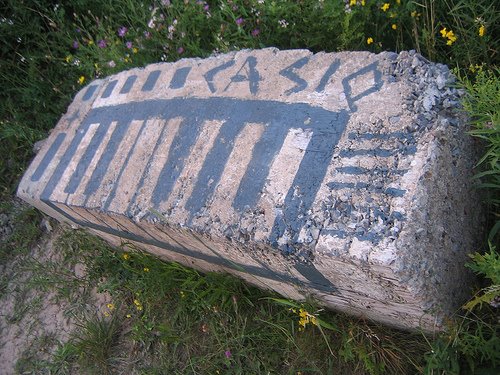
Casio Rock - New Flickr Shot

flickr by devowski. I keep telling myself I'm going to skip the next shot by devowski and then he comes up with stuff like this. A Casio Rock. This brings a new meaning to the saying, dead weight.

MIDIbox SEQ V3 Preview on YouTube


YouTube via ucapps
via sequencer.de.

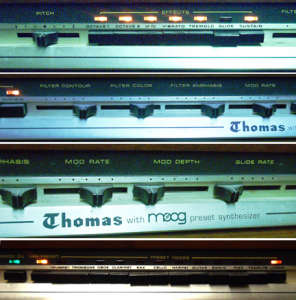
Thomas Organ with Moog Synth


via Craigslist

"Thomas Celebrity Royale 571 with MOOG Synthesizer Leslie Rotating speaker for Chorus or Tremelo A Fancy Foot Drum Machine all kinds of cool organ sounds, bass pedals, original seat and many piano and pedal books."

Deepsonic Videocollection


Click here for a 10.2M WMV. Check out Deepsonic for more on what the site has to offer.

via brian comnes in the comments of this post.

10 step sequencer on YouTube


Update via the comments:
"this is synthmonger's stuff. he's building what look like fairly nice little noiseboxes, sequencers, and so on and selling them fairly cheap direct and on ebay. i've got one of his CMOS VCO boxes on order and, if it's as good as it looks, i'll probably be picking up one of these sequencers as well -- where else can you get a standalone 10-step analog sequencer for under $200?"

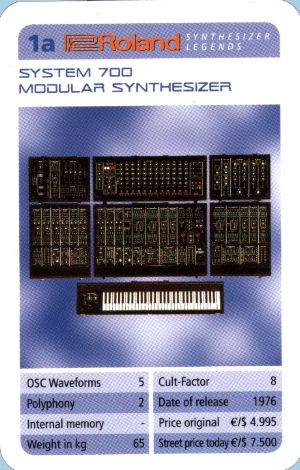
Roland Info Cards

Title link takes you there. via sequencer.de.

This reminds me. I still need to get my GMedia Trump Cards.

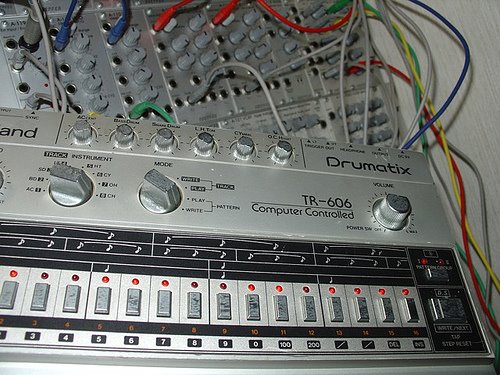
Acidlab Bassline / Roland TR-606 - New Flickr Shot

flickr by JSRockit.

"Acidlab Bassline through a Metasonix TM-1 Wave Shaper synced to a Roland TR-606 Drum Machine through a Frostwave Sonic Alienator. DIRTY!"

Roland SH-201 In The Flesh

Shot of the Roland SH-201 in the flesh. Title link takes you to the post on HC where I pulled it.

Cat - Up and Running

Yep... Let's all be glad it's just a midi controller and not a synth, althought that MS2000 is about to get nicked. : ) Via Another Day in Paradise.

Wednesday, July 19, 2006

Korg Keys - New Flickr Shot

flickr by donsnorkie.

Waldorf Wave Still For Sale

This is probably only interesting to me, but that Waldorf Wave that was up for sale in Sweden back in April is up for sale again. It didn't sell the first time. Asking price is $6000. What's also interesting is the asking price was $7000 when I put up the previous post but the link to that auction shows it ended with 0 bids at $6000. It's all supply and demand and the demand doesn't appear to be there at that price.

Buchin' it up eben mo - New Flickr Shots

flickr by ica~icarus. Title link takes you to more Buchla shots.

CP Music

Title link takes you to Pete's CP Music website, home to a few DIY projects, synth shots, samples, and more. One of Pete's projects is a Phase Shifter based on the CEM3320. There are images and a sample of his Prophet 600 going through the phaser on site. Also, make sure to check out the gallery when you get there. There are some nice shots including the DK Synergy a rare digital synth from the early 80s. You can find more on the Syndergy here. And of course some lovely waveshape shots.

Spaceware on the PDP-1

flickr by the earthling. The caption reads, "Spacewar was the first video game... ever. Yes, I played it on this restored PDP-1." I wonder if it produced sound and if so, how. If you have any idea if the PDP-1 could produce sound, please comment.

via unrest.

Update via solipsisnation in the comments:
"Well, PDP systems were digital, and their CPUs were waaaay too slow for anything resembling real-time sound.

That said, the PDP series was used for electronic music composition, and while I was going to mention Paul Lansky's "Mild und Leise" (AKA "the neat FM-y noises from Radiohead's 'Idiotique'"), that appears to have been made on an IBM: link

Here's a timeline that mentions PDP-series computers, though: link

Of interest are these paragraphs:

"In 1968, Barry Vercoe working at Princeton developed a very fast version of MUSIC IV B, entitled MUSIC 360 [9] [12] for the new generation IBM 360 mainframes. In 1973 at MIT, Vercoe developed a compact version of MUSIC called MUSIC 11 [3]. It was written in PDP-11 assembler code for the PDP-11 computer. This was the first digital music synthesis program for mini-computers with a keyboard and teletypewriter VDU (Visual Display Unit).

John Chowning and James Moorer at the University of Stanford, California wrote another version of MUSIC called MUSIC 10 [13] for the PDP-10 in 1975. Further improvements to MUSIC 10 were implemented both at Stanford and IRCAM (Institut de Recherche et Coordination Acoustique/Musique) in Paris. The IRCAM implementation allowed input of short external samples through the use of Analog-to-Digital (A/D) converters. The input could be analyzed digitally providing data for modifications and re-synthesis, in combination with internally generated sounds."

So, the PDP-1 was probably too primitive, but systems with a similar architecture could be used to synthesize audio in a very slow and painstaking way-- no realtime sound, for sure. These were the days before microprocessors, and even KHz CPUs were still in the future. "

Acid ohne Roland's TB303

Title link takes you to a list of TB acid tracks featuring various synths inlcuing:

Propellerheads Rebirth
Yamaha AN1X
Kawai K5000S
Waldorf Microwave XT
Korg Z1
Korg Poly 61
Yamaha FX900
Hohner HS-1
Access Virus C
3x Creakbox Beta
MAM Freebass FB383
Audiorealism Bassline V1.5
Roland JD800

Each track lists what synths were used. These are really good demos.

EMS Clones on Sequencer.de

Sequencer.de has a post up with different EMS Clones. There's more out their than I thought. Some of the sites have mp3s. Title link takes you there.

Doepfer and TR-606 - New Flickr Shot

flickr by unyo303.

MOOG 2005 New Years Eve - New Flickr Shots

flickr by Johnny V.

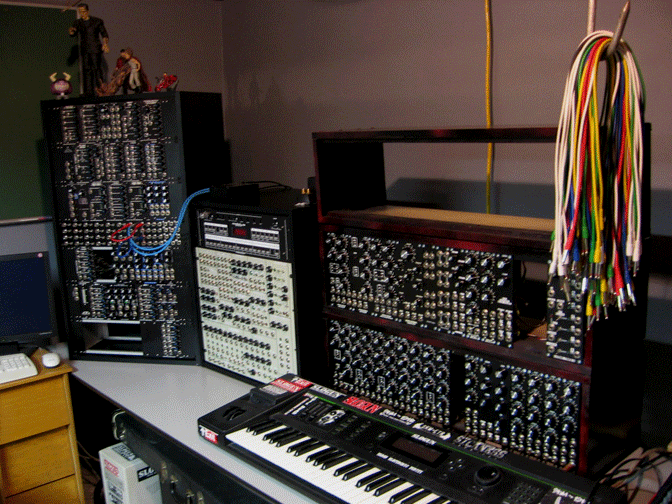
Ken Elhardt's Studio


With all this talk about Elhardt possibly behing behind the SMS 2000, I thought I'd put up a post on his studio.

Tuesday, July 18, 2006

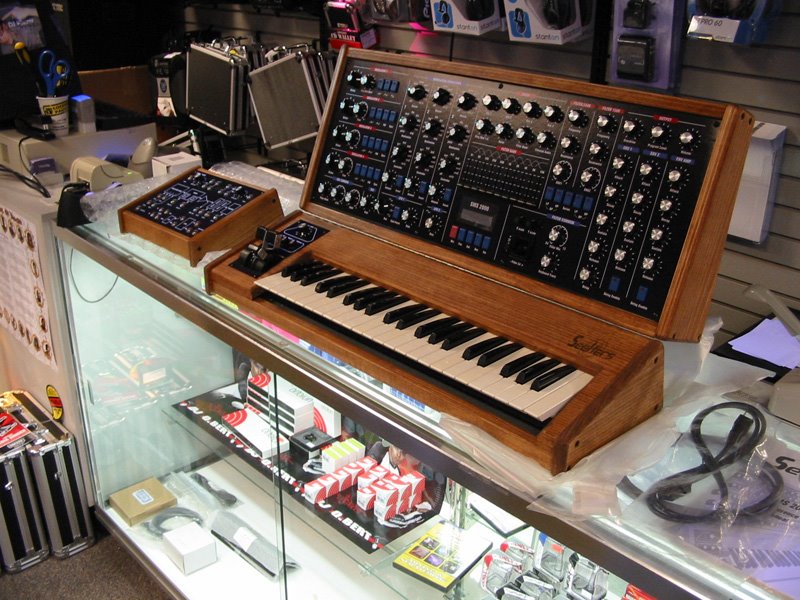
Seekers SMS 2000 Resurfaces


Update: Pevious posts in case you missed them:
1 (original post with convention shots)
2 (the SMS2000 in plastic)
3 (the first prototype) : )

Click here for a post on the SOS forum by SteveCooperman who claims he has played with one - shots saved below for posterity.

Thanks goes to Dennis Verschoor for sending this one in.

The following is the full post:

"About a week ago I received a call from a friend who likes to hop from shop to shop looking for vintage gear or interesting new items. He was standing infront of a synthesiser and describing it to me on his mobile. His description intrigued me to such an extent, I decided to take the hour plus drive to see it for myself. It happened that the synthesiser just arrived that morning and wasn't there more than three hours. After playing around with it a tad, I knew I had to have it. The synthesiser is a programmable monophonic analogue by Seekers called the SMS2000. I had never heard of the manufacturer but the bloke at the shop told me they made an analogue vocoder too.

What is it? The SMS2000 reminds me quite a bit of the Minimoog Voyager. It has an adjustable knob interface like the Minimoog, a 3 1/2 octave keyboard, a crazy set of performance levers, and even a joystick. See pictures at the URLs provided below. But it seems as if Seekers wanted to one-up the Moog Voyager in almost every respect. One more oscillator, one more LFO, one more ADSR, ring modulator, fixed filter bank - like a Moog MuRF right in there but with frequencies set to those of a typical equaliser, full dual filters, and something called an XCU is also included. That's an expansion control unit which is a breakout box similar to the Moog VX-351. I don't own a modular, but it will come in handy patching into my MS-20.

I had been on the fence for some time as to whether I wanted to put out the money for a Voyager. But there always seemed to be too many little niggles and limitations with it. The Seekers seems to have overcome many of those. For example the Voyager can't invert control voltages, the Seekers can. The Voyager forces you into using the display for programming, the Seekers puts every function out there with its own knob or button. The display is only used for patch storage and retrieval, and MIDI related functions. The Seekers has a joystick on the knob interface where vertical controls one filter and the horizontal the other filter. At first I thought it a bit daft that it couldn't be patched to control all kinds of other things too, but when I considered that it seemed like an extra bonus thrown in there, and most synthesisers don't have one at all, then it seemed pretty cool.

The manual is adequate but full of typos and poor translations. Seekers is a Japanese company. There is no mention as to whether the filters are imitations of well known filters or not. Only that the 24dB/octave is a ladder filter and the 12dB/octave is a state variable. But both filters contain lowpass and highpass which can also be combined for bandpass. Both can self resonate.

I've only had the SMS for a week, and with a busy work schedule I haven't had much time to delve deeply into it yet. I'll write a more extensive review after I spend more time with it. The owner of the shop seemed to indicate these are trickling off the assembly line and it could be a couple of months before another shows up. I would expect major players like Turnkey to carry them when they begin to proliferate.

Here are some photos of the SMS. My flat is getting a bit too crowded with audio gear, so it's only a temporary setup. The MS-20 went to the floor to make room for my SMS. My Micromoog will probably be up for sale soon. I can't keep it all."


The Alison Project


The Alison Project

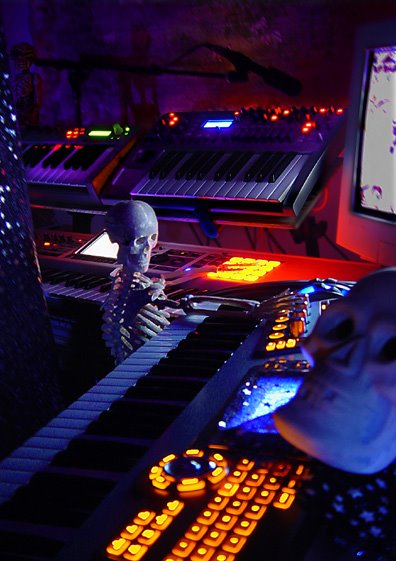
Skeletons Dig Synths

via this HC thread.

Aussie Babies Love the Jupiter 8

This one including title in via Ross. The title, of course, is in reference to this post. I thought the following blurb from Ross was pretty funny. Makes me wonder if I should have named my daughter Cynthia. : )

"It must be an Australian thing with babies and Jupiter 8s

My son OSCar( yes named after the synth, it was that or Roland
Oberheim), loves playing the Jupiter so much so he calls it Daddy, and
he doesnt call me daddy???:-)"

Thanks Ross. BTW, I thought of Roland Oberheim as well, but my wife killed that one pretty quickly, and we had a daughter, so...

Noise FX

Love the copper case on this.

via sequencer.de. BTW, looks like sequencer.de has had a facelift. Looks nice!

Title link takes you to Noise FX.

Details:
It's a synth; a power electronics artist's wet dream. It's a noise box; a noisician's nirvana. It's a lot of things, but one thing it isn't is a full fledged keyboard. It's basically an oscillator on steroids with many filtering effects. Each switch yields new sounds ranging from squeels, to bleeps, to pulsating power electronics doom. No need for an amp, this sucker is loud. It has a slight learning curve as it is an unorthodox sort of oscillator but rest assured, when you get one of these in your hands, you can definately start making sounds right away. You can tweak it live to add changes to a song, or if you are a techno fanatic, you can use it to sample some strange sounds, do whatever.

* 3 knobs to changes the frequency, modulations, etc.
* 11 switches to change filtering effects, pitches, throbs, etc.
* On/Off switch
* Audition Push Button
* Runs off 9v power adapter (Boss style, we recommend Godlyke)
* It's LOUD!

Moog Sonic Six

Title link takes you to more shots sent my way via Lee including shots of the inside. Lee asks, "Anyone know what the 8 pin "accessory" jack is for?" If you know please post in the comments.

Update via the comments:
Loscha said...

The 6 pins are labelled on the service manual as:
Ground
+15
-15
N/C
Pitch
Trigger

Oberheim Four Voice SEM - New Flickr Shots


flickr by Heath Finnie

click here for more.

20SYL - Beat Making Video


"The producer's name is 20syl. He is from France. He is also a member of Hocus Pocus and C2C. This is an in depth video on how to make hip-hop beats. I have made some hot joints with him. Check them out here."

Crap 2600

Title link takes you to a predominantly Atari 2600 track. Via elmosexwhistle on this VSE post:

"Here's my track with a lot of atari 2600 sounds on, and a few parts from the unknown64 vst plugin to beef it up and fill it out...it's called "crap 2600". I love the atari's snare drums, theyre so chunky and gratifying!"

synth 002 - New Flickr Shots

flickr by M. McGrath. Title link takes you to more.

"Chris McDonald's Alison Project Modular Synth."

MS-20&B.S. - New Flickr Shot

flickr by unyo303.

CS-01 - New Flickr Shot

flick by s_p_a_c_e_m_a_n.

Korg SQ10

Title link takes you to shots pulled from this auction.

Korg MS20

Title link takes you to shots pulled from this auction.

Monday, July 17, 2006

Ode To Synthesizers

By Joshua Langberg via AH:

"Hello,
I had to write some poems for my poetry class. One had to be an ode, what do I owe more to than my synthesizers?! I hope some of you enjoy it:

Oscillators that stay in tune.
Filter sweeps will make girls swoon.
Black ebony, white ivory,
49, 61 and 88 key.

All made up of circuit boards,
if polyphonic you can play chords.
Special chips make you temperature stable,
unless of course, you have a wave-table.

Multiple envelopes contour the sound,
while distortion effects bring forth the hellhound.
Frequency modulation is the control,
that combines oscillator sounds, it can shake the soul.

With a keyboard or rack-mountable,
using a TRS or XLR cable.
Voltage controlled amplifier,
How you titillate my desire.

One can never have too many LFO’s,
they’ll sound like the engine of a UFO.
Blipps and bleeps, multimode filters squelching,
most are made in Tokyo, not Beijing.

Sample and hold, you turn my world to chaos,
random voltages you are the embodiment of Eros.

Waldorf, Quasimidi, Ensoniq, and Polyfusion,
you bring me out of dissolution.
Oberheim, Arp, E-MU, and Access,
give me the need to continually practice.
Moog, Roland, Korg, and Sequential,
you make the most of my potential."

Gugy's Synth Studio in Australia

More shots after the hop. Title link takes you there.

Roland Jupiter-8

MiniKorg 700 in Custom Case

Two shots of a Korg MiniKorg 700 in a custom case. Click here for shots on what they normally look like.

Title link takes you to the listing on Craigslist where I pulled these from - while it's up.

"guts of a Korg mini....in a custom case!"

Hawkind EMS Putney

If you have $6250 to spare, this one can be yours. : ) Title link takes you there. Shots saved here for posterity.

"This is a pre- Prestopatch unit. It is an earlier model that has had the power supply upgraded. It is autographed by Dave Brock of Hawkwind. VCO3 works,veneer, needs adjusting (if you want, I like this flaw). This is one of the most musical sounding VCS3 I have ever seen. Many sound like lab gear. The same is true with Minimoogs. That's why Alien Planetscapes and Hawkwind used this synth and kept it in the family."

Red Alesis A6 Shots

Title link takes you to more shots pulled from this auction.

via okto.

MIDIbox SID Bassline Session c64 on YouTube


via gerald. Video updloaded by ucapps. Thanks gerald!

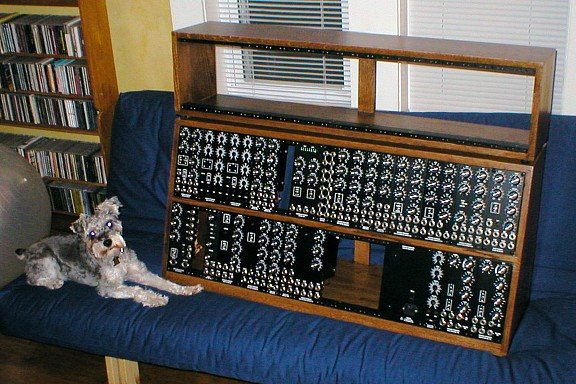
Eric Frampton Studio Shots


Click here for more. This one's for the dogs. ; )

Dogs: 3, Cats: I'm not even going to try and count.

That's a MOTM BTW.

EMS SynthE - New Fickr Shot

flickr by toybreaker.

Synth Ties - New Flickr Shots

via toybreaker. Title link takes you to more shots.

EMS Synthis synth tie

ARP 2600 Modules


ARP 2600 Balanced Modulator Module 4014


ARP 2600 Soloist Moog Filter 4012

both via this set of auctions.
PREVIOUS PAGE NEXT PAGE HOME


Switched On Make Synthesizer Evolution Vintage Synthesizers Creating Sound Fundlementals of Synthesizer Programming Kraftwerk

© Matrixsynth - All posts are presented here for informative, historical and educative purposes as applicable within fair use.
MATRIXSYNTH is supported by affiliate links that use cookies to track clickthroughs and sales. See the privacy policy for details.
MATRIXSYNTH - EVERYTHING SYNTH