Title link takes you to the archived site on web.archive.org. The site itself is gone. Makes you wonder how many other synth resource sites have gone to limbo. Fortunately web archives saves some of it for us.
One of the reasons why I chose Blogger for Matrixsynth was because it is owned by Google and it runs on the Blogger servers, not my server. I don't have to deal with performance issues, costs (it's free!), and most importantly, the site will live on long after I'm gone.
Details:
"Input - Audio Input Preamp with Vari-decay Envelope Follower
The modular works at high signal levels so external audio signals must be brought up to suitable levels. Suitable for line or mic level signals (low or high gain settings respectively). The EnvFlw generates a smoothed CV representing the amplitude of the input signal.
RingMod - Multiplier / Modulator
Ring-modulation of oscillators or audio input results in some great klang-tones and you've got the modular scope to make the input waveforms do some interesting things. This module also allows amplitude modulation, so can be used for basic VCA applications in AM mode.
Inverters - CV / Audio inverters x 2
Two simple inverters that work with CV or audio signals. Useful for changing the polarity of modulation waves.
VCOs - 3 x Thomas Henry XR2206 VC(LF)Oscillator
These VCOs have some great power and with three of them you can reach some really extreme sonic areas by cross modulation and/or chaotic feedback. The concise design is from Thomas Henry (used with permission) - there are details online here and I've published a compact PCB for you to DIY here. I've added a switch to allow Oscillator or LFO ranges from about 1cycle a minute up to super-high frequencies (10+ kHz) and the oscillators are roughly scaled to 1v/oct (though I wasn't aiming for a typical keyboard driven synth system! You'll get at least four octaves of decent tracking).
The oscillator generates Sin/Tri waves (switchable) and squarewaves, has diverse modulation inputs, sync input and a strange/wonderful VC-waveshaping control that inverts half of the Sin/Tri waveform resulting in rich harmonics (the waveshaping doesn't change the squarewave)
The controls are (from top): Range Switch (Osc / LFO), Coarse Tune, Indicator LED, Fine Tune, Sin/Tri Switch, Waveshape, Exponential Modulation with depth control (use this input for 1v/oct response), Linear Modulation with depth control, Waveshape modulation with depth control, Sync input, Sin/Tri output, Square output.
VCF - State Variable VC Filter
A standard but powerful VC Filter design (12dB/Oct) with two audio inputs and three response outputs (Low / Band / High pass). There are controls for Cutoff and Resonance and two cutoff modulation inputs with depth controls. The two audio inputs (with level controls) are mixed together before the filter.
Delay - PT2399 digi-delay module (not voltage controlled).
The PT2399 is a good sounding digital delay chip - it is only specified to generate delays up to about half a second, but when you slow it down further you get some noisy, crunky, wonder sonics (hear the audio demos). You get two (switchable) time ranges - long or short, with long generating the crunchy sounds. Then there are controls for delay time, feedback (into overload) and dry/wet balance.
Output Mixer - 3 channel output mixer
A simple output mixer with level controls and master output level control.
The Rear Panel - Ins / Outs / Power / Decoration!
On the back of the unit you've got the input and output 1/4" mono unbalanced jack sockets, power input / on-off switch / LED indicators (bright blue!) and common ground connection (if you want to hook the unit to other modular devices). Pretty looking, no?
Connections - all internal connections use 4mm banana connections. These are great because they're colourful, reliable and, best of all, stackable - so you can take an output to many different inputs at the same time for modulationary overload.
Power - the box runs off a bipolar (+/- 12v) supply so you can only use it with the supplied AC (not DC!) power adaptor. I have a range of AC adaptors suitable for your global location and will supply your choice of UK, Euro or US.
Case - the box is a compact 12 x 6 x 6 inches and has a carrying handle on top. Damn, you can travel in style with this box - it looks kind of like a vanity case!
Sound Demos - an important factor! Here are some mp3 demos (320 kbps) - they are all recorded straight in with zero effects - what you hear is what you get! And do try to listen on decent speakers to hear the extreme low-frequencies possible. These sounds, of course, give only a brief overview of the sonic possibilities."
Demo1 - starts with slowly modulated oscillations, moves through some delay sounds and down into clickety bubbles.
Demo2 - some synthy sounds (not played with keyboard! purely square-wave modulation depth), more delay and then into a chaotic scream section. Finishes with some hyper-high-freq slow moves to cleanse your ears.
Demo3 - audio processing with a drum beat. Highlights the VCF with modulation from the EnvFlw and oscillators. Moves into ringmod sounds and the end has some subtle sync'ing rhythmics.
Demo4 - Low-end sine modulations - you need to hear the lows. Shows some waveshaping and modulation inversion."
You can find the demo links in the auction and mirrored here for when the auction goes away.
Another "made you look" auction image. This one features what looks like a Quad Sherman Filterbank. The auction is for the Casio PT-10. Title link takes you to the shots pulled via this auction. I have a feeling these are going to get old pretty fast, but it's interesting seeing this technique for the first time. This is via the same seller as the last post.
Details: "HARDCORE PUNK CIRCUIT BENT CASIO PT-10. FOUR BLACK MOMENTARY BUTTONS UNDER YOUR FINGERS & ONE TOUCH SENSITIVE STUD THAT INDUCES PITCH SWOOPING FOR LEFT HAND MANIPULATION. THESE BUTTONS ARE SUPER HIGH QUALITY FOR CLEAN ENGAGEMENT OF BENDS AND FEATURE A SMOOTH SPRINGY REBOUND. THE STUD IS UNSHARPENED APPAREL QUALITY AND IS SOLIDLY MOUNTED AND RE-ENFORCED SO YOU CAN WAIL ON IT. ADDED 1/8 INCH OUTPUT FOR MIXERS, EFFECTS... I HAVE BEEN PLUGGING STRAIGHT INTO MY MODULAR SYNTH AND USING IT AS A SOUND SOURCE OR FURTHER BLASTING WITH THE SHERMAN FILTERBANKS I USE SO OBSESSIVELY... GOOD SOLID MODIFIED DEVICE WITH LOADS OF ATTITUDE AND AGGRESSIVE SOUNDS AND RHYTHMS AS WELL AS THE STOCK PIANO, FANTASY, VIOLIN & FLUTE PRESETS. ALL THE BENDS WORK INDEPENDENTLY AND IN COMBINATION WITH ONE ANOTHER FOR VARIOUS RESULTS WITH VARIOUS VOICE, RHYTHM, AND OTHER SETTINGS ON THIS KEYBOARD. PORTABLE; THE PT-10 WORKS WITH 4 AA BATTERIES & THE BATTERY COMPARTMENT IS CLEAN, UNOBSTRUCTED; THE COVER INTACT... ...& IT WILL RUN OFF OF THE 6v DC ON THE MULTI-VOLTAGE MULTI-ADAPTOR I AM INCLUDING IN THIS AUCTION ! THE SPEAKER IS INTACT AND PRODUCES LOUD CLEAR SOUND THAT IS NOT SIMPLY OVERDRIVEN INTO DISTORTION BY THE BENDS."
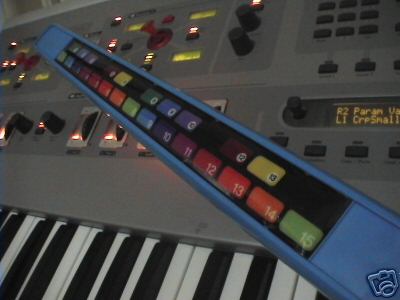
File this one under one of the best "made you look" Ebay auctions. I'm going through the newly listed stuff and I see a thumbnail of this image listed as "Magic Musical Thing." You can barely make out the image in the thumbnail but I see lots of colors and lights, so of course I click. And... It's a Hartmann Neuron! Only the Neuron of course is not up for auction, but rather... the "Magical Musical Thing"
No title link. Just the two shots and some details pulled via this auction.
Details:
"RARE MATTEL 1978 MAGICAL MUSICAL THING. THIS SYNTH WAS MARKETED AROUND THE TIME OF THE HIGHLY SUCCESSFUL MOTION PICTURE 'CLOSE ENCOUNTERS OF THE THIRD KIND' & MAY HAVE BEEN AN ATTEMPT TO CAPITALIZE ON THE MARRIAGE OF COLOR AND SOUND THAT COMPRISED COMMUNICATIONS BETWEEN THE HUMAN AND TERRESTRIAL IN THAT FAMOUS FILM'S FINALE SEQUENCE... VERY GOOD FULY FUNCTIONING CONDITION DESPITE THE LOSS OF THE MATTEL LOGO AND OTHER ADORNMENTS. COMES WITH BOX AND BOOKLET OF INSTRUCTIONS AND SONGS. STRANGE BEAUTY AND PROBABLY A WONDERFUL CANDIDATE FOR A CIRCUIT BENDING PROJECT... WILL BE ABOUT 5lbs. PACKAGED"
Apologies for the all caps, but I'm not about to convert that to lower case.
Title link takes you to shots pulled via this auction.
Details: " This is a Roland SH-1000 synth. It is the first synth Roland produced and possibly one of the first commercial Japanese synths, which makes it quite a collectible.
It has 10 preset sounds and a synth section for creating your own sounds. On the synth section there are 9 synth selectors giving a range from 32' to 2' each of which can be combined for generating more complex waveforms. It also has a VCF and VCA. Effects include Vibrato, Tremelo, Portamento, Glide, Growl, Waw and Random Note which plays "accidental" random notes, interesting effect. There is also White and Pink noise. It's got pretty much everything. Spend a little time with it and you will be soon producing some very cool and unique basses, leads and weird sounds.
It has a nice rich analog sound and has some very interesting modulation features not found on the later SH models."
"In 2000 the Finnish demoscene musician Janne Suni (also known as 'Tempest') won the Oldskool Music Competition at the Assembly demoparty with his four-channel Amiga .MOD entitled 'Acid Jazzed Evening.' A Commodore 64 musician called 'grg' remade the song on the C64 (using the infamous SID soundchip); it is this that was stolen."
Synth content: C64 in the original track. Title link takes you to non synth details. There's more detail in the description of the YouTube video. Here's the TinyUrl referenced at the end of the video.
This came in on the AH list. Bookmarking this one for future reference.
According to the service manual there are NINE different versions:
Below 171700: OC-8 (optie) test production 171700 - 181899: D/A converter from 12 to 14 bit ---: OC-8 is optional for 12 en 14 bit models 181900: PROM compatibel with OC-8 PROM's 202100: Modulation circuit 202210: RAM Module Controller Board 242750: Brighter leds installed 272850: Button added to dimm Leds 282880: DCB Board standard
NB: the OC-8 board was the predecessor of the DCB Board
Title link takes you to the mp3 via greg. mods: bass boost (more like bass un-cut) accent decay/min decay extension vco output filter input filter input level/overdrive resonance boost env min, max extension cutoff extension vca decay square, saw and vca to vcf FM accent to filter extension
Title link takes you to a pdf via this thread on HC.
"OS 2.0 for Virus TI has some new oscillator types:
"The new version features additional oscillator types, enhanced Wavetable synthesis and more wavetables. It allows you to see how expensive a chosen patch is and features Section Locking through Virus Control. Patches can be finally sorted by category and the onboard patch ROM contains addition 256 sounds by Matthew Stolley and Matt Picone.
We have included new oscillator modes, greatly expanding on the flexibility of these already powerful sound-sculpting tools.
The remaining oscillator modes all make use of a new technology for the Virus TI, called Grain Table. The basic idea behind this technology, is to take the existing wavetables, and apply similar techniques as those used in some granular sampling and pitch-shifting algorithms to open up a whole new world of possibilities. Each of the two main types: Grain Table and Formant Table are presented in both Simple and Complex formats. In each case, the Simple mode offers fewer parameters, and a higher polyphony than Complex, with the values of parameters common to each mode remaining constant.
It’s important to note that the characteristics of the Grain Table and Formant Table oscillators are quite different to those of traditional “granular” sampling/synthesis techniques, which tend to be associated with other-worldly “clouds” of sound. In the Virus TI, we have instead employed the technology to achieve a very musical result which should prove every bit as useful as the other oscillator types in all manner of musical projects."
"After years of design and months of work I have a kind of working prototype of the Envelooper MARF. It works, but not perfectly yet. I am still getting the bugs out. This is targeted to the Frac-Rac format.
MARF stands for "Multiple Arbitrary Function Generator". One of the shortcomings of modular synthesis is the lack of complex controllers for modules. To generate a complex control function now, you have to sum together multiple envelopes and LFOs. The Envelooper allows you to draw complex control functions visually, with enough points to reproduce the effect of summing multiple envelopes and LFOs. It also stores pitches like a sequencer, and you can draw an envelope in channel 4 for each pitch.
The Envelooper is designed to support true "gestural" synthesis where a single key press or button push can produce control signals for a complete musical gesture. Multiple gestures are stored in different Banks and can be selected by voltage control. Using a black and white keyboard, you can select and trigger gestures with just the keyboard. The Envelooper also has a "Loop" switch that sets it to free running loop without needing a gate or trigger.
The Envelooper is modeled after an ADSR envelope generator. For the Envelooper, each segment of the A, D, S and R is four 256 byte pages stored in a PROM, for a total of 1024 bytes for each envelope. Four 8 bit outputs are produced simultaneously with a channel to channel skew of an inaudible 1 microsecond.
Each ADSR segment has an independent "playback" time control from 1 millisecond to 20 seconds. The shortest total envelope time is 4 milliseconds and the longest is 80 seconds.
The ouputs are calibrated like the Mini-Wave to 1 volt per octave. Two steps = 83.3 millivolts = a semitone. So the table programmer in Wave 256 can be used to program pitch information using actual note names.
The Wave256 software used to program the Waveform City and Mini-Wave is also used to program the Envelooper. The waveforms in a "Wave" are set up like this for the enveloopers four outputs; A1, A2, A3, A4, D1, D2, D3, D4, S1, S2, S3, S4, R1, R2, R3, R4.
The programming rules are as follows; A(ttack) pages start at -128 and end at +128, D(ecay) pages start at +128 and end at 0, S(ustain) pages start and end at zero, Release pages start at 0 and end at -128. Following these programing rules produce envelopes with no audible "splice" when the device switches from one segment to another.
The four outputs are mapped two different ways for East Coast and West Coast patches. For East Coast use, output 1 controls the pitch of the VCO, output 2 controls the waveform, output 3 controls the VCF (Boogie) and output 4 controls the VCA (Borg 2). For West Coast use, output 1 controls the pitch of the VCO, output 2 controls the waveform X, output 3 controls the waveform Y and output 4 controls the lowpass gate.
8 bits has a fair amount of zipper noise, for pitches we want this quantization, but it is a problem for VCAs and other inputs. One of the little known things about Vactrols is that they remove zipper noise. So running an 8 bit signal through a Vactrol smooths out the steps into continuous function. The VCO will have Vactrols or the equivalent on the waveform X and Y inputs to remove zipper noise. The Borg and Boogie filters are based on Vactrols and already remove zipper noise.
I just wanted to post a little note to let everyone know that Wiard R&D will continue to produce ground breaking designs not available anywhere else. For those REALLY interested I have posted the test PROM file in the files section called adsr4.256 Use the Wave256 software to view the segment designs. Please note this is just an experimental file to test ideas, NOT the final file which will ship with the module."
Again, check out Muff Wiggler for more module mayhem.
Model 21 Milton Venti (The new Milton has arrived) Model 25 Multi-tasking Audio Processor Model 26 Multi-tasking Control Processor Model 27 Digital Delay Model 16 Spectral Multiplexer
There's a longer version of the video I put up in the previous post. If you already watched it, the new lofi video is worth checking out as there's a bit more to it.
Remember this post? Title link takes you to a wicked 4.83M mp3 mashup via Doktor Future. If I remember correctly Doktor Future was the person who claimed all 200e samples sounded like a banjo.
If Tom Waits had a banjo, this is what it would sound like.
Update: I put this post up after reading the comments of this post. I just checked my email and found an email from Doktor Future with a link to the mp3 and this better quality WAV along with, "I'm including a graphic to go with the post (if you want to post it). The graphic, appropriately, has nothing to do with anything." Works for me. : ) Somehow the image actually seems appropriate - you're going to want to use it after listening to this.
Update: I accidentally put up the video labeled hifi thinking it was the same video as the lofi. It's not. Here's the lofi vid. Title link takes you to the hifi. the hifi is considerably shorter, so watch this one.
"this is just a simple 16 step sequence from a mobius driving the metasonix wretch machine starring me turning knobs and the wretch machine making noises."
Electronic Music by Allen Strange
Details:
"Analog Synthesis Textbook: ELECTRONIC MUSIC - SYSTEMS, TECHNIQUES & CONTROLS by Allen Strange 160 pages, copyright 1972, 10th printing, 1980."
Details:
"Bob Moog, Tom Coster, George Duke, Roger Powell and other experts offer practical,creative instruction on how to master the technical and artistic potential of your synthesizer. Volume II in the Keyboard Synthesizer Library. 113 pages, 1984."
Auctions via 123Synthland aka Minime123. Title link takes you to more items up for auction via 123Synthland.
You don't see these often. Oakley TB3030. No title link just the two shots via this auction sent my way via Evil Paul.
Details: "This is a TB3030 synth, which is basically an exact copy of the classic Roland TB 303 synth engine with a few extra enhancements, but without the sequencer.
I always wanted to get that classic analog 303 sound but didn't want to fork out the cash ($$$!) for an original Roland TB 303. I came across a guy on the internet who went to a massive amount of trouble to copy the 303 circuit exactly, add some extra features, and print some new circuit boards for it. I bought a circuit board from him, sourced all the parts (some were very hard to find!) then constructed it (I'm an electronic engineer). I worked on it every night for a month to build it, and it worked reasonably expensive to get all the parts for it.
I also built a midi interface into it, so it can be controlled by any external midi keyboard, or a sequencer such as a computer running Cubase.
It also includes a number of mods to the original 303 synth engine (in the vein of the devilfish mods), which make it more versatile as a synth. It includes a balanced output, an overdrive/distortion circuit, filter FM, a sub octave generator, VCA decay control and an accented decay control, all of which are not included on the original 303.
It certainly has an awesome tone! You can download some samples (and other info for it) from this page: http://www.oakleysound.com/tb3031.htm. Note that these sound samples are for the newer version (TB3031) which is slightly different, however the guts are basically the same and mine sounds basically the same.
Looking at the front panel, it has the following controls:
* Tune * FM Modulation * VCO Waveform select * FM Wave Select * Slide * Filter cutoff frequency * Filter resonance * Accent * Accent Decay * VCF Envelope * VCF Envelope Decay * Sub oscillator (adds extra bass an octave down for a really fat sound) * Mod wheel control (from memory this is mapped to filter cutoff, allowing you to control the filter frequency directly from your keyboard or sequencer) * Drive (distortion circuit that really makes this thing bark) * VCA Decay * Processor control on/off (allows slide and accent to be controlled with midi velocity) * Volume
On the back it has Midi in and Midi thru connectors, signal out and filter input jack, and the power connector. It has been built into a 3 unit rack case."
"The long awaited IPTV series The Top 20 Greatest Synths will be going live here at Sonic on Wednesday February 14, 2007. Each of the 8 episodes broadcasted once a fortnight, will be around 10 minutes long and feature 3 chart positions with full length episodes for the number 2 and number 1 slots later in the series. The entire programme will then be posted in the Spring as one contiguous show.
Each episode has footage, facts and features about the greatest electronic instruments ever produced as well as interviews with the people who made ‘em and the people who played ‘em. It’s basically a big fat excuse to rant about all-things-synth in a show that aims to be witty, passionate, respectful and shamelessly nostalgic about electronic music, circuit boards, the 1980’s, resistors, wood finishes, keyboards with knobs on and everything in between."
Looks like the new Waldorf products are listed on Novamusik. Prices are still TBA for BloFeld, Stromberg, and Zarenbourg. The Q Phoenix is listed at $2299 and the Micro Q Phoenix is $699; both include a free copy of the Waldorf Edition (Attack, D-Pole, and PPG Wave 2.V).
I didn't realize it when I first posted the obituary for Doug Curtis, but there is a guest book there that you can sign. If you are up to it I encourage you to sign it and show your support to his family and friends. For those who do not know who Doug Curtis is, read this post. Note that the guest book is updated after review, so you will not see your entry immediately.
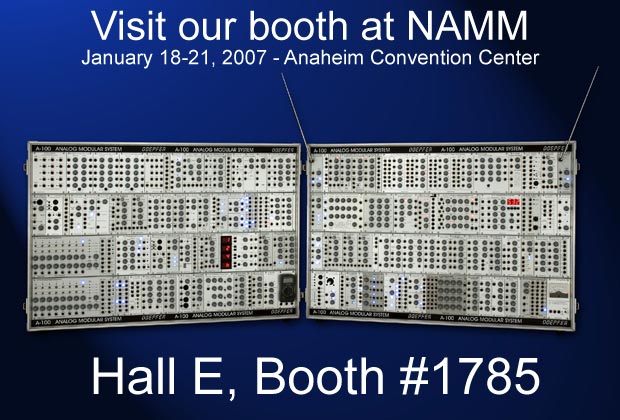
Thought this was kind of interesting. I went over to the Doepfer site after checking out these videos. I see the image to the left and click on it. I scroll not really paying attention and start reading the news: "december 21st, 2006 : happy holidays! it's our second holiday season and there is much to be excited and thankful about. for you modular fans, it has been one wild year with the explosion of new modular makers in the eurorack and frac rack lines and enough energy and ideas to keep things very exciting into 2007. for you analog keyboard fans, this year saw the release of new synths by bob moog (little phatty) and dave smith (mono evolver) as well as by up and coming legend ken macbeth (m5). for fans of virtual analog and digital synthesis, the virus ti and korg radias proved to be worth the wait and new boxes by creamware (prophet 12 & arp odyssey) are showing why soft synths and va's are best with real knobs and being outside of your main box." It goes on to list other manufacturers, and I'm thinking, ???, this is pretty cool of Doepfer showing their support for other manufacturers, and then I see a listing for a Korg Kaoss Pad 3 for sale. That's when it clicks. I scroll back up and see Analogue Haven in the header. It's not just a section on the US distributor, but the actual Analogue Haven site. The odd thing is I'm still on the Doepfer site. Analogue Haven is just embedded on the right. Eentwesting... The Deutsch (German) site does the same which is even more interesting when you think about it. Anyway, it just seemed a little odd to me.
Title link takes you to a sample of the RS-09 by donaldm via this VSE thread. Note it is not a musical track but just examples of what the RS-09 sounds like. Many of the examples is just holding down the keys so you can get a sense of the movement.
Click here for a 5.1M mp3, featuring nothing but the Buchla 200e by Matt. I asked Matt if I could put it up along with a mirror, and he gave the all clear. I thought the title was kind of funny because nearly every time I put up a 200e sample, a certain someone comments on how it sounds like a banjo. Apparently Matt named this track because he read the comments too. Too funny. : ) Enjoy the track.
No title link. Just two shots pulled via this auction.
Anyone know more about these? Update via RyBread in the comments:
"They're a percussion synth that was marketed for actual drummers. the mounts allowed it to be mounted to a drum stand for live use. The Schemo can be found at [link].
I've been trying to find the time to build one for more than a year now."
I just put this one up on MATRIXSYNTH-B, and decided to put it up here as well, as you just don't see these come up often. The DK Synergy is 100% digital, but the one I played sounded very warm - very nice.
Title link takes you to shots pulled via this auction.
Passed gently from this world on January 10 following a five month battle with pancreatic cancer. He is survived by his wife and two daughters, and mourned by extended family including two sisters, two nephews and a niece. Doug is known to the music industry as the founder of Curtis Electromusic Specialties where he developed twenty signal-processing products for electronic music synthesizers and audio equipment. He holds three patents for various elements of his signal processing methodology. Several more patents in his name are assigned for chips designed into various commercial products. When the advent of digital technology and software changed the electronic music industry, Doug broadened his focus beyond synthesizers forming OnChip Systems. He was recently inducted in to the San Jose Rocks Hall of Fame. Doug was known for his intelligence, love of family and nature, and his steadfastness. A funeral mass will be held at St. Mary's Church in Los Gatos. Donations in his honor may be directed to PANCAN."
DACS FREQue II Details
FREQueII (pronounced FREAK) two ring modulators and two oscillators with external CV inputs which work concurrently with the internal variable FM. Frequency Shifting adds and subtracts the oscillator frequency to the frequency of each harmonic component of the music inputs, and outputs them separately - the possibilities are virtually infinite. Balanced inputs and outputs.
Title link takes you to DACS. Description via Front End Audio.
"GuruOneMP (GOMP) Jr is a VST MIDI FX Plugin. It is a musical scripting language, taking the best from traditional programming languages adding high-level functions / concepts using standard music theory
New 1.5 Features:
. Two views of GOMP now available. One basic for performance mode and the other advanced for programming mode . Line/ascii editing. Now Mac users can take full advantage! . RND and Reset buttons to respectively mess-up and restore parameters . C.C.# variable to allow easier handling of continuous controller events . Temporary variables to avoid having to borrow valuable parameters . Quick number and list entry . RAW midi import
Features:
. Runs on Mac/OS X (10.2.8 to 10.4 universal) or PC/WinALL . Full support for the MIDI standard including CCs . In-built logic and math . Sixteen fully-automatable parameters . Infinite mapping possibilities . MIDI import. Play entire MIDI sequences from single keys . Smart Note Off . Modular - Multiple instances can be used to expand functionality . Includes a set of powerful in-built scripts ranging from utilities to easy chord players and rhythm/glitch (see Downloads page for more info.)
Limitations:
BASIC support package. In other words, GuruOne.biz will help you to create your own scripts, but not write them for you. Also, small upgrade fee may apply
Features : -2 oscillators that can produce the two most popular and useful shapes for subtractive synthesis: fat, bright SAW and PULSE shapes, with adjustable pulse width. -Noise generator. -Ring modulation -Sync modulation -16 voice polyphony -4 voice UNISON with user-adjustable stereo panning and 'Octaver'. The Octaver expands the harmonic range and flexibility of the unison sound to support the creation of realistic 'vox-like' effects -2 ADSR envelope generators. One for traditional envelope duties, the other can be user assigned -3 FILTER modes - low pass, band pass and high pass. PoiZone features a warm, super-trooper-extra-analog-moog-like-mega filter with self oscillation. Special attention has been given to precise filter tuning so that when KEYTRK is set to maximum, the PoiZone filter will track keyboard frequency precisely so it can be used as an oscillator. The PoiZone filter has bright and clean sound or it can be 'grungy' and 'angry' when resonance is introduced as it features some light distortion. And even with distortion the filter sounds clean on high frequencies as it has no aliasing -Keyboard and Velocity tracking for the filter -Multi-mode Arpeggiator -Noise Gate with an adjustable 16 step pattern. The gate features smoothness control and the ability to import/export patterns to .fxp files -DELAY effect, with tempo-synced click-free stereo delays and delay time modulation. Lo-cut and hi-cut for trancers! -CHORUS with a warm sound with great unison emulation -MIDI learn feature with the ability to save/load MIDI setups to/from a patch -LFO and MOD WHEEL modulation. Can be assigned to a wide range of performance parameters in PoiZone
 Title link takes you to the archived site on web.archive.org. The site itself is gone. Makes you wonder how many other synth resource sites have gone to limbo. Fortunately web archives saves some of it for us.




.JPG)